









UK citizens can only spend 90 days at a time in the EU without a visa, making long stays or a new life abroad more complicated.
At the same time, more British citizens are looking to move somewhere with better weather, lower living costs, and a slower pace of life. Portugal ticks all the boxes and offers several visa options that make long-term stays possible.
For those with enough income or savings, the most popular choices are the D7 visa for passive income, the D8 visa for remote work, and the Golden Visa obtained by investment. This article explains how to move to Portugal and what to expect from life there in 2026.
9 reasons why UK citizens are moving to Portugal
Many people from the UK are choosing to move to Portugal thanks to its sunny weather, delicious food, and more affordable lifestyle. As of January 2025, around 47,500 British citizens were living there. Portugal also offers several residency options that are not tied to study or employment[1]The Portugal Resident — Brits flocking to Portugal: get the information you need.
1. Favourable climate
Portugal has a mild subtropical climate without extreme temperature changes — quite a contrast to the often cold, wet, and unpredictable weather in the UK. The north of Portugal is cooler and wetter, while the south and central regions are warmer and drier.
In summer, temperatures in Lisbon and southern Portugal can reach 29°C, but cooling breezes from the Atlantic make the heat more comfortable. Winters are mild, with average temperatures around 14°C, and occasional rain and fog — much gentler than the chilly, damp winters common in Britain.
2. Safety
In 2025, the Global Peace Index ranked Portugal as the 7th safest country in the world, based on factors like crime rates, civil liberties, and access to firearms. In comparison, the UK ranked only 37th.[2]Institute for Economics & Peace — Global Peace Index map and data (Vision of Humanity)
3. Affordable cost of living
The cost of living in Portugal is, on average, 40% lower than in the UK. For example, living in Lisbon would require about €4,650 to maintain the same standard of living that would cost €8,000 in London, assuming you rent.
On average, rental costs in Portugal are half those in the UK. For instance, a one‑bedroom apartment in central Lisbon costs around €1,400 per month, while a similar apartment in London costs €2,600. Utilities are also about twice as cheap in Lisbon.
Some UK citizens choose to live in Portugal, benefiting from the lower cost of living and comfortable conditions, while also renting out their properties in the UK to earn additional income. Rental prices in the UK continue to rise annually, with demand often exceeding supply in many regions.
Approximate monthly cost of living in Portugal
4. Expat-friendly environment
Portuguese people are welcoming to newcomers. In the InterNations Expat Insider 2025 survey, Portugal ranked 17th out of 46 countries worldwide for expats. The country received particularly strong scores for quality of life, climate, safety and the friendliness of local residents.[3]InterNations — Expat Insider 2025: Portugal
Around 1.6 million foreign residents were living in Portugal in 2024. This accounts for nearly 15% of the country’s population and is four times higher than in 2017.[4]Agency for Integration, Migration and Asylum — Relatório Migrações e Asilo 2024
Portugal has dozens of expat clubs, Facebook groups, and meetups to help newcomers settle quickly. Many citizens have English-language services and schools.
5. High-quality healthcare
Portugal has a strong healthcare system and ranks Portugal ranks 23rd in the global Health Care Index. The ranking estimates the quality of healthcare, including infrastructure, medical professionals, and prices.[5]Numbeo — Health Care Index by Country 2025
If you’re moving to Portugal from the UK, you’ll need to show proof of health insurance when applying for a residence visa. Once you’ve received your Portuguese residence permit, you can register with the Portuguese National Health Service, or SNS, and use public healthcare services just like Portuguese citizens.
6. Accessible higher education
Portugal offers some of the most affordable university education in the EU, significantly cheaper than in the UK. At the University of Cambridge, one year of an undergraduate degree can cost around €11,000 for home students [6]University of Cambridge — Undergraduate tuition fees and finance. In contrast, at the University of Lisbon, Portuguese nationals pay approximately €700 per year, while international students may pay as little as €1,500 annually[7]University of Lisbon — Law undergraduate programme.
UK citizens who have lived in Portugal for at least two years are eligible to apply to public universities under the same conditions as local students.
Diplomas from Portuguese universities are recognised throughout Europe, and some courses are jointly designed with UK universities, allowing students to earn double degrees.
7. Great for retirement
Portugal is one of the best places in the world to retire. According to Living magazine’s 2025 Global Retirement Index, it ranks 2nd globally for retirement living[8]International Living — The Best Places to Retire. The rating considers living costs, healthcare standards, climate conditions, and lifestyle choices, enriched by insights of local retirees.
Portugal is popular for its low living costs, good healthcare, mild climate, and safe, relaxed lifestyle. It offers various residence permits, including options for those with passive income. British retirees love its charming cities, tasty food, golden beaches, and easy travel links to the UK and Europe — making it a comfortable and convenient place to retire.
8. No double taxation
Portugal and the UK have a double taxation agreement, which means you won’t pay tax twice on the same income[9]UK Government — Portugal tax treaties. If you move to Portugal and become a Portuguese tax resident, you’ll pay tax in Portugal on your worldwide income. But if you still earn income in the UK, such as a pension or rental income, you’ll pay UK tax on that amount, and then get a credit for it on your Portuguese taxes.
9. No inheritance or wealth taxes
Portugal doesn’t charge inheritance tax. This tax was abolished in 2004, and today, the only tax that may apply is a 10% stamp duty on inherited property. Even better, close family members are exempt from this stamp duty — this includes spouses, parents, grandparents, children, and grandchildren.
Portugal also has no wealth tax, meaning there’s no yearly charge on your assets like savings or investments.

Trusted by 10,000+ investors
Check your eligibility for the Portugal Golden Visa
How can a UK citizen get a Portugal residence permit?
Since the Brexit transition period ended on December 31st, 2020, UK citizens no longer have the automatic right to live and work in EU countries, including Portugal. British citizens can still visit Portugal for up to 90 days in any 180-day period without a visa. However, if you plan to stay longer, you’ll need to apply for a long-stay visa or a residence permit.
Long-stay visas allow UK citizens to stay in Portugal for various purposes, such as studying, internships, work, or medical treatment. They can be temporary or intended for residency, and applications can be made at the Consulate General of Portugal in London or Manchester.
Temporary stay visas are valid for stays of up to a year. They allow multiple entries into Portugal during that period. To apply, your passport must be valid for at least 3 months beyond your intended stay.
Residency visas are the first step towards getting a residence permit. They allow 2 entries into Portugal and are valid for 4 months. During this period, you must apply for a residence permit through the Agency for Integration, Migrations, and Asylum, or AIMA.
Several types of visas can lead to a residence permit in Portugal:
- Startup Visa for entrepreneurs launching innovative projects;
- D1 Visa for individuals with a job offer from a Portuguese company;
- D2 Visa for business owners or freelancers starting a venture in Portugal;
- Portugal Global Talent Visa for professionals working in highly skilled roles;
- D4 and D5 Visas for students enrolling in Portuguese education programmes;
- D6 Visa for family members joining someone already living legally in Portugal;
- D7 Visa for retirees or other financially independent persons with passive income from outside Portugal;
- D8 Visa for digital nomads working remotely for non-Portuguese companies;
- Portugal Golden Visa for investors.
To receive a residence permit in Portugal, you typically need to show proof of financial means, such as savings, income, or a job contract, have valid health insurance, and provide a clean criminal record.
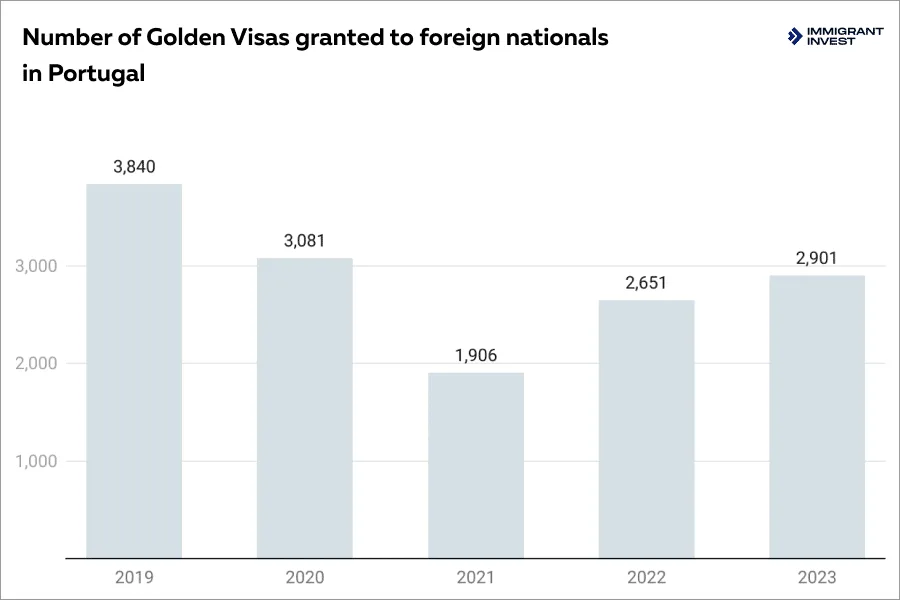
Portugal Golden Visa for UK citizens: program overview
The Portugal Golden Visa is a popular and relatively straightforward route for UK citizens to gain a residence permit in Portugal. Unlike some other visa types, it does not require proof of professional qualifications or accommodation in Portugal.
Processing time. Getting a Golden Visa usually takes 12 months or more. This time includes gathering documents, applying, passing background checks, meeting investment requirements, and attending a biometric appointment in Portugal.
Investment options. To qualify, you must make one of the following investments:
- €250,000 in arts, culture, or heritage projects;
- €500,000 in a Portuguese investment fund;
- €500,000 in a company that creates at least 5 jobs;
- €500,000 in scientific research;
- starting a company that creates at least 10 jobs in Portugal, with no minimum investment specified.
Eligibility. A Portugal Golden Visa can be granted to investors who are over 18, have legal income earned outside Portugal, and have a clean criminal record.
The investor can include a spouse, children up to the age of 26, and parents in the application. For children over 18 and parents, proof of financial dependency on the investor is required. Adult children also need to live with the investor or be enrolled at university.
The investment amount stays the same no matter how many family members the investor includes. However, government fees increase for each additional person.
Document requirements for a Portugal Golden Visa include:
- Application form.
- Passport.
- Marriage, divorce and birth certificates, if applicable.
- Two passport-size photos.
- Health insurance policy.
- Criminal record certificate.
- Investment-related documents.
Immigrant Invest lawyers assist investors by providing a list of required documents. They also fill out government forms, and help translate and notarise documents.
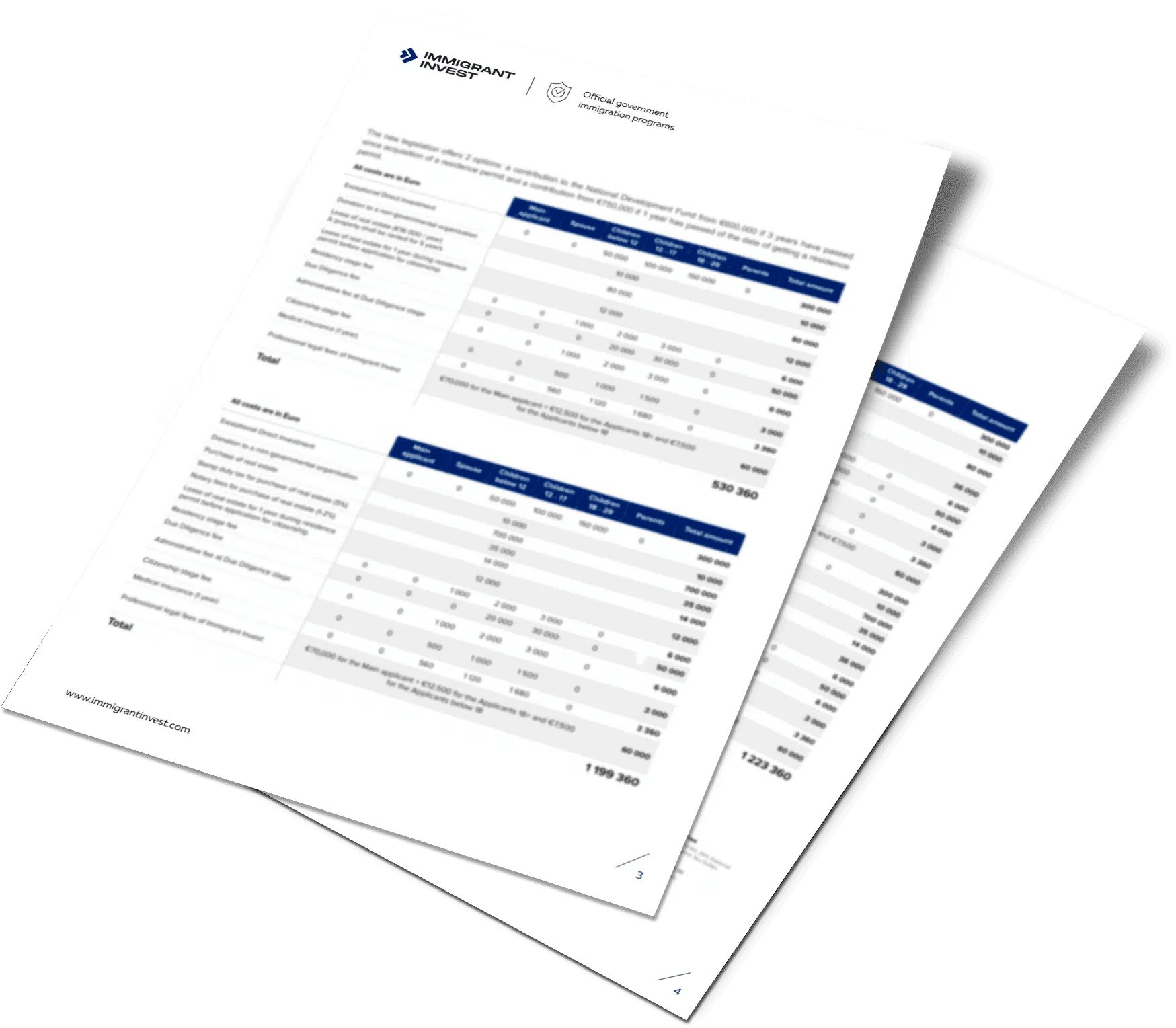
How to obtain Portugal Golden Visa: step‑by‑step procedure
Emigrating to Portugal from the UK by obtaining the Portugal Golden Visa takes at least 12 months, according to Immigrant Invest lawyers, who assist applicants throughout the entire procedure.
1 day
Preliminary Due Diligence
A certified Anti-Money Laundering Officer carries out a mandatory confidential Due Diligence check. This identifies potential issues and reduces the rejection risk to 1%.
Immigrant Invest signs an agreement with the investor only after knowing the check results. If there are any risks, we offer a solution, such as choosing another program or adding documents.
A certified Anti-Money Laundering Officer carries out a mandatory confidential Due Diligence check. This identifies potential issues and reduces the rejection risk to 1%.
Immigrant Invest signs an agreement with the investor only after knowing the check results. If there are any risks, we offer a solution, such as choosing another program or adding documents.
1—2 weeks
Obtaining a tax number
A unique nine-digit number called NIF is issued to applicants. It is required to open a bank account in Portugal, buy or rent real estate, register a business, and more.
A unique nine-digit number called NIF is issued to applicants. It is required to open a bank account in Portugal, buy or rent real estate, register a business, and more.
1—1.5 months
Opening a bank account in Portugal
It is possible to make an investment under the Portugal Golden Visa Program only from an account in a Portuguese bank. We help open and activate the account.
It is possible to make an investment under the Portugal Golden Visa Program only from an account in a Portuguese bank. We help open and activate the account.
2—3 weeks
Investing
Applicants fulfil the investment conditions by purchasing fund units, creating a company, or making an investment directed at supporting arts or science.
The lawyers collect all the supporting documents to prove the investment made.
Applicants fulfil the investment conditions by purchasing fund units, creating a company, or making an investment directed at supporting arts or science.
The lawyers collect all the supporting documents to prove the investment made.
5—6 months
Preparation of documents and application
Immigrant Invest lawyers provide the investor with an individual list of documents required for a residence permit. They fill out government forms and help translate and notarise documents. The process takes up to two weeks.
E-copies of the documents are sent to the Agency for Integration, Migrations and Asylum, AIMA, of Portugal. The application is considered for 5—6 months.
Immigrant Invest lawyers provide the investor with an individual list of documents required for a residence permit. They fill out government forms and help translate and notarise documents. The process takes up to two weeks.
E-copies of the documents are sent to the Agency for Integration, Migrations and Asylum, AIMA, of Portugal. The application is considered for 5—6 months.
1—2 weeks
Fingerprinting
The investor and their family members come to Portugal to submit original documents and fingerprints for residence permit cards. The appointment must be booked in advance in the electronic register.
The investor and their family members come to Portugal to submit original documents and fingerprints for residence permit cards. The appointment must be booked in advance in the electronic register.
6—8 months
Approval and getting the residence permit cards
AIMA checks the documents for up to eight months from biometric data.
After approval, the investor pays the fee for the residence permit cards. The cards are prepared within two weeks and issued personally to the investor or their lawyers by proxy, who then send the documents to the investor.
AIMA checks the documents for up to eight months from biometric data.
After approval, the investor pays the fee for the residence permit cards. The cards are prepared within two weeks and issued personally to the investor or their lawyers by proxy, who then send the documents to the investor.
Residence permits are initially valid for 2 years and can be renewed every 2 years indefinitely, as long as the conditions are met.
To maintain residency, permit holders must spend at least 7 days per year in Portugal and maintain their investment. If the investment is non‑refundable — such as a donation to a cultural project — it does not need to be repeated for each renewal.
Immigrant Invest supports UK nationals by preparing the necessary documents and submitting renewal applications on their behalf.

Portuguese D7 Visa: best choice for UK retirees
The D7 Visa is one of the best options for UK citizens who have a stable passive income, such as pensions, dividends, or rental earnings. It offers a path to Portuguese residency without the need for employment or large investments.
Requirements. Applicants must show they have a regular passive income at least equal to the Portuguese minimum wage. The amount required depends on the size of the household and is calculated as a percentage of the legal minimum wage:
- 100% for the main applicant;
- 50% for a spouse;
- 30% for each child.
In 2026, the required monthly income is €920 for the main applicant, €460 for a spouse, and €276 per child. The minimum annual income for an individual is €11,040. In addition to this, the applicant must deposit an extra €11,040 into a Portuguese bank account as proof of savings.
A home purchase or rental in Portugal is another requirement for the applicant’s family to qualify for the D7 visa.
Step-by-step procedure to obtain a residence permit in Portugal for financially independent individuals is the following:
- Register with the tax office in Portugal and obtain a tax number, NIF.
- Open a bank account in Portugal and transfer the required amount of savings.
- Buy or rent a property in Portugal.
- Prepare your D7 visa documents.
- Apply in person at the consulate of your home country for the D7 Visa.
- Travel to Portugal on the D7 Visa.
- Apply for a residence permit for financially independent people at AIMA in Portugal.
- Obtain your residence permit card.
It usually takes at least 6 months to get a D7 Visa and the subsequent residence permit.
Validity. The D7 Visa is valid for 4 months. During this period, the applicant must enter Portugal and apply for a Portuguese residence permit through AIMA. If the residence permit is not issued within those four months, the visa may be extended for an additional 90 days.
Once granted, the residence permit is initially valid for 2 years and can be renewed for another 3 years. To maintain residency, the holder must spend a total of 16 months in Portugal during the first two years and 28 months during the next three. They must also avoid leaving Portugal for more than 6 consecutive months.
Portugal D8 Visa: an attractive option for digital nomads
The D8 Visa, often called the Digital Nomad Visa, is designed for people who work remotely for companies based outside Portugal. It offers a flexible path to residency for professionals who want to live in Portugal while continuing their international careers.
Requirements. To qualify, applicants must earn a regular monthly income of at least €3,680. This amount remains the same regardless of family size.
In addition, applicants need to show they have enough savings to support themselves in Portugal. The required minimum is €11,040 per year for the main applicant. If family members are joining, additional amounts must be added:
- 50% per spouse or parent;
- 30% per child.
Applicants must also either buy or rent a home in Portugal. The law does not specify a minimum value for the property, but if it’s a rental, the lease must be for at least 1 year.

Zlata Erlach,
Head of the Austrian office
Most digital nomads moving to Portugal obtain a residence visa and convert it into a residence permit. However, there is also a temporary stay visa.
The two visa types differ in terms of duration and renewal options. A residence visa is valid for 4 months, after which the holder applies for a 2‑year renewable residence permit. In contrast, the temporary stay visa lasts for 1 year only and cannot be renewed.
Step-by-step procedure. The entire process takes at least 6 months, and includes the following steps:
- Getting a Portuguese tax number, NIF.
- Purchasing or renting housing.
- Collecting and submitting documents for the Digital Nomad Visa.
- Obtaining the Digital Nomad Visa.
- Entering Portugal on the Digital Nomad Visa.
- Opening a bank account in Portugal and transferring the required savings.
- Applying for a residence permit.
- Receiving the residence permit card.
Validity. The D8 Visa is valid for 4 months, during which the applicant must travel to Portugal and apply for a residence permit.
Once granted, the residence permit is valid for 2 years and can be renewed for 3 more years. To keep your residency, you must spend at least 16 months in Portugal during the first two years, and at least 28 months during the following three years. You must also avoid being outside Portugal for more than 6 consecutive months.
Portugal Global Talent Visa: residence route for highly qualified professionals
The Portugal Global Talent Visa is designed for highly qualified specialists who want to contribute to the country’s innovation, research and technology sectors. It is aimed at professionals in fields such as IT, engineering, science, and higher education.
The programme allows experts to obtain Portuguese residency through collaboration with a local university or research institution rather than through passive income or large personal investments.
Requirements. Applicants must demonstrate strong professional qualifications and experience in a specialised field. Typical requirements include:
- recognised higher education degree and relevant professional experience;
- Letter of Commitment or cooperation agreement with a Portuguese university or research institution confirming the applicant’s participation in research, teaching or innovation activities;
- clean criminal record and valid health insurance;
- proof of accommodation in Portugal and sufficient financial means to support themselves and their family.
Applicants also participate in the programme through a financial contribution starting at €170,000. This amount covers the main applicant and up to three family members.
Unlike most Portuguese residence visas, the Global Talent Visa does not require applicants to spend 183 days per year in Portugal. Residence requirements are more flexible and are linked to the applicant’s professional or academic activities in the country.
Step-by-step procedure to obtain a residence permit under the Global Talent programme is the following:
- Obtain a Portuguese tax number, NIF.
- Open a bank account in Portugal.
- Sign a collaboration agreement with a Portuguese university or research institution.
- Prepare the required documents for the Global Talent Visa.
- Submit the application through the programme operator and the relevant authorities.
- Travel to Portugal after approval.
- Apply for a residence permit with AIMA.
- Receive the Portuguese residence permit card.
The processing time for the Global Talent Visa is usually around 4 months, depending on the preparation of documents and the approval process.
Validity. The residence permit issued under the Global Talent programme is initially valid for 2 years and can be renewed for another 3 years. After five years of legal residence, participants may apply for permanent residency or Portuguese citizenship, provided they meet the general requirements, such as basic Portuguese language knowledge.
D7, Digital Nomad, and Golden Visa in Portugal for Brits: comparison
The D7 Visa and the Digital Nomad Visa are excellent options for UK citizens who want to move to Portugal without making a large financial investment. These visas are ideal for individuals with a stable income, whether from pensions, remote work, or other passive sources.
In contrast, the Portugal Golden Visa is aimed at investors who want to secure residency — and potentially citizenship — without the need to live in Portugal full-time. Golden Visa holders are only required to spend 7 days per year in the country.
This investment route not only offers flexibility but can also be financially rewarding. For example, applicants may choose to invest in Portuguese investment funds, which could generate a return while fulfilling visa requirements.
Golden Visa vs. D7 Visa vs. Digital Nomad Visa to Portugal
How to move your belongings when emigrating to Portugal from the UK
Before moving to Portugal from the UK, investors need to obtain a Baggage Certificate, known as Certificado de Bagagem. It is issued by the Portuguese consulate in the UK and costs €30[10]Ministry of Foreign Affairs of Portugal — Consular fees (Portal das Comunidades). The certificate allows for the duty-free import of personal belongings that have been owned for at least 6 months.
Personal items must be intended for the same use as in the UK. Additionally, the belongings should arrive in Portugal within the first 12 months of the validity of the investor’s temporary residence permit.
How to move to Portugal with pets
Pets moving to Portugal must meet the following conditions:
- be over 12 weeks old;
- be microchipped;
- be vaccinated against rabies;
- have an animal health certificate or pet passport — UK passports are no longer accepted by EU countries.
Small pets can travel with their owners, while larger animals travel in cargo. Some shipping companies also offer pet transport services. The cost varies from €100 to 1,000, depending on the animal.
Cats, dogs, and ferrets staying in Portugal for longer than 120 days must be registered with the Sistema de Informação de Animais de Companhia. Owners of dog breeds considered dangerous, such as Rottweilers and Pit Bulls, must additionally obtain a licence.
Living in Portugal: the most important aspects
Moving to a new country involves more than choosing a city or obtaining a visa. Expats also need to understand everyday practical matters such as employment opportunities, banking, education, healthcare, taxation and transport.
Job market
The minimum wage in Portugal is €920 per month, and the average salary is around €1,300[11]Trading Economics — Portugal wages statistics. In comparison, the average salary in the UK is about €2,800 — more than twice as high. This means UK citizens working remotely for a British employer can enjoy a higher standard of living in Portugal. Even with a local job, most can maintain a good lifestyle, as both salaries and living costs are lower in Portugal.
Key sectors include tourism, technology, customer service, finance, and agriculture. Lisbon and Porto are major hubs for tech and startups.
Main online job portals:
- Sapo Emprego offers a wide range of job listings across various sectors;
- Jobs in Lisbon focuses on the English-speaking job market;
- Indeed is a popular international job search engine with many listings in Portugal.
While many multinational companies and startups operate in English, knowledge of Portuguese is beneficial and sometimes necessary.
Banking system
Portugal's banking system is overseen by the European Central Bank and Banco de Portugal, ensuring stability and transparency.
Non-residents may open an account without a residence permit, though approval rates are higher for residents. Required documents include the following:
- valid passport;
- proof of income;
- recent bank statement;
- Portuguese tax number, NIF;
- proof of Portuguese address.
You can often apply remotely via banks’ websites or mobile apps.
Major banks with apps are Millennium BCP, Caixa Geral de Depósitos, Santander Totta, Novo Banco, and Banco BPI.
Education
Children of Portuguese residents can attend public schools for free; however, classes are usually taught in Portuguese. English-language courses are available in private international schools. On average, a year at an international primary school costs around €10,000 per child, compared to €18,000 in the UK[12]Numbeo — Cost of living comparison: United Kingdom vs Portugal.
5 Portuguese universities rank in the world’s top 500, with the University of Lisbon leading. UK citizens must pay tuition at both public and private institutions in Portugal. Public university fees range from €1,500 to 7,000 per year, while private ones can charge up to €15,000. In comparison, in the UK, fees are around €10,960 at public universities and up to €47,000 at private ones.
Most courses are taught in Portuguese, although some universities offer programs in English.
The country follows the Bologna System, which ensures consistent academic standards across Europe. To apply, students usually need A-levels or an International Baccalaureate. Many undergraduate degrees also include work placements with international companies, giving students real-world experience that’s valuable in job interviews.
Healthcare
Portugal has 243 hospitals, 112 of which are public. The National Health Service, NHS, provides public healthcare to both citizens and residents, covering most primary, diagnostic, secondary, and emergency care services. However, optical and dental care have limited coverage.
To register with the NHS, you need to visit your local health centre and provide:
- residence certificate;
- passport;
- tax identification number;
- social security number, if employed or self-employed.
UK citizens receiving the UK State Pension are eligible for healthcare coverage funded by the UK authorities. To benefit, they must obtain an S1 form from Overseas Healthcare Services and register with the Portuguese social security system.
Taxes
Foreigners become Portuguese tax residents if they spend at least 183 days per year in the country. Residents must pay income tax at rates ranging from 12.5 to 48%, depending on income[13]Economia e Finanças — IRS tax brackets for 2026.
The standard corporate tax rate is 20%, reduced to 14.7% in Madeira and the Azores[14]PwC — Corporate income taxes in Portugal.
The United Kingdom and Portugal have a double taxation agreement, so you do not need to pay taxes on the same income in both countries.
Driving and transport
Holders of UK driving licences do not need to exchange them for Portuguese licences. If they choose to exchange, no driving test is required. In Portugal, people drive on the right-hand side of the road.
Lisbon and Porto have underground metro systems. In Lisbon, the metro serves the city and some nearby municipalities, while in Porto, it mainly covers the central area. Other regions rely on buses and regional trains.
Travel between mainland Portugal and Madeira or the Azores is possible by plane or ferry. Most people prefer flying because it is faster, more convenient, and relatively affordable.

The popular yellow tram in Lisbon is not only a tourist attraction but also part of the public transport system. It runs through the city centre, from Martim Moniz Square to the Prazeres district
Best Portuguese regions for living
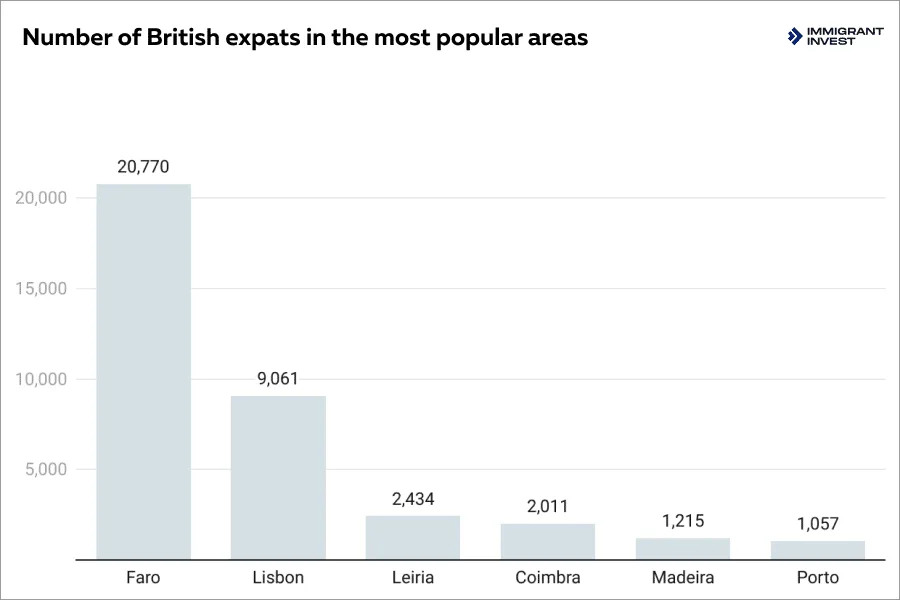
Lisbon. Portugal’s capital offers a dynamic expat-friendly lifestyle with widespread English, direct UK flights, good infrastructure, and a strong business scene. Surf schools along the nearby Atlantic coast add appeal for active newcomers. Yet, expats must expect high living costs and competitive housing.
Porto. More affordable and relaxed than Lisbon, Porto suits remote workers and families. It has a strong community feel, creative energy, and scenic surroundings. While cooler and rainier, it’s well-connected and close to the Douro Valley, Portugal’s premier wine tourism region.
Coimbra is ideal for retirees and budget-conscious remote workers. It offers low costs, quality healthcare, and good public services. English is less common, but the city is calm and well-connected.
Leiria is affordable and family-friendly with a growing tech presence. The city has good schools, healthcare, and transport links. English is limited, but it’s safe and offers authentic Portuguese life. Surfing beaches and nature spots are nearby, including the Atlantic coast and limestone parks.
Faro, Algarve, is great for sun-seekers. It combines historic charm, modern amenities, and international airport access. The city is quiet off-season but has strong expat support and outdoor leisure options year-round. The Algarve is also the golf capital of Europe, with top-tier courses and clubs.
Madeira is best for nature lovers and digital nomads. The region boasts a high quality of life, EU stability, a mild subtropical climate, and strong English proficiency. Funchal and Ponta do Sol support remote workers, while the island offers hiking, canyoning, mountain biking, and marine wildlife experiences.
Housing in Portugal: rent or buy?
Property market overview
Portugal’s property market is steadily growing. For instance, in the first quarter of 2025, prices rose by 6.6% compared to the end of 2024[15]Vida Imobiliária — Housing price growth in Portugal. This is the most significant growth since 2007.
The average cost per square metre ranges from €2,650 to 3,700, depending on location, with Lisbon being the most expensive. In the capital, prices range from €3,850 to 6,600 per square metre[16]Numbeo — Property investment index: Portugal.
Rental markets are competitive, especially in Lisbon and Porto, where demand often exceeds supply. In Lisbon, the average monthly rent is around €1,200 for a one-bedroom apartment and €2,200 for a three-bedroom apartment, depending on location. In contrast, rural areas and smaller towns offer more affordable long-term rental options.
Pros and cons of renting a property
UK nationals choosing to rent a property benefit from the following:
- Flexibility to relocate. In the UK, you’re often bound to a 6- or 12-month assured shorthold tenancy. In Portugal, most contracts last 1 year, renewable by agreement, with just 30 days’ notice after 6 months.
- Lower initial outlay. Back home, you’ll budget for a month’s rent, a holding deposit and sometimes hefty agency and solicitor fees. In Portugal, you normally pay a security deposit of 1 to 3 months’ rent plus the first month in advance. There is no stamp duty land tax and no mortgage valuation fees.
- The landlord takes care of big repairs. Just as in the UK, landlords must handle structural faults. In high-tourist areas such as Porto or the Silver Coast, they’re especially keen to maintain standards to protect future rental income.
However, high demand — especially in Lisbon, Porto, and coastal hotspots like the Algarve — means competition is fierce. Properties often rent out within days, and prices have been rising by around 4—5% annually, which may outpace your income, especially if you're working locally rather than remotely for a UK-based employer.
Additionally, rental agreements restrict personalisation. You won’t be able to renovate or redecorate beyond minor, reversible changes. If your landlord decides not to renew your lease, you could face the inconvenience and expense of moving again, with little notice.
Pros and cons of buying a property
Buying a property may be advantageous for the following reasons:
- Building equity and potential gains. In sought-after regions, such as Algarve or Lisbon, values have risen steadily over the past decade, offering both forced savings and the prospect of capital growth.
- Full control and long-term stability. Whereas many UK flats are leasehold, Portuguese apartments are often sold freehold, giving you full say over renovations and décor.
- Holiday-let opportunities. Portugal has booming tourism, which allows you to let your property via short-stay platforms when you’re away. Net yields of 4—6 % in Lisbon or Porto often exceed buy-to-let returns in UK provincial markets.
That said, buying is a significant financial commitment. You’ll need a 20—30% deposit, along with property transfer tax, stamp duty, and legal fees — expenses that easily add up to tens of thousands of euros. And, unlike renting, homeowners are fully responsible for all repairs, maintenance, and taxes. Unexpected problems like a leaking roof or plumbing failure can lead to high, unplanned costs.
It’s also worth remembering that property is not a liquid asset. Selling a home in Portugal can take several months, and transaction fees can eat into your profits.
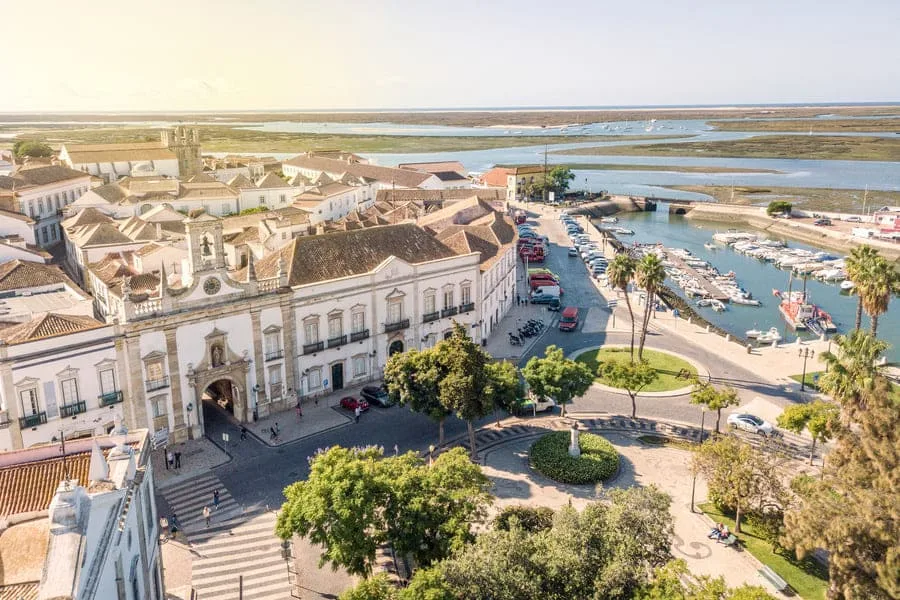
The average monthly rent for an apartment in Faro, the most popular city among UK expats, is around €1,000. The best areas to live in include Cidade Velha, Montenegro, Gambelas, and Ilha de Faro
Moving to Portugal from the UK: checklist
Before moving to Portugal and while you’re still in the UK, consider doing the following:
- Check your passport’s expiration date. It should be valid for at least 6 months beyond your planned arrival in Portugal.
- Make copies of all important documents. Scan and print passports, visas, birth and marriage certificates, and rental contracts.
- Apostille is necessary for documents, especially birth and marriage certificates. This is useful if you plan to get married or have children in Portugal.
- Arrange transport or storage of belongings.
- Close accounts or notify your UK bank of your move. This helps avoid account freezes or fraud alerts.
- Open a euro or multi-currency bank account. This is useful until you open a Portuguese bank account.
- Notify HMRC about your departure. Submit form P85 and check your UK tax residency status.
After arriving in Portugal, consider doing the following:
- Apply for a Portuguese tax number, which is required for renting, opening a bank account, or signing contracts.
- Open a Portuguese bank account. This is often necessary for visa validation, housing, and utility payments.
- Register your address and apply for a residence permit. Book appointments early, as slots can fill up fast.
- Register or exchange your UK driving licence. This must be done within 60 days after entering Portugal.
- Register with the public healthcare system at your local health centre.
- Set up mobile phone and internet services — leading providers include MEO, NOS, and Vodafone.

Are you a perfect fit for the Portugal D7 Visa?
Discover your eligibility with our simple quiz!
How to adapt to living in Portugal
Understand local culture. Life in Portugal often moves at a gentler rhythm than in the UK. While you might be used to the hustle of London’s rush-hour Tube, the Portuguese pace of life slows after lunchtime as many businesses close for a “siesta”, particularly in smaller towns.
The Portuguese place great value on community, much like you may recognise in UK village fêtes, but celebrations frequently spill onto the streets and last well into the evening. Join in the colourful local festas, sample regional specialities such as bacalhau à Brás or pastel de nata to feel at home in Portugal.
Make connections. In the UK, you might be accustomed to the pub as a social hub; in Portugal, cafés and “esplanadas”, pavement terraces, play a similar role. Make an effort to chat to your neighbours over an espresso or join meetups.
Groups for expats might be found on Facebook. Some of them are “Expat Community Portugal”, “Expats Lisbon” or “Portugal Expat Hub”. Events for expats are often published on websites like InterNations or Meetup.
Learn basic Portuguese. Although English is widely spoken in Lisbon and Porto, making the effort to learn Portuguese will pay dividends. Simple phrases such as obrigado — thank you, por favor — please, and bom dia — good morning, will earn you instant goodwill.
Learning Portuguese helps in daily interactions, builds rapport with locals and demonstrates respect for the culture. It can prove especially useful in smaller towns and rural areas.

Portugal is home to dozens of native grape varieties. The Douro Valley is the birthplace of famous Port wine, as well as robust reds and crisp whites
Portugal citizenship prospects for UK citizens
The UK and Portugal both allow dual citizenship, meaning a British citizen can obtain a Portugal passport and enjoy the benefits of EU citizenship while still retaining their British nationality.
After 5 years of legal residence in Portugal on a residence permit, a British citizen can apply for a permanent residence permit or apply directly for Portuguese citizenship by naturalisation. It usually takes 7—12 months to obtain Portuguese nationality. Citizenship applications may be submitted online, in person, or by post to the Central Registry Office.
Documents required to apply for citizenship in Portugal are as follows:
- Application form completed in Portuguese.
- Two passport photographs taken no later than 6 months ago.
- Passport or its notarised copy.
- Proof of permanent income sufficient to live in Portugal without state subsidies.
- Proof that at least 5 years have passed since the foreigner submitted their residence permit application.
- Proof of residence in Portugal.
- Proof of no criminal record from the UK and other countries where the applicant has resided continuously for more than one year.
- Proof of knowledge of Portuguese at A2 level or higher.
If additional documents are required, the applicant will be notified and must submit them within 20 days.
Underage children can also obtain Portuguese nationality if their parents have maintained a residence permit in the country for five years. Children under the age of 12 do not need to take a language test.
Portugal vs. other European destinations for relocation
Three most popular destinations for UK citizens in Europe are Spain, Ireland, and France.
Spain vs. Portugal
Both countries offer sunshine and vibrant cultures, with a similar cost of living. However, Portugal boasts a significantly higher level of safety. Portugal has a high level of English proficiency, while in Spain, English is moderately spoken and mostly limited to larger cities.
The flexible Golden Visa route makes it easier and more cost-effective for foreign investors to settle in Portugal and eventually obtain citizenship without the need to renounce their existing nationality. In contrast to Portugal, Spain recently abolished its Golden Visa, meaning foreigners can no longer obtain Spanish residency by investment.
Ireland vs. Portugal
Ireland captivates with its emerald landscapes, storied pubs, and the Wild Atlantic Way, but its famously unpredictable weather can diminish the experience. Portugal’s Mediterranean climate guarantees over 300 days of sunshine per year, mild winters, and coastal waters warm enough for swimming into late autumn.
Living in Portugal is more affordable: average rents and restaurant prices in Dublin are 25—30% higher than in Lisbon.
Portugal’s Digital Nomad Visa, Passive Income Visas, and Golden Visa options make it easier for remote professionals and investors to legally live and work here. In contrast, Ireland offers no dedicated visa pathways for investors or digital nomads.
France vs. Portugal
On average, Portugal is slightly more affordable than France, especially compared to Paris. Portugal consistently ranks among the world’s safest countries, well above France.
English is widely spoken in Portugal, whereas proficiency in France tends to be lower. The Portuguese are also known for being warm and welcoming.
Portugal offers a straightforward Digital Nomad Visa, while France does not, making it easier for remote workers to live and work in Portugal.
Portugal vs. Spain vs. France vs. Ireland: comparison
Main points on navigating post‑Brexit visa options for UK citizens moving to Portugal
- UK citizens wishing to move to Portugal post-Brexit have several visa options, including the Golden Visa for investors, the Portugal Global Talent Visa for professionals, the D7 Visa for those with passive income or pensions, and the Digital Nomad Visa for employees of foreign companies.
- Each visa has specific requirements but offers a pathway to residency and eventual citizenship in Portugal.
- To obtain the Portugal Golden Visa, a UK citizen must make an investment of at least €250,000.
- To get Portuguese residency through the D7 Visa, one must prove they earn a stable passive income of at least €920 per month.
- The Portugal Digital Nomad is granted to foreigners employed by companies outside Portugal who earn a minimum monthly income of €3,680.
- The Portugal Global Talent Visa is designed for highly qualified professionals who collaborate with Portuguese universities or research institutions and contribute to innovation, education or scientific development in the country.
- Moving to Portugal offers favourable living conditions, including safety, a pleasant climate, and a lower cost of living compared to the UK.

 Trusted by 10,000+ investors