


Worldwide Offices
May 20, 2026
Reading time: 18 min

How much does it cost to obtain a Golden Visa in Portugal?

Portugal remains a strong Plan B in the EU: safe, warm, Atlantic-facing, and expat-friendly. The Golden Visa gives investors and their families the opportunity to become Portuguese residents without the need to relocate.

The programme no longer works exactly as it did a few years ago. Investment routes, tax rules, and citizenship timelines have changed.

This guide covers the newest 2026 details on the Portugal Golden Visa: investment options, costs, requirements, benefits, timelines, and risks.

Vladlena Baranova
Guided through the Portugal Golden Visa
Fact checked by Elena RudaElena Ruda
Elena Ruda
Fact checked by Elena Ruda
Elena helped over 500 investors’ families to choose and obtain second citizenship or residency. She knows the pros and cons of each investment option and improves the industry expertise at the company.
Reviewed by Pavel ReshetnikovPavel Reshetnikov
Pavel Reshetnikov
Reviewed by Pavel Reshetnikov
Pavel performed preliminary Due Diligence checks for more than 1,000 investors. All the investors who passed the preliminary Due Diligence checks obtained citizenship or residence permits under state investment programs.
Portugal Golden Visa guide for investors

What is the Portugal Golden Visa?

The Portugal Golden Visa is a residence permit for foreigners who invest in the country. The visa gives its holders the right to live in Portugal as residents and is renewable every 2 years. Family members can also be included in the application.

Investors can choose one of the following options:

  • supporting arts and cultural heritage — €250,000+;
  • financing research activities — €500,000+;
  • purchasing investment fund units — €500,000+;
  • opening a company and creating 5 jobs — €500,000+;
  • opening a company and creating 10 jobs — no minimum investment.

Besides making an investment, applicants must meet several requirements. The main applicant must be over 18, have a clean criminal record, have no debts in Portugal, prove the legal origin of the funds, and earn the investment money outside Portugal. 

The programme’s official name is Autorização de Residência para Investimento, ARI. It is administered by Agência para a Integração, Migrações e Asilo, AIMA[1]. The ARI regime was introduced by Law No. 29/2012.

10 benefits of the Portugal Golden Visa

The Portugal Golden Visa is a way to keep the EU within reach without changing one’s life overnight. Investors get legal residence in Portugal, easier travel across the Schengen Area, and the option to relocate later, with their family included in the same strategy.

1. Plan B

The Portugal Golden Visa gives investors a secure legal base in the EU. There is no need to move immediately, sell property, change schools, or restructure a business at once. It works as a reserve option: Portugal is there when the family needs it — for relocation, education, healthcare, business, or simply a safer environment.

2. Visa-free travel within the Schengen Area

Golden Visa holders can travel across the Schengen Area without applying for separate visas. They can spend up to 90 days in any 180-day period in other Schengen states, which makes business trips, family travel, and holidays in Europe much easier.

Portugal Golden Visa for freedom of movement

During the pandemic, I realised how fragile my business was when every trip depended on visas and changing border rules. Supplies from Europe were delayed, customers were leaving, and I could not travel to meet my partners in Italy and Germany or renegotiate delivery terms.

Portuguese residence by investment gave me the mobility I needed. After obtaining the permit, I could travel to the EU without waiting for a Schengen visa, meet suppliers in Milan, and keep the regular customers my business depended on.

3. Low stay requirement

The Portugal Golden Visa does not require investors to live in the country permanently. To maintain the residence permit, they need to spend only 7 days a year in Portugal and renew their residence cards on time.

4. Asset diversification

The fund route gives investors access to a regulated Portuguese investment structure. It allows them to place part of their capital in Portugal while also securing mobility and a long-term residence option.

The capital may be returned after the fund term ends — often within 6 to 12 years, depending on the fund’s rules, performance, and exit structure.

5. Inclusion of family members

The main applicant can include close family members in the Golden Visa application: a spouse, children under 25, and parents. Family members receive residence permits and enjoy the same rights as the investor.

6. High level of safety

Portugal offers the kind of safety that is felt in everyday life: quiet streets, low violent crime, stable democratic institutions, and a strong sense of public order. In the Global Peace Index 2025, Portugal ranked 7th in the world. The index measures countries on indicators such as societal safety and security, ongoing conflict, and militarisation[2].

Portugal Golden Visa: when safety and education come first

During our last year in Peru, our house in a gated community was robbed twice. I was spending most of my time at work and realised I could no longer feel confident about my wife’s and children’s safety.

The Portugal Golden Visa helped us move the family to Cascais, a calm coastal town with good schools, sports clubs, and a safer everyday environment. My wife and children have already settled there, and I plan to join them permanently once I arrange a stable source of income in Portugal.

7. Access to healthcare and education

Under the Portugal Golden Visa rules, investors acquire private healthcare insurance. Portugal has private hospitals with international accreditations, for example, Hospital da Luz Lisboa has Joint Commission International accreditation.

Public healthcare can also serve as a backup. Portugal performs well in preventive care: preventable mortality stands at 117 deaths per 100,000 people, below the OECD average of 145, which points to strong primary care and disease prevention[3].

Children can study free of charge in Portuguese-speaking public schools. International schools are paid, while public universities offer domestic tuition rates, often starting at around €700 per year.

8. Work and business rights

The Portugal Golden Visa allows investors and their family members to work, run a business, or be self-employed in the country. These rights apply regardless of the investment route.

9. Business expansion

Portugal is a practical base for entrepreneurs who want a European foothold. A company can be registered online within 48 hours, while the country offers access to the EU market, Atlantic trade routes, a growing tech ecosystem, and a skilled multilingual workforce.

Business owners can also benefit from flexible structuring. Corporate taxation depends on the region, business activity, and available incentives: rates start at 8.75%. This makes Portugal attractive for companies in technology, services, innovation, tourism, trade, and international operations.

10. Joining the Mediterranean pace of life

Portugal offers a lifestyle built around the ocean, mild weather, walkable cities, long lunches, local markets, and time spent outdoors. The country has over 800 kilometres of Atlantic coastline, with beaches, marinas, fishing towns, surf spots, golf resorts, and hiking routes within easy reach of major cities.

Portugal is one of Europe’s great outdoor countries. Residents surf in Ericeira and Nazaré, sail along the coast, play golf in the Algarve, hike in Madeira, spend weekends in the Douro Valley, and enjoy beach weather for much of the year.

Portugal Golden Visa cost
In 2026, 396 beaches in Portugal received Blue Flag status, an international award given to the world’s cleanest and safest beaches[4]

What are the investment options under the Portugal Golden Visa?

The Portugal Golden Visa can be obtained through several investment routes, but not all of them work the same way. The choice depends on the investor’s priorities: capital preservation, potential return, acceptable risk level, liquidity, involvement in business operations, or a simpler contribution-based path.

Purchase of investment fund units — €500,000+

Purchasing units in a Portuguese investment fund is now one of the main routes to the Portugal Golden Visa. The minimum investment is €500,000, and the fund must meet the programme’s eligibility rules.

Fund categories. Qualifying funds invest in different assets and follow different strategies:

  1. Venture capital funds invest in young companies with growth potential.
  2. Private equity funds invest in companies that are already operating and growing.
  3. Mixed or balanced funds invest in several types of assets, such as company shares and fixed-income instruments.
  4. Sector-specific funds focus on one area, such as technology, healthcare, infrastructure, energy, or real estate development.

Diversification. Investors can split the required €500,000 between several eligible funds. This helps spread risk and reduce dependence on a single fund manager, strategy, or portfolio while keeping the investment compliant with Golden Visa rules.

Estimated returns. Expected returns usually vary from 2 to 20%, depending on the fund strategy, asset class, risk level, fees, market conditions, and exit structure. Higher expected returns usually come with higher risk and less predictable liquidity.

Portuguese allocation. Eligible funds must place at least 60% of the subscribed amount into companies based in Portugal. This gives investors exposure to the Portuguese market, but the portfolio cannot be fully global.

The remaining 40% may be invested in other markets if the fund’s rules allow it. Some managers use this part to add sector or geographic diversification.

Holding period. Golden Visa-eligible funds must have a minimum maturity of 5 years at the time of investment. In practice, many investors redeem their units after 6—12 years, depending on the fund’s rules and exit strategy.

Golden Visa funds must be regulated by Comissão do Mercado de Valores Mobiliários, CMVM, Portugal’s securities market regulator.

CMVM does not publish a separate public list of funds that qualify specifically for the Golden Visa. This means each fund must be checked individually before the investor subscribes.

Immigrant Invest works only with verified funds and reviews their Golden Visa eligibility in advance.

Vladlena Baranova,
Head of Legal & AML Compliance Department, CAMS, IMCM

Business investment — €500,000+

There are two business routes under the Portugal Golden Visa:

  1. Invest €500,000 in opening a company and create at least 5 jobs for Portuguese citizens or residents.
  2. Open a company and create at least 10 jobs, with no minimum investment amount; in a low-density area, the requirement is reduced to 8 jobs.

Company setup costs. Opening a company in Portugal usually costs €500 to 1,000, depending on the registration method and additional services.

The main incorporation fees are:

  • €220 if a company uses the pre-approved memorandum and articles of association;
  • €360 if a company uses the memorandum and articles of association drawn up by interested parties;
  • €440 to 720 for urgent requests[5].

If the entrepreneur wants a custom company name, they may need a certificado de admissibilidade de firma. This certificate confirms that the name is available and can be used. If the company is registered with an associated trademark, an additional fee may apply.

Office rent depends on the city and location. As a rough benchmark, a small office of 10 to 12 m² can cost €300 per month.

Corporate taxation. Corporate tax in Portugal depends on the company’s location, size, and activity. The main rates are:

  • 19% — standard corporate income tax in mainland Portugal;
  • 13% — standard rate in Madeira and the Azores;
  • 15% — for SMEs and Small Mid-Cap companies on the first €50,000 of taxable income;
  • 10.5% — for SMEs in Madeira and the Azores on the first €50,000;
  • 12.5% — for SMEs operating in inland regions of mainland Portugal;
  • 8.75% — for SMEs in specific beneficiary areas of Madeira and the Azores on the first €50,000.

Additional charges can increase the final tax burden:

  • municipal surtax — up to 1.5% of taxable income;
  • state surtax — 3 to 9%, applied progressively to large profits[6].

As a result, the combined corporate tax rate in mainland Portugal can reach 29.5% for large companies with profits above €35 million.

Financing art or research — €250,000+ or €500,000+

Cultural heritage. The minimum contribution to support arts and cultural heritage in Portugal is €250,000. The investor makes a non-refundable contribution to the restoration of national heritage sites or to projects that support cultural activities.

Research activities. For research financing, the minimum contribution is €500,000. The applicant donates to research and development projects carried out by accredited Portuguese entities, such as universities, R&D centres, and other recognised institutions.

The routes do not usually involve additional investment-related expenses, but the contributions are non-refundable.

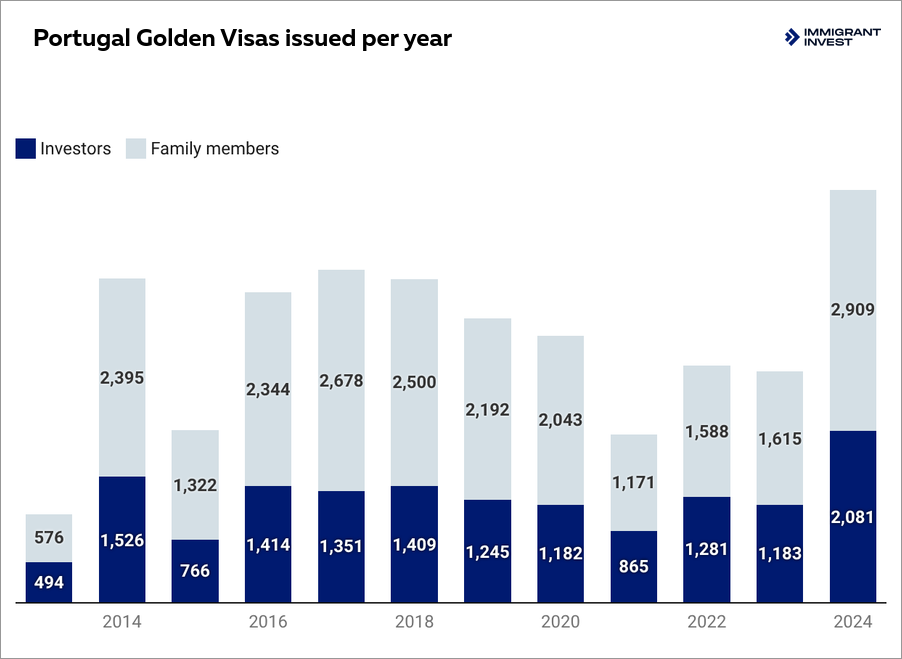
portugal golden visa statistics

Can you obtain a Portugal Golden Visa by purchasing real estate?

Buying real estate no longer qualifies for the Portugal Golden Visa. Portugal removed the property route under Law No. 56/2023, which took effect in October 2023. The change was part of the Mais Habitação, or More Housing, reform package, introduced to respond to Portugal’s housing affordability crisis and reduce pressure on the property market[7].

To apply for the programme, investors need to choose one of the remaining qualifying routes, such as investment fund units, support for arts and cultural heritage, research financing, or company creation.

Foreigners can still buy property in Portugal for personal use or investment. A purchase can also help with a practical requirement of the programme: applicants need a registered address in Portugal. Investors may use purchased property for this purpose, but the purchase itself will not give them Golden Visa eligibility.

Examples of real estate in Portugal

Portugal, Porto
€353,000 — €442,000
Three bedroom apartment in a new residential project
141 m² — 164 m²
3
2
Portugal, Evora
€280,000 — €350,000
Share in a 5-star hotel complex with vineyards
Portugal
€450,000+
Stylish house with 4 bedrooms, Aveiry
400 m²
4
3

Costs besides investment under the Portugal Golden Visa

The investment amount is not the only expense in the Portugal Golden Visa process. Applicants also need to budget for state fees, medical insurance, and, in the fund route, charges linked to the selected investment fund.

Government fees and medical insurance

Government fees are charged for every person included in the application, not only for the main investor. They include two key payments:

  • application fee of €632.10;
  • residence card issuance fee of €6,314.20.

Each applicant must also have valid health insurance for the full residence period, which is 2 years. The minimum coverage is €30,000. In practice, policy prices usually start at €400 per person per year, or at €800 per person for the first 2-year card period.

Fund-related fees

Applicants who choose the investment fund route should also account for fund charges. These costs vary by fund and can affect the investor’s final return:

  1. Subscription fee — 0 to 2%. This is a one-time charge paid when the investor buys fund units. It is calculated as a percentage of the invested amount.
  2. Performance fee — 0 to 30%. This fee applies only if the fund makes a profit or reaches a specific return benchmark.

For example, if the performance fee is 20%, the fund manager may keep 20% of the profit. The remaining 80% stays with the investor.

Estimated Portugal Golden Visa costs for the €500,000 fund route

Cost itemSingle applicantCoupleFamily of four
Purchase of investment fund units€500,000 €500,000€500,000
Application fee€632.10€1,264.20€2,528.40
Residence card issuance fee€6,314.20€12,628.40€25,256.80
Health insurance for 2 years€800+€1,600+€3,200+
Total€507,746.30+€515,492.60+€530,985.20+

Which family members can join the Portugal Golden Visa investor?

The Portugal Golden Visa can become a family route, not only an individual residence permit. The main applicant may include close relatives in the same application, but the rules differ by family member.

Spouse or partner

The investor can include a spouse, including a same-sex spouse. A spouse does not need to prove financial dependence on the main applicant.

A partner may also qualify even if the couple is not officially married. If the partnership is not registered, the couple usually needs to prove a stable relationship of at least 2 years.

Children

Children of the investor or the investor’s spouse can be added to the application if they are under 25 and principally dependent on the main applicant.

Adult children must also study at a university and be registered at the same address as the investor.

Parents

Parents of the investor or the investor’s spouse can also be included. Those aged 65 or older usually qualify without proof of financial dependence. Parents under 65 must prove financial dependence on the investor.

How to obtain the Portugal Golden Visa step by step

Obtaining the Portugal Golden Visa usually takes at least 12 months, based on Immigrant Invest’s experience. The timeline can vary depending on document preparation, bank compliance checks, the selected investment route, AIMA processing, and appointment availability.

The process is mostly remote at the early stages. However, at least one visit to Portugal is normally required: the investor and included family members must attend a biometrics appointment and submit original documents.

[P12M]
1 day
Preliminary Due Diligence

Before signing a contract, Immigrant Invest conducts preliminary Due Diligence. This helps assess the applicant’s profile in advance and reduce the risk of refusal to 1%. The check is confidential. At this stage, the investor only needs to provide a passport.

2 weeks
Collecting documents

A dedicated Immigrant Invest lawyer prepares the list of documents for the investor and their family members. The lawyer also helps arrange certification, translation, notarisation, and legalisation where required, so the file meets Portuguese immigration standards.

1—2 weeks
Obtaining a tax number

The investor obtains a Portuguese tax number, called Número de Identificação Fiscal, NIF. It is required for key steps in Portugal, such as opening a bank account or starting a business. Immigrant Invest lawyers guide the investor through the process.

1—1.5 months
Opening a Portuguese bank account

The qualifying investment must be made through the applicant’s Portuguese bank account. Immigrant Invest helps the investor open and activate the account. Once the account is ready, the investor transfers the funds required for the selected Golden Visa option.

1 week to 1.5 months
Making the investment

The investor chooses the Golden Visa route that matches their goals, budget, and preferred level of involvement. Immigrant Invest assists with the selected option and collects documents confirming that the investment has been completed.

5—6 months
Preparing and submitting the application

Lawyers prepare the full application package. They complete government forms, translate and notarise documents, and check that the file is ready for submission. Copies of the documents are then submitted to AIMA.

1—2 weeks
Attending biometrics in Portugal

The investor books a biometrics appointment and travels to Portugal on the scheduled date. Family members included in the application usually need to attend as well. At the appointment, applicants submit fingerprints and provide the originals of their documents.

Within 6 months after biometrics
Receiving approval and residence cards

AIMA reviews the original documents and makes the final decision on the residence application. After approval, the investor pays the residence card issuance fee. The residence cards can be collected in person or through a lawyer acting by proxy.

Every 2 years
Renewing the residence permit

The Portugal Golden Visa residence permit is issued for 2 years and must then be renewed.

At each renewal, the investor confirms that the qualifying investment is still maintained, proves compliance with the minimum stay requirement, provides updated criminal record certificates, and pays government renewal fees for each family member.

What documents are required for the Portugal Golden Visa?

The Portugal Golden Visa application requires a standard set of personal, financial, and investment documents, including:

  • passport;
  • evidence of legal entry and stay in Portugal;
  • Portuguese tax number;
  • tax identification number in the country of residence;
  • medical insurance;
  • police clearance certificate;
  • authorisation for AIMA to check Portuguese criminal records;
  • proof of tax compliance and no debts in Portugal;
  • proof of residential address in Portugal;
  • bank statement for the previous 6 months;
  • documents confirming the legal source of investment funds;
  • evidence that the qualifying investment has been made;
  • application fee payment receipt;
  • sworn statement confirming compliance with the programme requirements;
  • completed and signed forms, including investment subscription forms, anti-money laundering declarations, and investor profile questionnaires.

If family members join the application, additional documents may be required. These can include birth certificates for children and marriage certificates for spouses. For unmarried partners, documents proving a stable relationship may also be needed.

All foreign documents must usually be translated into Portuguese, notarised, and legalised or apostilled, depending on the country of issue.

Discover the benefits of the Portugal Golden Visa

What obligations do Portugal Golden Visa holders have?

To maintain the Portugal Golden Visa and renew their residence permits, investors must continue to meet the programme conditions throughout the residence period. The main obligation is to keep the investment.

Golden Visa holders must also:

  • spend at least 7 days a year in Portugal;
  • keep valid health insurance;
  • maintain a registered address in Portugal;
  • pay taxes in Portugal if they become liable to do so;
  • avoid criminal offences and keep a clean police record;
  • inform the authorities of relevant personal changes, such as a new address, marital status, or changes in family composition.

Even though real estate investment is no longer an option for a Portugal Golden Visa, we can help applicants who need housing in the country. We select several properties to choose from, contact the owner, check the contract terms and the condition of the property, and conclude the rental or purchase agreement by proxy.

Vladlena Baranova,
Head of Legal & AML Compliance Department, CAMS, IMCM

How to renew a Portugal Golden Visa residence card

Portuguese residence permit cards must be renewed every 2 years until the holder obtains permanent residence or a Portugal passport. The renewal application is submitted online no later than 30 days before the residence card expires[8].

The renewal document package usually includes:

  • valid residence permit card, or a card that expired less than 6 months ago;
  • passport;
  • two photos;
  • proof of financial solvency;
  • authorisation for AIMA to check Portuguese criminal records;
  • tax payment information, if applicable.

The government fee for reissuing the residence card is €3,157.80 per person, which is half the initial card issuance fee.

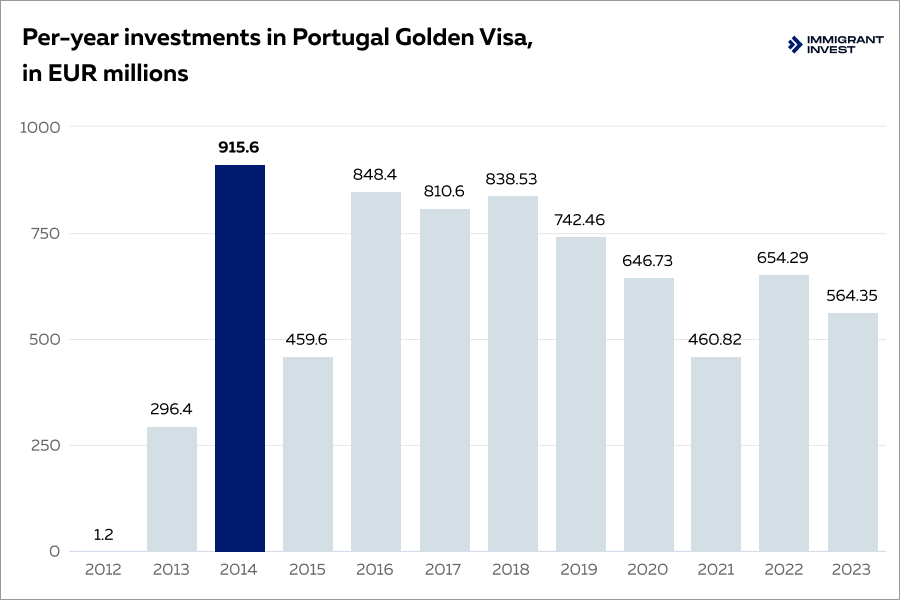
portugal golden visa statistics

Can Portugal Golden Visa holders obtain citizenship?

Portugal Golden Visa holders can apply for citizenship after 10 years of legal residence. A shorter period of 7 years applies to citizens of Portuguese-speaking countries[9].

Children may benefit from faster access to citizenship. A child born in Portugal can qualify if, at the time of birth, one of the parents has legally lived in Portugal for at least 5 years.

To apply for Portuguese citizenship, Golden Visa holders must:

  • pass a Portuguese language test;
  • show knowledge of Portuguese culture, history, and the political system;
  • declare in writing their commitment to democratic principles;
  • keep a clean criminal record.

The application review usually takes around 7 months, while the full citizenship process can take up to 1 year.

Portugal allows dual citizenship. This means investors do not need to renounce their first citizenship after obtaining a Portuguese passport, unless the laws of their country of origin prohibit dual nationality.

Portuguese citizens can travel visa-free to the Schengen Area and over 170 other countries and territories, including the UK, Japan, Canada, Singapore, the UAE, and Brazil.

Instead of a Portugal passport, investors can obtain permanent residence after 5 years. This option is suitable for those who do not want to wait for citizenship, maintain the investment or residence permit any longer, or for applicants who would lose their first citizenship if they became Portuguese citizens.

To obtain permanent residence, investors need to prove basic knowledge of Portuguese, along with accommodation in Portugal and sufficient income.

Vladlena Baranova,
Head of Legal & AML Compliance Department, CAMS, IMCM

Tax considerations for the Portugal Golden Visa holders

Portugal Golden Visa holders do not automatically become tax residents. Tax residence depends on how much time they spend in the country and whether Portugal becomes their main base.

Tax residence triggers

A person is considered a Portuguese tax resident if they spend more than 183 days in Portugal within a 12-month period, even if the days are not consecutive. Tax residence can also be triggered by having a home in Portugal that shows an intention to keep and use it as a habitual residence, even with a shorter stay.

Once a person becomes a Portuguese tax resident, they are taxed in Portugal on their worldwide income. Non-residents are taxed only on Portugal-sourced income.

Personal income tax

In Portugal, personal income tax is charged on a progressive scale. For tax residents, rates range from 12.5 to 48%, depending on the annual income amount.

Non-residents pay a flat 25% tax on Portugal-sourced income.

An additional solidarity rate applies to higher incomes. Taxable income above €80,000 is subject to an extra 2.5%, while income above €250,000 is subject to an extra 5%. This charge is added on top of the regular personal income tax rate[10].

Income tax rates and deduction amounts

Annual incomeFor non-residentsFor Portuguese tax residents
RateDeduction
Up to €8,34225%12.5%€0 
€8,342 to 12,58715.7%€266.94
€12,58 to 17,83821.2%€959.26
€17,838 to 23,08924.1%€1,476.45
€23,089 to 29,39731.1%€3,092.77
€29,397 to 43,09034.9%€4,209.94
€43,090 to 46,56643.1%€7,743.27
€46,566 to 86,63444.6%€8,441.48
€86,634+48%€11,387.17
€86,634 to 250,000 25% + 2.5% of the solidarity rate48% + 2.5% of the solidarity rate€13,387.17
Above €250,00025% + 5% of the solidarity rate48% + 5% of the solidarity rate€19,637.17

Other taxes

Capital gains tax. Capital gains tax applies to the sale of shares. As a general rule, gains are taxed at a flat rate of 28%. However, only 50% of the gain is taxable if the shares are held in a micro or small company that is not listed on a stock exchange[11].

Inheritance and gift tax. Portugal does not impose wealth tax, inheritance tax, or gift tax on transfers to close family members: spouses, children, grandchildren, parents, and grandparents. 

If assets are transferred to a distant relative or to a person outside the family, a 10% stamp duty applies to gifts and inheritances[12].

Property tax. Property owners in Portugal pay an annual municipal real estate tax. The rate is 0.3 to 0.45% for urban properties and up to 0.8% for rural properties. 

High-value real estate may also be subject to an additional wealth tax: 0.4% for companies and 0.7 to 1.5% for individuals[13].

Property transfer tax. The property transfer tax rate depends on the type and location of the property. Rural property is taxed at 5%. Commercial real estate is taxed at 6.5%, regardless of whether it is urban or rural. Residential urban property is taxed on a progressive scale, with rates reaching 7.5%[14].

Stamp duty. Stamp duty applies to a wide range of transactions, contracts, and legal acts. A 0.8% rate applies to real estate transfers for consideration or donation. 

Gifts and inheritances may also be subject to an additional 10% stamp duty, unless an exemption applies.

The transfer of a going concern may be taxed at 5%. Insurance policies covering risks in Portugal may also be subject to stamp duty, with rates depending on the type of insurance[15].

Value-added tax. Portugal applies three VAT rates, depending on the type of goods or services:

  • standard rate — 23% in mainland Portugal, 22% in Madeira, and 16% in the Azores;
  • reduced rate — 13% in mainland Portugal, 12% in Madeira, and 9% in the Azores;
  • super reduced rate — 6% in mainland Portugal, 4% in Madeira, and 4% in the Azores.

Exports and intra-EU supplies of goods are zero-rated for VAT purposes[16].

Corporate income tax. Companies that are tax residents in mainland Portugal pay corporate income tax at a flat rate of 19% on taxable income. In the Autonomous Regions of Madeira and the Azores, the rate is reduced to 13%.

Tax on dividends. Dividends and interest income are taxed at a flat rate of 28%[17].

Portugal has double tax treaties with 79 countries, helping taxpayers avoid being taxed twice on the same income. The treaty network covers EU member states and major global economies, including the UK, the US, Canada, Japan, China, India, and the UAE.

Vladlena Baranova,
Head of Legal & AML Compliance Department, CAMS, IMCM

Portugal Golden Visa vs. other EU Golden Visas

Besides Portugal, Golden Visa programmes are also available in Greece, Hungary, Italy, and Latvia. Cyprus and Malta offer investment programmes that grant permanent residence immediately, while the other countries issue temporary residence permits first.

Each programme has its own requirements, investment options, thresholds, and additional costs. The best choice depends on the investor’s goal: relocation, asset diversification, tax planning, business expansion, or a long-term route to permanent residence or citizenship. Each route comes with its own advantages, limitations, and practical trade-offs.

Comparison of the European Golden Visa programmes

CountryInvestment thresholdMain investment routeObtaining timeFirst permit validityFamily inclusion
Latvia€50,000+Business, real estate, bank deposit5+ months5 yearsSpouse, children under 18
Portugal€250,000+Fund units12+ months2 yearsSpouse or partner, children under 25, parents
Greece€250,000+Real estate4+ months5 yearsSpouse or partner, children under 21, parents
Hungary€250,000+Fund units5+ months10 yearsSpouse or partner, children under 18, parents
Italy€250,000+Innovative startup4+ months2 yearsSpouse, children under 18, disabled children over 18, parents
Cyprus€300,000+Real estate9+ monthsPermanentSpouse or partner, children under 25, disabled children of any age
Malta€169,000+Real estate6+ monthsPermanentSpouse or partner, children under 29, parents, grandparents

Risks and pitfalls of obtaining the Portugal Golden Visa

The Portugal Golden Visa remains one of Europe’s strongest residence-by-investment routes, but it is not a “set and forget” programme. The real challenges usually appear after the investment is made: waiting times, document updates, tax questions, fund performance, and changing rules.

Administrative delays

Portugal Golden Visa applicants can face long processing times, but AIMA has started moving more procedures online to reduce manual handling and make renewals easier.

From February 16th, 2026, Portugal Golden Visa renewals are submitted through AIMA’s Renewal Portal. Applicants file the renewal request and pay the fees online; in-person appointments are required only if AIMA needs to collect biometric data[18].

In May 2026, AIMA announced that digitally signed documents are accepted for residence permit applications and renewals in Portugal. This should make document submission faster and reduce the need for paper-based procedures[19].

Still, delays remain a practical issue. They can affect biometrics, approval, card issuance, renewals, family planning, and school admissions.

Legislative and tax changes

Portugal has already changed the Golden Visa framework, and future changes remain possible. The biggest change was the removal of real estate as a qualifying investment. 

Tax rules have also changed. The old Non-Habitual Resident, NHR, regime has ended for most new applicants, while the new IFICI is narrower and mainly targets highly qualified professionals in specific sectors[20].

Citizenship rules are another moving part. In May 2026, Portugal approved reforms that extend the naturalisation period from 5 to 10 years for most non-EU and non-CPLP nationals and 7 years for EU and CPLP nationals, subject to final publication, transition rules, and implementation guidance.

Tax residence confusion

A Portugal Golden Visa is an immigration status, not an automatic tax residence. Holding the card does not itself mean the investor becomes a Portuguese tax resident.

A person is considered a tax resident in Portugal if they spend more than 183 days in the country in a 12-month period or have a home in Portugal that indicates an intention to keep and use it as habitual residence.

The pitfall is simple: investors may either overestimate or underestimate their tax exposure. A registered address, property purchase, long stays, family relocation, or business activity in Portugal should be checked with a tax adviser before the move becomes a factual tax residence.

Underexplained fund route risks

The fund route is now one of the main Portugal Golden Visa options. A regulated fund is still an investment product, not a guaranteed deposit.

Investors should check the fund’s strategy, fees, lock-up period, exit terms, asset allocation, governance, reporting, and track record. Some funds may have limited liquidity, uncertain resale options, or delayed exits. Performance and subscription fees can also reduce the final return.

The main pitfall is treating the fund route as a purely immigration step. It is both an immigration route and an investment decision.

Source-of-funds risk

Portugal Golden Visa applicants must prove that their investment money has a legal origin. This can become difficult if the funds come from several accounts, business income, dividends, property sales, inheritance, crypto assets, loans, or corporate structures.

The safest approach is to prepare the source-of-funds file before transferring the investment money.

Document expiry and compliance fatigue

The Portugal Golden Visa process requires many documents, and some are valid only for a limited time. If the application takes longer than expected, parts of the file may need to be updated before submission, biometrics, approval, or renewal.

Criminal record certificates are usually accepted only if issued within the last 3 months. Bank statements must also be recent, commonly covering the previous 6 months. Health insurance must remain valid for the residence period, and passports must be valid long enough for card issuance.

The practical problem is compliance fatigue: the investor prepares the file once, but delays may require new certificates, updated bank documents, fresh translations, and renewed insurance before the residence card is issued.

Biometrics trip with the whole family required

Golden Visa applicants must attend a biometrics appointment in Portugal. If family members are included in the application, they usually need to attend as well.

For one applicant, this is usually manageable. For a family, it can become harder to coordinate. The trip may involve visas, flights, school terms, work calendars, elderly parents, medical needs, and document validity. If one family member cannot attend the appointment, their part of the application may be delayed.

How Immigrant Invest can help with the Portugal Golden Visa

Immigrant Invest is a licensed consultancy firm that helps investors obtain residence and citizenship by investment. We have 20 years of experience, 11 offices worldwide, and have assisted over 10,000 clients with international relocation, investment migration, and long-term residence planning.

For the Portugal Golden Visa, we support the investor at every stage of the process. Our services include:

  • preliminary Due Diligence to assess the applicant’s profile and reduce the risk of refusal;
  • source-of-funds review before contracts are signed, or capital is transferred;
  • coordination with independent specialists where tax or investment advice is required;
  • NIF registration and Portuguese bank account opening by power of attorney;
  • selection and verification of the qualifying Golden Visa route, including fund eligibility checks;
  • preparation of the Golden Visa application, including family members;
  • translation, notarisation, and legalisation of documents where required;
  • tracking document validity to avoid expiry during the process;
  • submission of the application through the official portal;
  • coordination of biometrics appointments in Portugal;
  • support with obtaining or renting housing for a registered address in Portugal;
  • renewal support every 2 years;
  • monitoring of legal and regulatory changes that may affect the investor’s timeline.

Immigrant Invest helps investors avoid common mistakes, such as transferring funds before checks are complete, missing document validity periods, or misunderstanding tax and renewal obligations. We also monitor legal and regulatory updates and promptly inform clients of changes that may affect their application or timeline.

Key takeaways about the Portugal Golden Visa

  1. The Portugal Golden Visa offers 5 investment options: purchasing investment fund units for at least €500,000, supporting arts and cultural heritage for €250,000+, financing scientific research for €500,000+, opening a company for €500,000+, or creating at least 10 jobs with no minimum investment threshold.
  2. The main applicant can include family members in the application. Eligible relatives may include a spouse or partner, children under 25, and parents.
  3. Obtaining the Portugal Golden Visa usually takes 12+ months.
  4. The minimum stay requirement is only 7 days per year. This allows investors to keep Portugal as a Plan B, stay mobile across Europe, and decide separately whether they want to become Portuguese tax residents.
  5. The key benefits include visa-free travel within the Schengen Area, access to healthcare and education, work and business rights, and the option to live in a stable, safe Mediterranean country.

Frequently asked questions

Is it easy to get a Golden Visa in Portugal?

Getting a Portugal Golden Visa is manageable with proper legal support, but it is not a simple or instant process. It usually takes at least 12 months, depending on document preparation, bank checks, the investment route, processing times, and biometrics appointment availability.

Applicants must obtain a Portuguese tax number and open a Portuguese bank account before making the qualifying investment. They also need to pass Due Diligence and source-of-funds checks, prepare documents, submit the application, and travel to Portugal for biometrics.

With 20 years of experience, Immigrant Invest supports clients throughout the whole process, including renewals.
How much is the Portugal Golden Visa fee?

Portugal Golden Visa applicants pay two main government fees: an application fee of €632.10 and a residence card issuance fee of €6,314.20 per person. The minimum investment under the programme is €250,000, which applies to the arts and cultural heritage route. Other qualifying options require higher investment amounts.

How can I get permanent residency in Portugal?

To obtain permanent residency in Portugal, an investor must hold a temporary residence permit for at least 5 years. Golden Visa holders are not required to live in Portugal permanently during this period. They can maintain their status by meeting the programme’s minimum stay requirement: 7 days per year.

To qualify for permanent residence, applicants must also prove basic knowledge of Portuguese, have accommodation in Portugal, show sufficient income, and meet the general legal requirements.

How much money do you need to get residency in Portugal?

The minimum investment under the Portugal Golden Visa is €250,000. This applies to the arts and cultural heritage route, where the investor makes a non-refundable contribution.

Other options require a higher budget. Investors need at least €500,000 to finance research activities, purchase investment fund units, or open a company under the qualifying business route.

In addition to the investment, applicants pay government fees: an application fee of €632.10 and a residence card issuance fee of €6,314.20 per person. Medical insurance is also required and usually costs around €400 per person per year. In total, the Golden Visa costs at least €257,746.30 for a single applicant and €280,985.20 for a family of four.

Is Portugal ending the Golden Visa programme?

No, Portugal is not ending the Golden Visa programme in 2026. It remains open to new applicants. The programme has changed significantly, especially after the real estate and capital transfer routes were removed in 2023.

Investors can still apply through qualifying options such as investment fund units, arts and cultural heritage support, research financing, or business investment.

What is the minimum investment for a Golden Visa in Portugal?

The minimum investment under the Portugal Golden Visa is €250,000. This applies to the arts and cultural heritage route, where the investor makes a non-refundable contribution.

The most popular option is purchasing investment fund units for at least €500,000. Unlike a contribution, this route may allow investors to redeem their units after 6 to 12 years and receive potential returns.

Is it possible to obtain a Portugal Golden Visa by real estate investment?

No, since October 2023, real estate investment has no longer qualified for the Portugal Golden Visa. Applicants can still qualify through other options: supporting arts and cultural heritage, financing research activities, purchasing investment fund units, or investing in a business.

What is the cheapest Golden Visa in Europe?

Latvia currently offers the lowest investment threshold among Golden Visa programmes, with a business investment starting at €50,000. In other countries, the standard minimum investment is higher. Portugal, Greece, Italy, and Hungary require at least €250,000 under their qualifying investment routes.

Do all Portuguese investment funds qualify for the Golden Visa?

No, not all Portuguese investment funds qualify for the Golden Visa. To qualify, the fund must be regulated by Comissão do Mercado de Valores Mobiliários, CMVM, Portugal’s securities market regulator, and meet the programme’s eligibility rules. 

At least 60% of the subscribed amount must be invested in companies based in Portugal, while the remaining 40% may be invested in other markets if the fund’s rules allow it.

Golden Visa-eligible funds must also have a minimum maturity of 5 years at the time of investment. In practice, investors often redeem their units and return their capital after 6 to 12 years, depending on the fund’s terms, performance, and exit strategy.

What are the disadvantages of a Portugal Golden Visa?

The main disadvantages of the Portugal Golden Visa are:

  1. Administrative delays — processing can take longer than expected.
  2. Changing rules — Portugal has already removed real estate as a qualifying route, revised tax benefits, and approved changes to citizenship timelines.
  3. Tax residence confusion — a Golden Visa does not automatically make the investor a tax resident, but long stays, a habitual home, or relocation of family can trigger tax obligations.
  4. Fund route risks — investment funds are not guaranteed deposits.
  5. Strict source-of-funds checks — applicants must prove the legal origin of the investment money before transferring capital.
  6. Biometrics trip — the investor and included family members usually need to travel to Portugal for biometrics.

Can I get residency in Portugal if I buy a house?

No, buying a house no longer qualifies for the Portugal Golden Visa. Portugal removed the real estate route in October 2023. A property purchase can still be useful for personal residence, rental income, or a registered address in Portugal, but it does not give Golden Visa eligibility.

To obtain residency by investment, applicants must choose another qualifying route, such as investment fund units, arts and cultural heritage support, research financing, or business investment.

What are the benefits of the Portugal residency-by-investment programme?

The Portugal residency-by-investment programme gives investors and their families a legal base in Portugal without the need to relocate immediately.

Key benefits include:

  • Schengen visa-free travel — up to 90 days in any 180-day period;
  • low stay requirement — only 7 days a year;
  • asset diversification — through the investment fund route;
  • family inclusion — for a spouse or partner, children under 25, and parents;
  • access to healthcare, education, and the labour market;
  • business opportunities in Portugal and the EU;
  • high level of safety;
  • life in a mild Mediterranean climate.

What are Portugal Golden Visa requirements for applicants?

Portugal Golden Visa applicants must make a qualifying investment. The minimum investment is €250,000, which applies to the arts and cultural heritage route. Other routes require at least €500,000.

Besides the investment, the main applicant must:

  • be over 18;
  • have a clean criminal record;
  • have no debts in Portugal;
  • prove the legal origin of the investment funds;
  • earn the investment money outside Portugal.

Can you buy a property in Portugal without a Golden Visa?

Yes, foreigners can buy property in Portugal without holding a Golden Visa or any other residence permit. A buyer usually needs a Portuguese tax number and a Portuguese bank account to complete the purchase. They can buy property for personal use, rental income, or as part of relocation planning.

However, the purchase itself will not qualify the buyer for the Portugal Golden Visa, as real estate investment was removed from the programme in October 2023.

Sources

  1. Source: AIMA — Portugal Golden Visa
  2. Source: Vision Humanity — Global Peace Index 2025
  3. Source: OECD — Health at a Glance 2025: Portugal
  4. Source: Bandeira Azul Portugal — Portuguese Blue Flag programme page
  5. Source: Portuguese Government — Create a Company Online
  6. Source: PwC — Taxes on corporate income in Portugal
  7. Source: Diário da República — Lei n.º 56/2023, de 6 de outubro
  8. Source: Diário da República — Lei n.º 23/2007, de 4 de julho
  9. Source: Portugal Government — Parliament approves new Law on Nationality
  10. Source: PwC — Portugal personal income tax
  11. Source: PwC — Portugal individual income determination
  12. Source: Portal das Finanças — Stamp Duty Information Page
  13. Source: Portal das Finanças — Municipal taxes in Portugal
  14. Source: APCMC — IMT Practical Tables in Force 2026
  15. Source: Portal das Finanças — Stamp Duty Information Page
  16. Source: Gov.pt — Value Added Tax in Portugal
  17. Source: PwC — Portugal individual income determination
  18. Source: AIMA — Online ARI renewal portal announcement
  19. Source: The Portugal News — AIMA says digitally signed documents are valid for residency applications
  20. Source: Portal das Finanças — IFICI regime

Immigrant Invest is a licensed agent for government programs in the European Union and the Caribbean.

Subscribe
Notify of
guest

6 Comments
Newest
Oldest Most Voted
Inline Feedbacks
View all comments
Jason Lee
Jason Lee
10 months ago

Hello, does Portugal grant golden visa for crypto?

Immigrant Invest
Editor
Immigrant Invest
10 months ago
Reply to  Jason Lee

Hello,

Thank you for your question.
No, the Portugal Golden Visa cannot be obtained through investments in cryptocurrencies.

Li Wei
Li Wei
1 year ago

Hi, I want a Portugal Golden Visa together with my wife and my twins. What will the cost be?

Immigrant Invest
Editor
Immigrant Invest
1 year ago
Reply to  Li Wei

Hello Wei,

If obtaining the Portugal Golden Visa by purchasing investment fund units, you will encounter the following expenses:
- investment — €500,000+;
- fund commission when investing — up to 7.5%;
- medical insurance — €400+ per person;
- application fee — €605 per person;
- residence permit card fee — €6,045 per person.

Thus, total costs for a family of 4 will be at least €538,200.

Mehdi Esfandiari
Mehdi Esfandiari
1 year ago

Hello, I’m planning to buy a villa in Madeira. Will I be granted a golden visa?

Immigrant Invest
Editor
Immigrant Invest
1 year ago

Hello Mehdi,

Thank you for your question.

Portugal cancelled the real estate option under the Golden Visa program in 2023. This means that property buyers are no longer entitled to a Golden Visa.

However, you can consider other pathways to the Portugal Golden Visa. To analyse your individual case and get assistance in choosing the most suitable option, book apersonal meeting with our expert.

How much does it cost to obtain a Golden Visa in Portugal?
Share:
Home Blog
How much does it cost to obtain a Golden Visa in Portugal?