

Worldwide Offices
March 26, 2026
Reading time: 16 min

Portugal Golden Visa processing: stages and real timelines in 2026

The Portugal Golden Visa remains one of the EU’s most sought-after residence-by-investment programmes in 2026. As of the latest available data, around 38,000 residence permits have been issued to investors and their family members[1].

Understanding the Portugal Golden Visa processing time is key to planning the application properly. The full process, starting with Due Diligence and ending with the physical residence card, takes at least 12 months.

This guide explains each stage of the process, the fees involved, the current backlog, and the realistic timeline applicants should expect.

Zlata Erlach
Clarified the main nuances of Portugal Golden Visa processing time
Fact checked by Elena RudaElena Ruda
Elena Ruda
Fact checked by Elena Ruda
Elena helped over 500 investors’ families to choose and obtain second citizenship or residency. She knows the pros and cons of each investment option and improves the industry expertise at the company.
Reviewed by Vladlena BaranovaVladlena Baranova
Vladlena Baranova
Reviewed by Vladlena Baranova
Vladlena leads preparation to Due Diligence and application for citizenship or residency by investment. She performs independent and in-depth analysis of investors’ situations and indicates possible risks. Vladlena helped to get second passports and residence permits to over 300 investors from all over the world.
The Golden Visa Program of Portugal gives you a residency within 6 months.

What is the Portugal Golden Visa programme: key things to know

The Portugal Golden Visa, officially known as the Autorização de Residência para Atividade de Investimento, ARI, is a residence‑by‑investment programme. It grants non‑EU and non‑EEA nationals a Portuguese residence permit in exchange for a qualifying investment in the Portuguese economy.

Core features of the programme

The Portugal Golden Visa holders receive the right to live, work, and study in Portugal, and to travel freely within the Schengen Area without a separate visa. 

The residence-by-investment programme’s key features at a glance include:

  1. Minimum investment — €250,000.
  2. Total processing time — 12+ months.
  3. Minimum stay — 7 days per year.
  4. First card validity — 2 years.
  5. Citizenship eligibility — 5 years.
  6. Application fee — €632.1.
  7. Card issuance fee — €6,314.2.

After 5 years of legal residence, investors may apply for permanent residency or Portuguese citizenship, subject to meeting language and integration requirements.

Legal basis and programme history

Portugal launched the ARI programme in 2012 under Lei n.º 23/2007, the Foreigners Act, specifically Article 90-A[2]. Since then, the legal framework has been amended several times. 

The biggest change came with the Mais Habitação, or More Housing, package. It took effect on October 7th, 2023 and removed residential real estate purchases from the list of qualifying investment options[3]. 

In 2024, responsibility for the programme moved from SEF — the former foreigners and borders service — to the newly created Agency for Integration, Migration and Asylum, AIMA[4]. It now manages the ARI system and its online portal for applications and document uploads.

What investment routes qualify for the Portugal Golden Visa in 2026?

The Portugal Golden Visa currently offers four main investment routes: investment funds, support for arts and cultural heritage, business investment, and investment in research activities.

Investment funds — €500,000+

The Portugal Golden Visa fund route requires a minimum investment of €500,000 in a fund regulated by the Portugal's securities market regulator — Comissão do Mercado de Valores Mobiliários, CMVM. It keeps a public register of authorised funds that qualify for ARI purposes.

Key features of the fund route include the following:

  1. Eligible funds must invest at least 60% of their capital in Portuguese companies.
  2. Minimum holding period is 5 years, and capital is usually redeemed within 6 to 10 years, with estimated return varying between 2 and 20%.
  3. Subscription fee reaches 7.5%.
  4. Funds distribute profits to investors, with an annual fund commission on profits of 0.5 to 3%.
  5. Management fee ranges between 0.25 and 2.5%.
  6. Portuguese tax residents pay 14% tax on investment income, while non-residents are exempt.

The fund route has become the primary choice for Golden Visa applicants, gaining significant popularity after the real estate option was closed in 2023.

Supporting arts and restoring cultural heritage — €250,000+

Golden Visa applicants choose the cultural route by making a donation of at least €250,000. The contribution is non-refundable.

The funds are directed to the production, restoration, or preservation of cultural heritage sites or artistic projects approved by the government body — Gabinete de Estratégia, Planeamento e Avaliação Culturais.

Research activities — €500,000+

The scientific research route requires a minimum investment of €500,000. This investment is also non-refundable.

The funds are allocated to public or private research and technology institutions that participate in national science and technology programmes.

Business investment — 2 options

Business Golden Visa investors can qualify in two ways:

  1. €500,000 investment in a new or existing Portuguese company, plus the creation or maintenance of at least 5 permanent jobs for a minimum of 3 years.
  2. Creation of at least 10 permanent jobs in Portugal, with no minimum investment amount required.
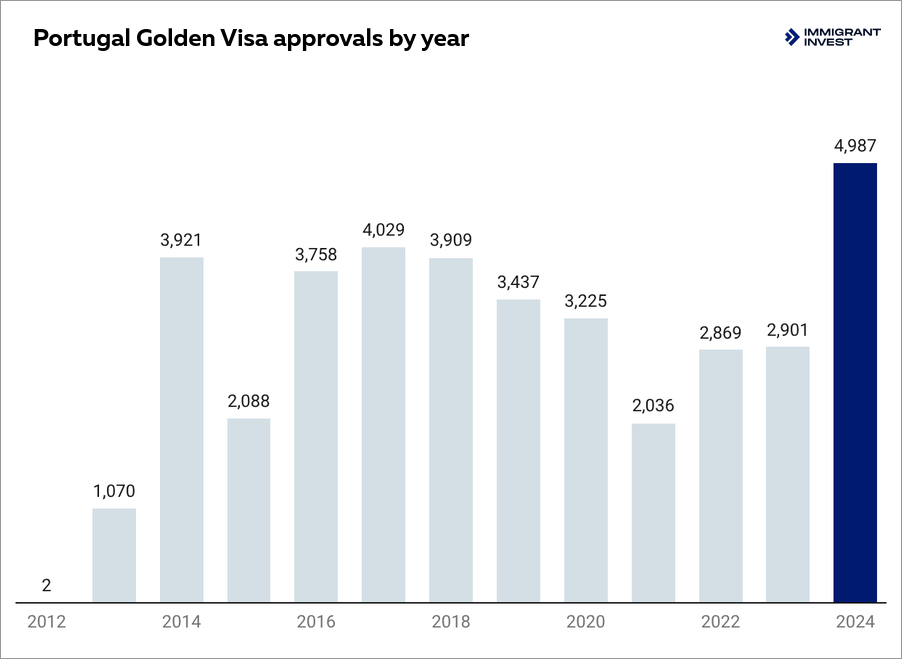
Portugal Golden Visa statistics
2024 saw the highest number of permits issued due to backlog clearance and a shift in new demand after the real estate option was closed

How long does the Portugal Golden Visa process take in 2026?

The Portugal Golden Visa process combines several fast administrative steps with a few stages that define the overall timeline. The whole process takes over 12 months and may extend beyond that due to administrative review times.

The quickest phases of the Portugal Golden Visa processing time are preliminary Due Diligence, obtaining a tax identification number, and opening a bank account, which can be completed within a few days if documents are ready.

The longest stage is the government review after submission. AIMA’s assessment and approval process takes 6 months or more, making it the main bottleneck. In addition, travel to Portugal is required for biometric data collection, and coordinating this visit can affect timing.

Processing time also varies by investment route and applicant profile. The fund route is generally the most predictable, as it follows standardised procedures. In contrast, business investments may extend earlier stages, particularly during investment structuring and document preparation.

Step-by-step procedure of obtaining the Portugal Golden Visa

The Portugal Golden Visa follows a structured sequence of steps, each with its own timeline and requirements. The overall timeframe varies by case, but careful preparation helps keep the process predictable and efficient. Immigrant Invest supports applicants at every stage, ensuring the process is handled smoothly and in full compliance with requirements.

1 day
Preliminary Due Diligence

At the first stage, an investor undergoes a preliminary background check. A certified Compliance Anti-Money Laundering Officer reviews the applicant’s information against international databases. 

Preliminary Due Diligence is mandatory and helps identify potential issues early. Based on the results, an appropriate strategy can be developed to minimise the risk of refusal to as little as 1%. 

The service agreement is signed after this check to ensure the case is well prepared and the process is set up for a successful outcome.

Up to 2 weeks
Preparation of documents

Immigrant Invest lawyers provide the investor with an individual list of documents required to apply for a Portugal residence permit by investment. They also fill out government forms and help translate and notarise documents.

1—2 weeks
Obtainment of a tax number

Each applicant is issued a unique nine-digit tax number — Número de Identificação Fiscal, NIF. It is required to open a bank account in Portugal, buy or rent real estate, or register a business.

1—1.5 months
Opening of an account in a Portuguese bank

Investment under the Portugal Golden Visa programme must be made from the applicant’s account in a Portuguese bank.

We help open the account and activate it. Once everything is ready, the applicant transfers the amount required for the investment.

1 week to 1.5 months
Investment
Investment

The timeframe at this stage depends on the chosen option. The applicant may purchase units in an investment fund, establish a company and create the required jobs, or make an investment in support of arts or science.

Our lawyers collect all supporting documents confirming that the investment has been made.

5—6 months
Application
Application

Electronic copies of the documents are submitted to AIMA. Before submission, the legal team checks that the documents meet the formal requirements, including validity periods, translations, certification, and consistency across the file.

1—2 weeks
Submission of biometrics

Once AIMA has approved the Portugal Golden Visa application for the next step, the applicant or their legal representative receives notice that biometric enrolment can be arranged through the online system. 

Appointments are offered at different AIMA offices in Portugal, but the location is not always freely selectable, as availability may depend on case volumes and the number of relatives included in the file.

For applicants who need a visa to travel, AIMA advises arranging the appointment 60 to 90 days ahead. Where foreign documents still need consular certification, the recommended lead time is 90 to 180 days[5].

Within 6 months after biometrics
Approval and acquisition of the residence permit cards

AIMA reviews the documents of the investor and their family within 6 months after the biometric submission date.

Once the application is approved, the investor pays the required fee for the residence permit cards.

The cards are issued within 6 months after biometrics and may be collected either by the investor in person or by a lawyer acting under a power of attorney.

Every 2 years
Renewal of the residence permit

To maintain residency, the investor and family members must spend at least 7 days a year in Portugal. The residence permit must be renewed every 2 years.

The renewal procedure is similar to the initial application: the same documents must be collected and submitted online, fingerprints must be provided, original documents must be presented, and new residence permit cards must be obtained.

Why can Portugal Golden Visa processing take longer than expected?

The Portugal Golden Visa average processing time in 2026 can be longer than expected, for reasons that are structural rather than exceptional. Four recurring factors account for most delays.

AIMA case backlog

When Portugal replaced SEF with AIMA in 2024, around 50,000 Golden Visa applicants and their family members were still waiting for their cases to be processed[6]. 

The government made it clear that ARI applications were not a priority within AIMA, as more urgent immigration cases were handled first. As a result, some investors faced waiting times of up to 40 months[7]. 

Many applicants turned to court action to force progress on delayed AIMA cases. This created a surge in lawsuits, with tens of thousands of cases reaching the administrative courts and more than 100,000 still unresolved. In response, the government tightened the rules, requiring proof of urgency and introducing court fees of about €600[8].

In October 2025, the Minister of the Presidency said that 93% of pending cases linked to the regularisation of all immigrants in Portugal had already been resolved and aimed to clear the Golden Visa cases in 2026[9].

Residence card production bottleneck

Even after AIMA approves the application, a separate production stage remains. Portugal’s biometric residence cards are produced by Imprensa Nacional-Casa da Moeda, the state entity responsible for secure identification documents[10]. 

The final step adds extra waiting time after approval, with delays possible during periods of high demand.

Regional office capacity variations

Portugal does not process Golden Visa cases through one central office only. AIMA operates through 35 offices across the country, and the ARI portal allows applicants to choose where to attend their appointment.

In practice, waiting times vary depending on local capacity, and during the backlog, some applicants faced extended delays in securing biometric appointments[11]. For that reason, appointment availability should be checked on a case-by-case basis rather than assumed to be the same everywhere.

Document expiry risk

AIMA requires foreign criminal record certificates for the Golden Visa applications to be issued within the previous 3 months[12]. If the biometric appointment takes place after that period, the applicant may need to obtain a new certificate and apostille it again, which adds cost and time.

To reduce that risk, it is better to obtain the certificate as close as possible to the document submission date.

Who can apply for the Portugal Golden Visa?

The Portugal Golden Visa is available not only to the main investor but also to certain family members, provided they meet the programme’s eligibility requirements.

Investor

To be eligible for the Portugal Golden Visa, the main applicant must satisfy all of the following criteria:

  • be at least 18 years of age;
  • hold a nationality that is not Portuguese, EU, EEA, or Swiss;
  • hold a valid passport for the entire processing period;
  • have no criminal record, verified through a police certificate no older than 3 months at the time of submission;
  • be able to demonstrate a legitimate source of funds for the qualifying investment;
  • use funds for investment transferred from abroad;
  • invest with money from outside Portugal;
  • obtain a Portuguese tax identification number — NIF;
  • open a bank account with a Portuguese-licensed financial institution;
  • maintain qualifying health insurance covering treatment in Portugal;
  • have no unpaid tax or social security debts in Portugal.

Family members 

The main applicant may include dependent family members in the same Golden Visa application. Eligible family members are:

  • spouse or legally recognised partner — with no criminal records or prosecutions, same sex couples included;
  • children under 18;
  • children aged 18 to 26 — financially dependent on the investor, unmarried, in full-time education or living with the investor;
  • parents — financially dependent on the investor.

A spouse must be either legally married to the investor or in a recognised unregistered partnership, with proof of at least 2 years of cohabitation.

What documents are required for the Portugal Golden Visa application?

Preparing the Portugal Golden Visa application requires a full set of personal, financial, and investment documents for the main applicant and each family member included in the file.

Core documents for the main applicant

The following documents are required for the primary Golden Visa applicant:

  • valid passport — full copy of all pages including stamps;
  • criminal record certificate — issued within the past 3 months;
  • health insurance — policy covering medical treatment in Portugal;
  • proof of investment — the confirmation certificate from the CMVM-regulated fund, or equivalent documentation for other routes;
  • NIF — Portuguese tax registration certificate;
  • proof of tax compliance by presenting a negative debt statement issued by the Tax Authority;
  • bank account confirmation — statement or letter from the Portuguese bank confirming the account is active;
  • AIMA application form — completed online via Portal ARI;
  • receipt of application fee payment.

Documents not issued in Portuguese, English, French, or Spanish must be translated by a certified translator and apostilled.

Applications are submitted digitally through the ARI portal, but applicants must present original or certified documents — including properly legalised versions — at the biometric appointment stage.

The passport must have sufficient validity for the full application timeline. Since the review process may take a year or longer and the first residence permit is issued for 1 year, the passport should remain valid well beyond the filing date. It is best to submit the application with at least 18 to 24 months of passport validity left, plus an additional 6-month buffer.

Zlata Erlach,
Head of the Austrian office

Additional documents for family members

Apart from a valid passport and health insurance, family members must also provide the following documents:

  • criminal record certificate for applicants aged over 16;
  • responsibility statement signed by the investor;
  • power of attorney and a copy of the professional licence.

For spouses, the file must also contain a marriage certificate issued within the last 6 months or documents proving a de facto union. Proof of tax compliance issued within 45 days and proof of social security compliance must also be added.

For parents, the file should contain the investor’s birth certificate together with documents confirming the investor’s professional status.

For children, the following documents apply:

  • birth certificate issued within the last 12 months;
  • statement from an educational institution confirming enrolment in the current academic year;
  • certificate confirming marital status, translated into Portuguese and certified.

All documents submitted for family members must meet the same translation and apostille requirements as those for the main applicant.

How much does the Portugal Golden Visa cost in total?

The total cost of the Portugal Golden Visa includes not only the investment, but also government fees and several additional administrative expenses that arise during the application process.

Government and administrative fees

Applicants pay government fees at several stages of the ARI process, including the initial application, the first residence card, and each renewal. As these fees are indexed periodically by the Portuguese government, the exact amounts should be checked on the AIMA portal at the time of application[13].

For a single investor, total government fees over the initial 5-year Golden Visa period, including the first residence card and two renewals, amount to €13,261.9, excluding investment and legal costs.

For a family of four — the investor, spouse, and two children — the total government fees amount to €53,047.6.

Portugal Golden Visa government fees 2026

Application fee€632.1 per personAt the online submission
First card issuance fee€6,314.2 per personAfter AIMA approval
Renewal fee€3,157.8 per personBefore card expiry

Ancillary costs

Additional costs of the Portugal Golden Visa that form part of the overall outlay include:

  • document translation: €1,000+;
  • health insurance: €400+.

Thus, the total cost of the Portugal Golden Visa is at least €264,661.9 for a single investor. For a family of four, the minimum total cost rises to €305,247.6.

How to renew the Portugal Golden Visa?

Renewing the Portugal Golden Visa means proving that the investment is still in place, the stay requirement has been met, and the updated documents are ready for submission. 

The first Golden Visa residence card is valid for 2 years, and after that, the permit must be renewed every 2 years until the 5th year of holding the status. Then, the permit holder is eligible to apply for permanent residence or citizenship if they meet the requirements.

Meet the stay requirement

Portugal’s Golden Visa has one of the lowest physical presence requirements among EU residence-by-investment programmes. Under the current rules, the investor is required to spend a minimum of 7 days in Portugal per year.

The days do not have to be consecutive. To avoid issues at the renewal stage, it is advisable to retain proof of travel and stay in Portugal, such as passport stamps, boarding passes, and accommodation records, in case AIMA requests supporting evidence.

Complete the renewal procedure

Each Portugal Golden Visa renewal follows the same general pattern and should be started well before the current card expires. 

To renew the residence permit, the applicant must take the following steps:

  1. Initiate the renewal through the ARI portal, where the applicant or legal representative submits the application and pays the required fees online.
  2. Update all documents with validity limits, including criminal record certificates, marriage certificates, and birth certificates, so they meet AIMA’s current requirements.
  3. Demonstrate that the qualifying investment has been maintained for the required holding period.
  4. Track the application status in the portal after submission.

Renewal fee amounts €3,157.8 per person. The whole process can be completed online. If biometrics are required, AIMA will notify the applicant and invite them to provide biometric data.

Over the 5-year Golden Visa period, the investor completes two full renewal cycles before becoming eligible to apply for permanent residence or citizenship.

Starting February 16th, 2026, AIMA has made ARI renewals available through the Renewals Portal: renewal applications and fee payments are now handled fully online[9]

Previously scheduled appointments must still be attended if they are needed only for biometric data collection due to invalid biometrics. If biometric collection is required after the online application is reviewed, AIMA will automatically schedule an appointment and notify the applicant. 

The change is intended to speed up processing, reduce unnecessary in-person visits, and make the system more predictable and efficient for investors.

Zlata Erlach,
Head of the Austrian office

How to get Portuguese citizenship through the Golden Visa

After obtaining the Portugal Golden Visa, eligibility for citizenship depends on maintaining legal residence for the required period and meeting the country’s integration criteria.

Maintain residency for 5 years

Individuals may apply for Portuguese nationality after 5 years of legal residence. For Golden Visa holders, this period is treated as counting from the residence application date rather than the card issuance date, which makes the route especially attractive during long AIMA delays.

Another major advantage is the stay requirement. Golden Visa holders need to spend only 7 days per year in Portugal. This is far lower than the 183-day physical presence rule usually expected in other Golden Visa countries.

Meet integration requirements

To qualify for Portuguese citizenship, applicants must satisfy several integration criteria:

  • demonstrate Portuguese language proficiency at A2 level;
  • show basic knowledge of Portuguese culture and society;
  • have a clean criminal record both in Portugal and in the country of origin;
  • have no outstanding tax or social security liabilities.

In addition, applicants are expected to show a connection to Portugal, for example, through family ties, professional activity, or property ownership.

Potential legislative update

Portugal Golden Visa holders may face a longer wait to qualify for citizenship under the legislative approach now under discussion.

The government has indicated that the required period may be extended to 7 years for CPLP nationals and 10 years for other applicants, with the countdown starting from the issuance of the residence permit. These changes are still subject to final confirmation and practical implementation details[14].

For Golden Visa holders, changes may shift the focus to permanent residence after 5 years, making it a more predictable milestone. Permanent residency allows maintaining lifelong legal status in Portugal without keeping the investment in place.

To obtain permanent residence, the investor must show sufficient means of subsistence, proof of accommodation in Portugal, basic knowledge of Portuguese, and compliance with tax and social security obligations.

Zlata Erlach,
Head of the Austrian office

What are the main benefits of the Portugal Golden Visa?

The benefits of the Portugal Golden Visa go beyond the right to live in the country. The programme also offers flexible travel across the EU, access to quality healthcare and education, and the opportunity to enjoy one of the continent’s most comfortable lifestyles.

1. Legal residence in Portugal

The Portugal Golden Visa grants full legal residence rights, allowing investors and their families to live, work, run a business, and study in the country without restrictions. 

There is no requirement to relocate permanently, so investors can maintain international lifestyles while keeping access to Portugal.

2. Schengen Area travel

Portugal Golden Visa holders can travel freely across the 29 Schengen countries without applying for visas. They may stay up to 90 days within any 180-day period in other Schengen states, making short-term travel simple and predictable.

Everyday travel is highly convenient. Major destinations such as Spain can be reached by car within a few hours, while France or Italy are easily accessible by short flights or train connections.

3. Education access

Children of Golden Visa holders can study at public schools in Portugal free of charge, although classes are mainly taught in Portuguese. For families planning a long-term move, this can be a practical way to integrate into local life.

International families also have a wide choice of private and international schools, with annual tuition fees usually ranging from €6,000 to 20,000. 

After obtaining Portuguese citizenship, students can apply to European universities on the same basis as EU nationals, including lower tuition fees. Portugal also has a strong higher education system, with five universities ranked among the top 500 in the QS rankings[15].

4. Healthcare access

Portugal Golden Visa holders can access Portugal’s public healthcare system once they become residents. They may use the European Health Insurance Card, which covers necessary medical treatment during temporary stays in other EU countries. Private health insurance remains mandatory under the programme and gives faster access to care.

Health outcomes in Portugal are strong, with life expectancy at 82.9 years[16]. One of the reasons is the country’s emphasis on preventive care and broad access to medical services[17].

5. Living in the country with a high quality of life

Portugal is known for its mild climate, with more than 300 sunny days a year in many regions. Life outdoors comes naturally here: the coast offers beaches and water sports, while inland areas are well-suited to hiking, cycling, and time in nature throughout the year.

Cultural life is just as appealing. Lisbon and Porto stand out for their historic character, museums, festivals, and strong traditions in music and architecture, giving everyday life a distinct sense of place.

The overall lifestyle is comfortable and relaxed. Good roads make it easy to travel around the country, and the atmosphere is both safe and welcoming, with Portugal ranking 7th in the Global Peace Index[18].

portugal golden visa processing time and benefits
Portugal ranks among the top 10 countries for quality of life, according to the Expat Insider Survey 2025[19]

What are the tax implications for the Portugal Golden Visa holders?

The Portugal Golden Visa does not automatically make an investor a Portuguese tax resident. Tax consequences may arise depending on how much time is spent in the country and how the investor structures their finances.

Portuguese tax residency triggers

Portugal treats a person as a tax resident if they spend more than 183 days in the country during a calendar year. Golden Visa holders who meet only the minimum stay requirement — 7 days per year — remain non-residents for tax purposes, as long as Portugal does not become their main home[20].

For non-residents, Portugal taxes only income sourced in Portugal, such as rent from property in the country or employment income earned there. Worldwide income and assets are not taxed in Portugal on that basis.

Tax status changes if the investor spends more than 183 days in Portugal in a year or makes Portugal their habitual place of residence. In that case, they become a Portuguese tax resident and are taxed on worldwide income.

Portugal personal tax rate

Portugal applies a progressive personal income tax system, with rates rising as income increases:

  • up to €8,059 — 12.5%;
  • €8,059—12,160 — 15.7%;
  • €12,160—17,233 — 21.2%;
  • €17,233—22,306 — 24.1%;
  • €22,306—28,400 — 31.1%;
  • €28,400—41,629 — 34.9%;
  • €41,629—44,987 — 43.1%;
  • €44,987—83,696 — 44.6%;
  • €83,696+ — 48%[21].

The progressive tax scale applies to residents on their worldwide income. Non-residents, by contrast, are taxed only on Portuguese-source income, at a flat rate of 25%.

IFICI special tax regime

Portugal’s Non-Habitual Resident, or NHR, regime, which gave new tax residents favourable tax treatment for 10 years, closed to new applicants on January 1st, 2024. It was replaced by the IFICI regime, the Tax Incentive for Scientific Research and Innovation.

Under IFICI, eligible new tax residents can pay a flat 20% tax rate on Portuguese-source employment or self-employment income for up to 10 years. 

The regime is aimed at specific professional groups, including researchers, university lecturers, technology and innovation specialists, executives at certified startups, and some qualified employees of export-oriented companies[22].

Golden Visa holders who meet only the minimum stay requirement and do not become Portuguese tax residents cannot use IFICI, as the regime is available only to tax residents in Portugal.

Investors planning to spend more than 183 days a year in Portugal should seek Portuguese tax advice to check whether IFICI may apply and whether tax residency fits their overall strategy. Immigrant Invest can coordinate this process with qualified tax advisers.

Zlata Erlach,
Head of the Austrian office

Portugal's double tax treaty network

Portugal has concluded double tax treaties with 79 countries, including the US, UK, China, India, Brazil, and most EU member states[23]. 

For ARI holders who do become Portuguese tax residents, these treaties can reduce the risk of double taxation on dividends, interest, royalties, and employment income.

What are the main risks of the Portugal Golden Visa?

Portugal’s Golden Visa is a well-established route, but approval is never automatic. The main risks usually relate not to the investment itself, but to compliance, document quality, timing, and long-term planning.

Delays and procedural uncertainty

Processing time remains one of the main risks of the Portugal Golden Visa programme. Even well-prepared applications can move slowly because of administrative backlog, limited biometric slots, and changing procedures at AIMA.

Delays create secondary risks. Investors may need to update expiring documents, repeat criminal record certificates, or adjust travel plans for biometric appointments. Long waiting times can also affect family planning, schooling, and tax residency strategy.

Source of funds and AML checks

One of the strictest parts of the Golden Visa process is the review of the investor’s source of funds. Applicants must show that the money used for the investment comes from lawful economic activity and can be traced clearly.

Supporting documents often include:

  • bank statements for the 6 to 12 months before the investment;
  • tax returns from the country of residence;
  • dividend records and corporate ownership documents for business owners;
  • sale agreements or portfolio statements for disposed assets;
  • employment contracts or payroll records for salaried applicants.

More complex structures usually attract more scrutiny. This includes wealth held across several jurisdictions, layered corporate ownership, transfers through high-risk jurisdictions, or unclear movement of funds between personal and corporate accounts. 

In such cases, the review may take longer, and additional documents may be requested. For that reason, a preliminary AML assessment is best done before the investment is finalised.

Programme changes

Portugal has changed the Golden Visa rules several times since the programme started in 2012. The removal of residential real estate in 2023 is the clearest example. This means investors should not assume that today’s rules will remain unchanged throughout the whole holding period.

Fund investment risks

For the Portugal Golden Visa investors using the fund route, immigration approval is only one side of the picture. The investment itself carries normal financial risk.

The main concerns are:

  • liquidity risk, as fund units usually cannot be sold or redeemed quickly;
  • performance risk, as returns are not guaranteed and losses are possible;
  • term mismatch risk, as the fund may run longer than the minimum immigration holding period.

In practice, the €500,000 fund investment should be treated as long-term and relatively illiquid capital. The exit strategy should be discussed before subscribing to the fund, not at the end of the immigration process.

Family dependency risk

Applications that include relatives can become more complex, especially when eligibility depends on dependency status. This often affects adult children and parents.

Risk arises when:

  • study status cannot be properly documented;
  • parent’s dependency cannot be demonstrated convincingly;
  • documents for a spouse or partner do not sufficiently prove the relationship.

If dependency is borderline, the family structure should be assessed before submission.

Tax and residence planning mistakes

Another common mistake is assuming that the Portugal Golden Visa automatically gives tax benefits. It does not. Tax consequences depend on how much time the investor spends in Portugal and whether Portugal becomes their habitual residence.

Problems may arise if an investor:

  • accidentally becomes a Portuguese tax resident;
  • fails to plan around reporting obligations;
  • expects special tax treatment without meeting the criteria.

Residence planning, tax planning, and investment planning should work together from the start.

The strongest applications are usually the ones prepared conservatively. That means checking the source of funds early, choosing the investment carefully, keeping documents consistent, and planning for delays rather than assuming the fastest timeline.

Zlata Erlach,
Head of the Austrian office

How Immigrant Invest can help with the Portugal Golden Visa

Immigrant Invest is a licensed investment migration firm that has worked in the industry since 2006. The company has helped more than 10,000 investors obtain passports and residence permits and works with a team of over 70 certified experts, including compliance specialists and legal professionals.

For Portugal Golden Visa applicants, Immigrant Invest provides support with the following:

  • preliminary Due Diligence, including checks of criminal records, sanctions lists, PEP status, adverse media, and source of funds;
  • clear breakdown of expected costs;
  • assistance with obtaining a Portuguese NIF and opening a bank account;
  • preparation, translation, and certification of application documents;
  • support with Portal ARI submission and communication throughout the procedure;
  • coordination of biometric appointments;
  • ongoing assistance with renewals, permanent residence, and citizenship.

Our support helps investors manage both the compliance side and the practical side of the process smoothly. Before moving forward, applicants can discuss their eligibility, source of funds, and expected timeline with Immigrant Invest.

Our assistance does not end when investors receive their residence permit. Immigrant Invest continues to help you stay fully compliant with local laws and provide ongoing support with renewals, permanent residence, and citizenship.

Key takeaways about the Portugal Golden Visa processing

  1. The Portugal Golden Visa process takes at least 12 months, counting from the first Due Diligence check to the physical residence card. The AIMA review stage alone often takes around 6 months.
  2. Delays may arise because of AIMA’s application backlog, residence card production times, differences in capacity between regional offices, and the risk of documents expiring during the process.
  3. The fund route, which requires a minimum investment of €500,000, is the main option and is generally the most predictable.
  4. The business route may take longer, as the earlier stages are often more complex, especially during investment structuring and document preparation.
  5. To reduce the risk of delays, investors should prepare documents in advance, check validity periods carefully, and complete a preliminary compliance review before submission.

Frequently asked questions

How long does the Portugal Golden Visa take to process in 2026?

The total process of obtaining the Portugal Golden Visa, starting with the initial Due Diligence and ending with receipt of the residence card, takes at least 12 months. The longest stage is AIMA’s administrative review, which currently takes around 6 months.

Scheduling the biometric appointment takes a further 1 to 2 weeks after the pre-approval notice. A well-prepared application with complete and accurate documents will not remove the queue, but it helps avoid additional delays on the applicant’s side.
Is residential real estate still a qualifying investment for the Portugal Golden Visa?

No, residential real estate was removed from the list of qualifying investments under the Portugal Golden Visa programme on October 7th, 2023. Applications submitted before that date under the real estate route continue to be processed under transitional rules. New applications can no longer qualify through the purchase of residential property.

What is the minimum investment amount for the Portugal Golden Visa in 2026?

The lowest entry point for the Portugal Golden Visa is €250,000, which is the minimum contribution under the cultural heritage and arts route. The most popular option is the fund investment route, which requires a minimum investment of €500,000.

How many days per year does a Golden Visa holder need to spend in Portugal?

The minimum stay requirement under the Portugal Golden Visa is 7 days per year. These days do not need to be consecutive. Investors should keep travel records as proof for renewal applications.

How does the AIMA biometric appointment scheduling work after submitting the Portugal Golden Visa application?

After AIMA validates the Portugal Golden Visa application, the applicant or their legal representative receives a notification and can book the biometric appointment through the online portal. Appointments are available at several AIMA offices in Portugal, although it may not always be possible to choose the exact service point due to application volumes and family size.

AIMA recommends booking at least 60 to 90 days in advance if a visa is needed for travel, and 90 to 180 days in advance if foreign documents require consular certification.

The investor must attend the appointment in person, as a legal representative cannot complete this step on the applicant’s behalf. Each family member included in the Portugal Golden Visa application must also attend a separate biometric appointment.

When does the 5-year clock for Portuguese citizenship start — at application or card issuance?

Under the current Portugal Golden Visa rules, the 5-year residence requirement for Portuguese citizenship starts on the date the Golden Visa application is submitted, not when the residence card is issued.

However, this may change. A law approved in October 2025 proposes to shift the starting point to the date of residence card issuance. As of March 2026, this change is still under presidential review and not in force.

What changed with Portuguese citizenship rules under the October 2025 nationality law?

On October 28th, 2025, Parliament approved a new nationality law that could make Portuguese citizenship harder to obtain for Golden Visa investors. According to reports in the immigration press, the required residence period would increase to 7 years for EU and CPLP nationals and to 10 years for all other applicants, including US and British citizens.

The law would also change when the residence period starts counting. Instead of starting on the date the Golden Visa application is filed, the countdown would begin only once the residence card is issued. As of March 2026, the law had not yet been officially promulgated.

Why is a Portugal Golden Visa application taking longer than 6 months?

Obtaining a Portugal Golden Visa takes at least 12 months. One of the main reasons is the large backlog AIMA inherited after the transition from SEF, with around 50,000 applicants waiting for processing as of January 2025. The Portuguese government has also acknowledged that Golden Visa applicants were placed behind more vulnerable immigration categories in the processing queue.

Since February 16th, 2026, AIMA has allowed Golden Visa renewals to be completed through the online Renewals Portal. Renewal applications and fee payments can now be submitted digitally, which should help speed up processing, reduce unnecessary in-person visits, and make the system more predictable for investors.

What is the total cost of obtaining the Portugal Golden Visa, including all fees?

The total cost of the Portugal Golden Visa varies based on the investment route, the number of family members included, and legal fees. The minimum cost over 5 years includes:

  • €250,000 — investment;
  • €632.1 — application fee; 
  • €6,314.2 — card issuance fee; 
  • €3,157.8 — two renewal fees;
  • €400+ — health insurance;
  • €1,000+ — document translation.

In total, the Portugal Golden Visa costs at least €264,661.9 for a single investor. For a family of four, the minimum required amount increases to €305,247.6.

Can a spouse and children be included in a Portugal Golden Visa application?

Yes, the Portugal Golden Visa applicant may include the following family members:

  • spouse or legally recognised partner — with no criminal records or prosecutions, same sex couples included;
  • children under 18;
  • children aged 18 to 26 — financially dependent on the investor, unmarried, in full-time education or living with the investor;
  • parents — financially dependent on the investor.

What happened to the Portugal NHR tax regime and what replaced it for Golden Visa investors?

The NHR tax regime closed to new applicants on January 1st, 2024. It was replaced by the IFICI scheme. This regime offers a 20% flat tax rate for up to 10 years on qualifying Portuguese-source employment or self-employment income. It applies to new tax residents working in scientific, research, or innovation-related activities.

For Portugal Golden Visa holders, this matters only if they become Portuguese tax residents by spending more than 183 days a year in Portugal. Investors who meet only the minimum stay requirement remain non-residents, so the IFICI regime does not apply to them.

How is a Portugal Golden Visa residence card renewed, and when should the process start?

Portugal Golden Visa renewal is completed through AIMA’s online platform. To renew the permit, the investor must continue to meet the investment requirement and comply with the stay requirement of at least 7 days per year in Portugal. 

The process also requires updated documents that meet the relevant validity periods, payment of the renewal fee, and a new biometric appointment in Portugal. It is advisable to start the renewal process at least 60 to 90 days before the card expires to avoid any gap in legal residence status.

What documents expire quickly and need careful timing during the Portugal Golden Visa application?

For the Portugal Golden Visa application, criminal record certificates are valid for 3 months from the date of issue. Since AIMA’s review may take around 6 months, documents submitted at the start of the process can expire before the biometric appointment takes place.

Investors should be prepared to obtain updated copies of time-sensitive documents if needed, especially when the biometric appointment is scheduled after the original validity period has ended.

What are the risks of investing in a Portuguese fund for the Golden Visa programme?

The main risks of investing in a Portugal Golden Visa fund are limited access to capital, uncertain returns, and the possibility that the fund term may last longer than the minimum holding period required for the visa.

Funds are usually illiquid, which means the investment cannot normally be redeemed during the 5 to 10-year term. Capital is also not protected, so returns are not guaranteed and the value of the investment may rise or fall.

Can the Portugal Golden Visa be applied for entirely remotely without visiting Portugal?

For the Portugal Golden Visa, most of the application process can be handled remotely. Document preparation and submission can be completed through a power of attorney issued to a Portuguese-licensed lawyer.

However, the biometric appointment must be attended in person at an AIMA office in Portugal. This means at least one trip to Portugal is unavoidable. Each family member included in the application must also attend a separate biometric appointment in person.

How many days per year must a Golden Visa holder spend in Portugal?

The Portugal Golden Visa has one of the lowest minimum stay requirements among EU residence-by-investment programmes: just 7 days per year. These days do not need to be consecutive.

Investors should keep clear records of their travel, such as passport stamps, boarding passes, and accommodation receipts, in case AIMA asks for proof at the renewal stage.

How long should a passport be valid when applying for a Portugal Golden Visa?

The passport must remain valid not only at the time of the Portugal Golden Visa application but throughout the entire process. As the application can take a year or longer, followed by the issuance of a residence permit valid for another year, the passport should cover this full period.

It is advisable to have at least 18—24 months of validity remaining at the time of submission, with an additional buffer of at least 6 months.

Can I speed up my Portugal Golden Visa application?

There is no formal way to fast-track a Portugal Golden Visa application, as the timeline largely depends on AIMA’s processing capacity. Applicants sometimes went to court when delays became excessive, but that option has become harder to use due to stricter rules and higher costs.

The best way to avoid delays is to make sure the application is prepared correctly from the start. Immigrant Invest lawyers help collect the required documents and guide applicants through each step of the process, so there are no issues on the investor’s side that could cause unnecessary delays.

Sources

  1. Source: AIMA — Relatório de Migrações e Asilo 2024
  2. Source: Diário da República — Lei n.º 23/2007
  3. Source: Diário da República — Lei n.º 56/2023
  4. Source: AIMA official portal
  5. Source: AIMA — FAQs: ARI Pendency Recovery Plan
  6. Source: Schengen News — Portugal to Accelerate Processing of Golden Visa Applications Amid Backlogs
  7. Source: VisaVerge — Portugal Golden Visa Processing Times Reach Record 39.6 Months in 2025
  8. Source: Diario de Noticias — Processos contra a AIMA descem 78% após mudança na lei. Mas ainda são milhares
  9. Source: The Portugal News — Golden Visa pendency to be resolved in 2026
  10. Source: Imprensa Nacional-Casa da Moeda official website
  11. Source: The Portugal News — “Good news” for golden visa applicants in Portugal
  12. Source: AIMA — FAQs: ARI Pendency Recovery Plan
  13. Source: AIMA — Tabela de Taxas
  14. Source: Governo da República Portuguesa — Government reinforces requirements on citizenship laws and residence
  15. Source: QS World World University Rankings 2026 — Portugal
  16. Source: Macrotrends — Life expectancy in Portugal

Immigrant Invest is a licensed agent for government programs in the European Union and the Caribbean.

Subscribe
Notify of
guest

4 Comments
Newest
Oldest Most Voted
Inline Feedbacks
View all comments
Jonathan Reed
Jonathan Reed
8 months ago

Hi, I’d like to apply for a Portugal Golden Visa from the US with my family. We have two kids who are 19 and 23. They’re both studying at university and don’t live with us. Will they be eligible for residency?

Immigrant Invest
Editor
Immigrant Invest
8 months ago
Reply to  Jonathan Reed

Hello,

Thank you for your question.

Under the current Portugal Golden Visa rules, children can be included up to the age of 26 if they are unmarried, financially dependent on the investor, and either live with them or study at a university. To include your children, you’ll need to prove their financial dependence.

For a detailed review of your family’s situation, please schedule a meeting with our expert.

Liam Patel
Liam Patel
1 year ago

Hello,
I heard somewhere that Portugal is no longer issuing golden visas for propery purchase, can you clarify?

Immigrant Invest
Editor
Immigrant Invest
1 year ago
Reply to  Liam Patel

Hello Liam,

Indeed, the Portuguese government discontinued real estate options in 2023.

The currently available options include the following:
- purchase of investment fund units — €500,000+;
- supporting arts and restoring cultural heritage — €250,000+;
- investments in research activities — €500,000+;
- business investments — €500,000+, with the creating at least 5 jobs;
- opening a company and creating at least 10 jobs.

To learn more about the program and choose the most suitable option, sign up for a personal meeting with an Immigrant Invest expert.

Portugal Golden Visa processing: stages and real timelines in 2026
Share:
Home Blog
Portugal Golden Visa processing: stages and real timelines in 2026