









At the end of 2023, Portugal introduced sweeping reforms to its Golden Visa programme. These changes sparked confusion among investors worldwide, with many assuming it had been shut down entirely.
In truth, the Portugal Golden Visa remains active. It has just been reshaped to align with the country’s broader economic and social goals.
In this guide, we explain what’s changed, who can still qualify, and why Portugal continues to be a compelling destination for residence by investment in Europe.
Is Portugal’s Golden Visa still running?
The Portugal Golden Visa is still active in 2025. Applications go through the Agency for Integration, Migration and Asylum, AIMA. The government recently confirmed there are no plans to end the programme.
Key facts at a glance:
- 4,987 Golden Visas granted in 2024, a record, up 72% year‑on‑year;
- 12,000+ main applicants and 20,000+ family members since 2012;
- €7+ billion invested into Portugal’s economy.
The programme is open to non‑EU, non‑EEA, and non‑Swiss nationals who make an eligible investment and pass Due Diligence, with the option to include close family members. Successful applicants receive a renewable residence permit that allows them to live, work, and study in Portugal and travel visa‑free across the Schengen Area.
Portugal Golden Visa: latest updates explained
Recent updates to Portugal’s Golden Visa included the termination of the real estate and capital transfer options, the phasing out of the NHR tax regime, and legislative adjustments that streamline the long‑term residency pathway.
Real estate and capital transfer options — eliminated
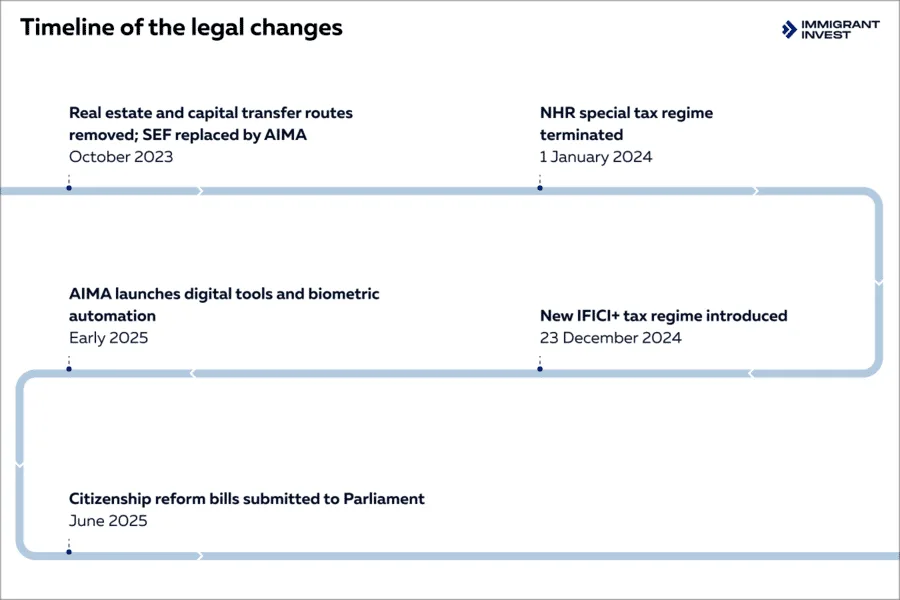
In October 2023, Portugal reformed its Golden Visa under the More Housing programme, or Mais Habitação. The biggest change was the removal of the real estate and capital transfer options, which were the two most widely used routes since the programme’s launch.
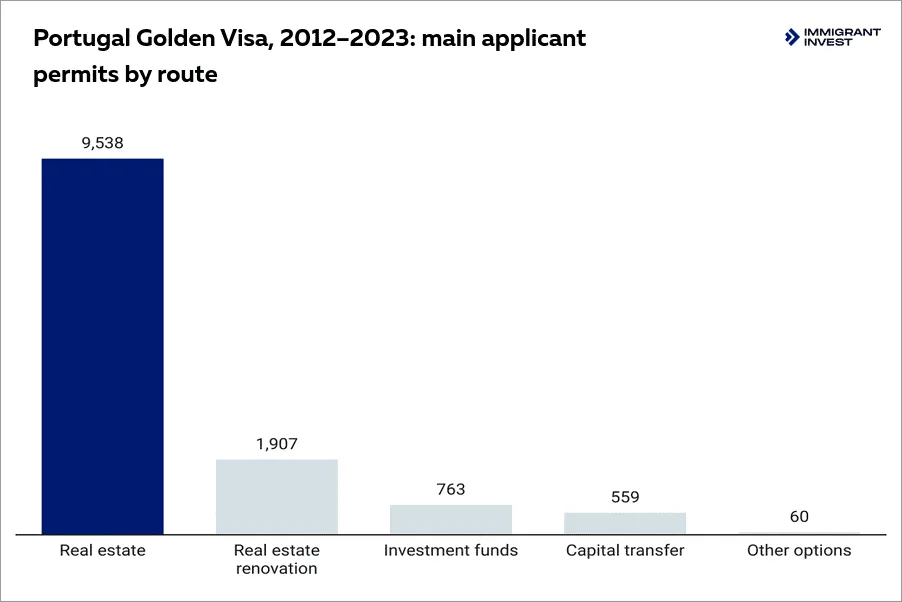
Purchasing real estate had long been the dominant pathway to residency, used by around 75% of applicants. Investors could previously qualify by purchasing property valued between €280,000 and 500,000, depending on location and rehabilitation status.
The capital transfer route allowed investors to obtain residency by depositing at least €1.5 million in a Portuguese bank.
Special tax regime — terminated and relaunched
End of the NHR regime. Until January 1st, 2024, Portugal’s Non‑habitual Resident, or NHR, tax regime was a major incentive for foreign professionals, investors, and retirees, offering a flat 20% income tax rate and 10% pension tax rate for 10 years. The regime has now been abolished, and new residents can no longer apply.
Introduction of the IFICI+ regime. On December 23rd, 2024, nearly a year after the cancellation of the NHR regime, the government introduced the Incentivo Fiscal à Investigação Científica e Inovação, IFICI+, a tax programme aimed at attracting talent in scientific research, technology, and innovation.
Qualifying professionals benefit from a 20% flat income tax rate and, in certain cases, a 0% rate on capital gains and dividends. These benefits are available for up to 10 years.
Eligible occupations for the IFICI+ regime include:
- executive and managing directors;
- specialists in physical sciences, mathematics, engineering and technology;
- industrial product and equipment designers;
- medical doctors;
- higher education lecturers;
- ICT professionals.
Golden Visa holders may also access IFICI+ if they meet the professional and sector criteria.
Citizenship application process — accelerated
Portugal offers one of the quickest routes to citizenship in the EU, with eligibility after just 5 years of legal residence. Until recently, this 5‑year clock started only once a residence permit was approved or issued.
A recent amendment to the Nationality Law has brought a significant improvement: the countdown now begins from the date the residence application is submitted, not from its approval.
This reform shortens the naturalisation process and eases a long‑standing frustration for applicants, many of whom faced delays of months or even years due to bureaucratic backlogs.
Reasons for the Golden Visa changes
Political motivations. Portugal’s housing market has seen rising prices and rental shortages, especially in major cities, due to limited supply, tourism pressure and demand from foreign buyers. To address these challenges, the government introduced Mais Habitação, a legislative package enacted under Law 56/2023 to boost housing supply, regulate short‑term lets and improve affordability.
As part of the same housing agenda, the prime minister said the Non‑habitual Resident regime no longer made sense, calling it a measure of fiscal injustice that contributed to an overheated market. Ending NHR was presented alongside the wider housing response.
Economic motivations. The revised Golden Visa programme now focuses on investments with long‑term economic and social value, such as funds that support business, research, or cultural heritage. The shift aims to channel capital into productive sectors rather than speculative assets.
Social motivations. The Golden Visa reform supports wider efforts to expand rental availability, protect tenants and curb speculation. The end of the property route was linked to housing affordability goals, improving property accessibility for residents.
What investment routes are still allowed under the Portugal Golden Visa?
Currently, five investment routes qualify for the Portugal Golden Visa: purchasing investment fund units, supporting cultural projects, contributing to scientific research, and two business‑focused options.
Purchasing fund units — €500,000+
Since the removal of real estate as an eligible route, regulated investment funds have become the most popular option.
Eligibility. Investors must commit at least €500,000 to a qualifying fund, which must invest at least 60% in Portuguese companies and avoid restricted residential real estate.
Fund structure and strategy. Most funds are closed‑end vehicles with fixed terms of 8—12 years, illiquid by design, but focused on exit‑driven returns. Open‑end funds exist but are less common. Strategies range from low‑risk infrastructure and agriculture to higher‑growth sectors like tech, hospitality, or digital assets.
Residency requirement and holding period. To maintain Golden Visa residency, investors must hold the fund units for at least 5 years, regardless of the fund’s actual term.
Expected returns by risk level. Returns vary widely:
- low‑risk funds target 2—5% annual returns;
- medium‑risk funds aim for 5—10%;
- high‑risk funds, including crypto or venture, may offer 10—20%, with higher volatility and longer exit timelines.

Trusted by 10,000+ investors
Check your eligibility for the Portugal Golden Visa
Supporting arts and culture — €250,000+
A €250,000 contribution to the arts or cultural heritage is one of the Portugal Golden Visa’s eligible investment options. This is the lowest threshold under the programme and is intended to channel private capital into public‑interest cultural initiatives.
Eligible recipients. The contribution must be directed toward projects carried out by:
- National or local government bodies.
- Government agencies and public institutions.
- Public foundations or private foundations serving the public interest.
- Cultural associations and local entities involved in artistic activities.
- Organisations responsible for the renovation, preservation, or reconstruction of national heritage.
Project types. Eligible projects may include the restoration of historic buildings, preservation of cultural sites, or funding for public art and performance. These initiatives are often delivered in partnership with local governments or state‑affiliated organisations.
Business investment — €500,000+
Two Golden Visa options focus on business activity:
- Investing €500,000 in a new or existing Portuguese company and creating at least 5 jobs.
- Starting a company that creates at least 10 jobs, with no minimum investment amount specified.
Scientific research — €500,000+
A capital transfer of €500,000 qualifies for this option. The funds must be directed to research activities carried out by public or private institutions that are part of Portugal’s national science and technology system. The recipient organisation must be officially recognised under this programme.
Do the changes affect earlier applicants?
In short, no, the changes in the Portugal Golden Visa do not affect earlier applicants. The government introduced measures to ensure applicants weren’t affected, allowing them to obtain and renew residency under the previous rules.
Transitional protection for earlier applicants
Golden Visa applications submitted before the October 2023 reform are protected. Law 56/2023 includes grandfathering provisions that allow these investors to proceed under the former rules, including those applying through now‑discontinued routes such as real estate or capital transfer.
Pending applications remain valid if they were:
- Formally submitted before the reform took effect.
- Still awaiting municipal pre‑approval on that date.
Renewals and family reunification
Residence permits granted under the previous regime can still be renewed. Family members linked to those permits also remain eligible for reunification or renewal. Supporting documents can still be gathered under the previous requirements.
On renewal, the permit is reclassified as a “residence permit for immigrant entrepreneurs,” but the physical presence requirements remain unchanged at 7 days per year.
Future of the Portugal Golden Visa programme
Portugal has introduced further changes that will shape the programme’s future. Some are positive, like efforts to speed up processing. Others are more restrictive, such as tightening naturalisation rules.
Administrative reforms — to reduce processing backlog
Mission to clear the backlog. Portugal’s Golden Visa is now facing processing delays, largely due to a backlog of applications carried over from the former immigration agency, SEF. To address this, the government launched a dedicated mission structure under AIMA, the new immigration agency, with a focus on clearing hundreds of thousands of pending residence cases.
As of August 1st, 2025, the renewal of residence permits became the exclusive responsibility of AIMA. Previously, this was handled by the Instituto dos Registos e do Notariado.
Outstanding volume remains high. As of May 2025, AIMA reported that approximately 440,000 expressions of interest had been analysed. However, around 130,000 cases were still awaiting resolution. An estimated 50,000 were related to Golden Visa applications, reflecting the scale of the challenge.
Digital reforms. To speed up processing, AIMA introduced digital tools in early 2025, including an automated biometric appointment system. The new setup aims to assign appointments within 30—90 days of online submission.
New applicants may see faster results, but older cases still face delays of up to 40 months. The reforms are intended to reduce these timelines and restore confidence in the programme.

Vladlena Baranova,
Head of Legal & AML Compliance Department, CAMS, IMCM
Although AIMA has updated its forms, many Portugal Golden Visa applications remain stuck in processing. In these cases, we can file a legal action requiring the court to compel AIMA to act.
Judges have already set precedents by ordering the agency to issue pre‑approvals and schedule biometrics within fixed deadlines. This remedy does not bypass Due Diligence or guarantee approval. It simply enforces the applicant’s right to a timely decision. Not every case qualifies. A lawyer must first assess whether court action is appropriate.
Citizenship law — reforms proposed
Tightening naturalisation rules. Portugal currently offers one of the most flexible naturalisation paths in the EU. Foreign nationals can apply for citizenship after just 5 years of legal residence. However, this framework may soon change.
Two legislative proposals — one from the centre‑right Democratic Alliance, AD, coalition and another from the nationalist Chega party — aim to tighten the requirements for citizenship and place greater emphasis on physical presence and social integration.
Stricter presence for Golden Visa holders. The AD coalition proposes raising physical presence requirements. Golden Visa holders currently need to spend just 7 days per year in Portugal; the reform would require more consistent time in the country to support stronger integration.
Chega’s broad citizenship bill. Chega’s proposal goes further:
- Children born in Portugal would only gain citizenship if a parent had legally resided for at least 10 years, which is up from just 1 year.
- The naturalisation period would rise to 10 years, or 7 for CPLP nationals — citizens of Portuguese‑speaking countries such as Brazil, Angola, and Mozambique.
- A new test would combine the existing A2‑level Portuguese exam with questions on history, culture, and national values.
If passed, these reforms would raise the bar for citizenship and emphasise long‑term presence and social ties.
Why is Portugal still worth considering without the real estate investment option?
Although the real estate option was abolished, Golden Visa holders still enjoy full residency rights, the ability to relocate with their families to one of Europe’s most attractive countries to live in and, notably, the potential for solid financial gains.
1. Investment returns of up to 20% per year
Target yields for qualifying Portuguese funds range from 2 to 20% annually, depending on risk profile, sector exposure, and leverage. These funds may focus on infrastructure, tech, energy, or hospitality.
Diversifying across multiple funds and vintages helps smooth out market fluctuations and improves long‑term return potential — an appealing prospect for investors seeking EU access and portfolio growth.
2. Family inclusion
The Portugal Golden Visa extends to close family members. Investors may include their spouse, children under 26, and dependent parents.
Families gain access to Portugal’s high‑quality healthcare system. Golden Visa applicants must carry private health insurance, giving them access to both the private and public sectors. Children of the investor can attend free public schools and get enrolled in higher education institutions, though tuition fees apply.
3. Schengen mobility with minimal stay requirement
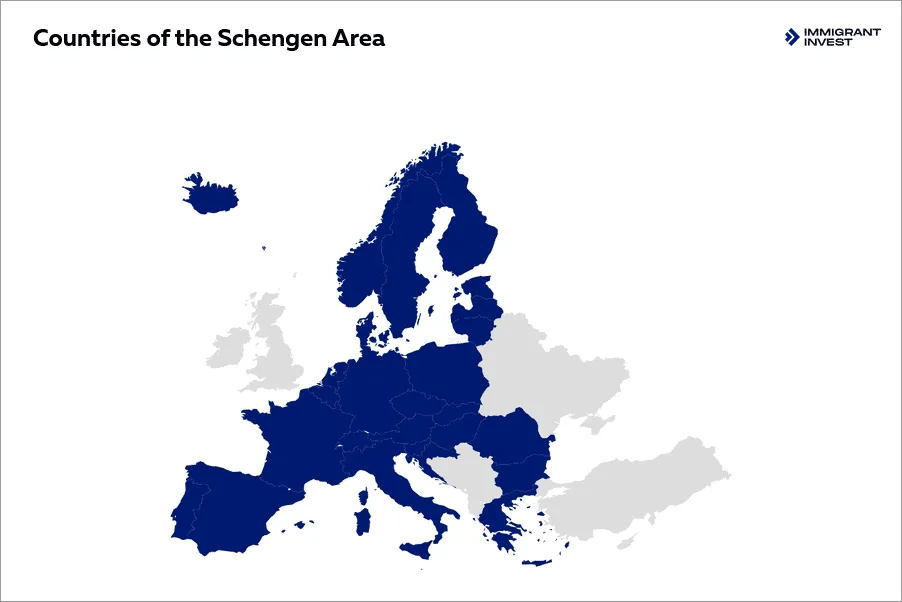
Golden Visa holders enjoy visa‑free access to the Schengen Area up to 90 days within any 180‑day period. Travel is seamless by car, train, or short‑haul flights, with many direct routes connecting Portugal to key EU cities. Ferries to Spain are also available from the Algarve.
Meanwhile, maintaining Portuguese residency requires just 7 days per year in the country, leaving travel plans and lifestyle choices remarkably flexible.
4. High quality of life
Portugal ranks 7th globally for quality of life in Expat Insider 2024. Expats value its safety, clean air, mild climate, and access to nature. The relaxed, inclusive culture and year‑round outdoor lifestyle also make it attractive for families.
At the same time, living costs stay moderate. A family of four needs around €2,500 per month, excluding rent, offering excellent value for a Western European lifestyle.
5. Business opportunities and expanded EU market access
Portuguese residency makes it easier to start or expand a business across the EU. It facilitates access to EU bank accounts, investor capital, contract signing, and Schengen‑wide travel for business, without extra visas or permits.
Portugal presents strong opportunities in data infrastructure, offshore wind and marine services, and tech and digitalisation.
Tourism is shifting toward premium and wellness segments, while green economy startups benefit from incentives for circular production, clean energy, and sustainable packaging. Growth is also supported in agritech, education, and logistics, especially refrigerated transport and last‑mile delivery solutions for exporters.

Portugal ranks 12th globally and 7th in Europe on the Travel & Tourism Development Index 2024, thanks to its rich natural and cultural assets and strong visitor infrastructure
Portugal ranks 12th globally and 7th in Europe on the Travel & Tourism Development Index 2024, thanks to its rich natural and cultural assets and strong visitor infrastructure
Which other European countries offer the Golden Visa in 2025?
Several EU countries continue to offer Golden Visa, each with its investment thresholds, family rules, and residence conditions. Portugal, Greece, Hungary, Italy, Latvia, Cyprus, and Malta remain active in 2025. Among them, Portugal and Greece are the most established and well‑known.
Beyond standard Golden Visas, Cyprus and Malta offer something different: permanent residence from day one. These programmes allow investors to secure lifelong EU residence status through real estate options, without the need for periodic renewals. For many families seeking stability and an immediate long‑term base in Europe, this alternative holds strong appeal.
EU residency by investment: country‑by‑country comparison
Country | Minimum investment | Real estate option | Family inclusion | Processing time | Minimum stay requirement |
|---|---|---|---|---|---|
€250,000 | No | Spouse, children under 26, parents | 12+ months | 7 days per year | |
| €250,000 | Yes | Spouse, children under 21, parents | 4+ months | None |
| €250,000 | No | Spouse, children under 25, parents | 5+ months | None |
| €250,000 | No | Spouse, children, parents | 4+ months | None |
| €50,000 | Yes | Spouse, children under 18 | 3+ months | Visit once a year |
| €300,000 | Yes | Spouse, children under 25 | 9+ months | Visit once every 2 years |
| €169,000 | Yes | Spouse, children under 29, parents, grandparents | 6+ months | None |

 Greece
 Hungary
 Italy
Italy Latvia
 Cyprus
 Malta
MaltaKey takeaways on Portugal Golden Visa changes
- Portugal Golden Visa was not suspended. In 2023, the government abolished two key investment routes: real estate and capital transfer.
- Despite this shift, 2024 marked a record 4,987 Golden Visas granted, a 72% year‑on‑year increase.
- Fund investment is now gaining popularity, with a €500,000 minimum threshold and yields reaching up to 20%.
- The real estate option remains available in Greece, Latvia, Cyprus, and Malta.
- SEF was replaced by AIMA, which is introducing digital tools to accelerate application processing.
- The NHR tax regime was terminated, but the government introduced a new one targeting talent in scientific research, technology, and innovation.
- In June 2025, citizenship reform bills were submitted to Parliament, aiming to tighten naturalisation rules.

 Trusted by 10,000+ investors