









Portugal offers several residency routes for non-EU nationals, including the Golden Visa for investors and the Global Talent Visa for highly qualified professionals. The Golden Visa starts from €250,000, while participation in the Global Talent route costs €170,000.
In this article, we explain which option is better suited for different types of applicants.
Overview: Portugal Golden Visa vs Global Talent Visa
The key distinction between these two routes lies in what the applicant brings: capital investment in one case and professional or academic value in the other. Although both lead to renewable residence permits and may provide access to citizenship their logic and requirements differ substantially.
Legal base
Both routes are regulated by Law 23/2007, Portugal’s immigration framework, and administered by AIMA. The Golden Visa is established under Article 90-A as the Autorização de Residência para Investimento, while the Global Talent Visa falls under Article 90 as a residence authorisation for highly qualified activity[1]Source: investment residence permit, AIMA.
Financial requirements
Portugal Golden Visa grants renewable two-year residence permits to applicants who make a capital commitment. The main options include:
- €250,000 for cultural production or heritage restoration, structured as a non-refundable contribution;
- €500,000 in venture capital funds, scientific research, or business investment with job creation.
The programme does not require employment in Portugal, and the minimum physical presence requirement is just 7 days a year. It is typically chosen by investors seeking portfolio diversification, mobility within the Schengen Area, and a long-term EU residence option without relocation.
Portugal Global Talent Visa is a residence permit for highly qualified professionals engaged in academic, scientific or innovation-driven activities. It is granted for an initial period of two years. This visa requires active employment or academic engagement in Portugal. It is generally processed more quickly, but it depends on maintaining professional activity.
The required level of physical presence is linked to the format of this engagement and the terms agreed with the host institution.
Applicants must hold at least a bachelor’s degree or demonstrate significant specialist experience. In addition, they must secure a Letter of Commitment from a Portuguese university or research institution for teaching or research activity.
The total participation cost is €170,000 for the main applicant and up to three dependants included in one application. It covers compliance checks, document preparation, coordination with the eligible employer or university, and standard government charges, including the AIMA residence permit fee, biometric fees, and even the residence renewal fee.

Trusted by 10,000+ investors
Check your eligibility for the Portugal Global Talent Programme
Processing time difference
In the case of the Golden Visa, applicants must first invest and then submit their application through AIMA. Due to a significant backlog in recent years, many applicants wait approximately 2—3 years for a biometrics appointment after initial submission.
Following biometrics, the residence card is typically issued within 6—12 months. As a result, the full timeline from application to first residence permit may extend to three years or more.
The Global Talent Visa is processed much faster. After verification of qualifications and confirmation of the employment or academic basis, biometrics are usually scheduled within 3 weeks, and the residence permit is commonly issued within 1—3 months thereafter.
In practice, the entire process often takes around 4 months. This difference in speed reflects administrative prioritisation of highly qualified activity rather than a simpler legal framework. For applicants who place a high value on timing and predictability, this distinction is often decisive.
What both programmes have in common
Both residence permits:
- allow travel within the Schengen Area in accordance with Schengen rules;
- permit family inclusion, including a spouse and dependent children;
- may lead to permanent residence or Portuguese citizenship after five years of legal residence under current nationality law and passing a Portuguese language test at A2 level[2]Source: highly qualified residence Tech Visa, AIMA.
At the same time, proposed amendments to the nationality law, including a possible extension of the required residence period, remain under parliamentary review[3]Source: Portuguese nationality law, Diário da República. Applicants should therefore assess timing and eligibility carefully before choosing a route.
Portugal Golden Visa vs Global Talent Visa: overview comparison
Eligibility and requirements: who qualifies for each programme?
Although both routes lead to residence in Portugal, their eligibility criteria are based on different principles: capital for the Golden Visa and professional qualifications for the Global Talent Visa.
Portugal Golden Visa main applicants
Eligibility for the Portugal Golden Visa is primarily investment-based. Applicants must:
- be non-EU citizens aged 18 or over;
- have no criminal convictions in Portugal or in the country of origin or residence;
- make an investment under the programme rules;
- demonstrate the lawful origin of the invested funds.
Proof of source of funds is a central element of the process. Applicants are required to provide bank statements, tax returns and supporting declarations confirming that the capital was obtained legally and, where applicable, properly taxed.

Vladlena Baranova,
Head of Legal & AML Compliance Department, CAMS, IMCM
An employment contract, academic qualifications or knowledge of Portuguese are not required at the application stage. However, AIMA conducts detailed Due Diligence and verifies the legality and traceability of the funds before granting approval.
Global Talent Visa main applicants
Eligibility for the Global Talent Visa is based on qualifications and professional background rather than capital. Applicants must:
- hold a bachelor’s, master’s or doctoral degree or demonstrate at least five years of relevant specialist experience in a high-value field;
- secure a Letter of Commitment from a Portuguese university or research institution confirming a teaching or research role.
Academic documents must be duly legalised and, where necessary, recognised in Portugal.
At the time of application, Global Talent applicants are also required to provide proof of accommodation in Portugal and valid health insurance coverage.
Family members eligibility for both routes
Under both programmes, applicants may include close family members. This typically covers:
- spouse or registered partner;
- dependent children under 18;
- children over 18 who remain financially dependent and are enrolled in full-time education.
For Golden Visa applicants, family members may be included in the initial application. Under the Global Talent Visa, family members apply for residence by family reunification after the main applicant has obtained their permit.
Key procedural difference
Golden Visa applicants must first open a Portuguese bank account and complete the investment before obtaining pre-approval. This means capital is committed at an early stage and subject to source-of-funds scrutiny during the review.
Global Talent applicants, by contrast, undergo verification of their qualifications and employment contract before committing significant programme fees. The applicant is guided by a legal advisor or programme provider, who helps find a host institution, manages communication, and prepares the required documents.
As a result, financial exposure at the initial stage is generally lower, although approval always depends on meeting all statutory requirements.
Investment and cost comparison: total capital required
The Portugal Golden Visa and the Global Talent Visa are built on different financial models. The Golden Visa requires a qualifying capital investment, while the Global Talent route is based on participation fees and professional eligibility rather than asset acquisition.
Investment and cost comparison: how the financial models differ
Although both routes lead to residence in Portugal, their financial logic is very different. The Golden Visa is built around a qualifying investment that must be made before the application can move forward, while the Global Talent Visa is based on participation fees linked to professional eligibility rather than asset acquisition.
Investment structure
The Portugal Golden Visa requires applicants to make an investment. The entry threshold starts at €250,000 for a contribution to artistic production or the restoration of national heritage. This route is structured as a non-refundable contribution and should be treated as a direct cost rather than a recoverable investment.
A higher threshold of €500,000 applies to several other eligible routes, including investment in regulated collective investment funds, funding for scientific research, and business investment combined with job creation. In these cases, the applicant commits capital to an eligible structure, but financial return and liquidity depend on the specific investment selected.
The Global Talent Visa does not require investment in funds, property, or business. Instead, the applicant pays for participation in the programme, with the financial model tied to qualification, document support, and residence processing rather than to capital placement in an asset.
For Global Talent applicants, the total participation cost is €170,000 for the main applicant and up to three dependants included in one application. This makes the route cheaper than the €500,000 Golden Visa option in headline terms, but it remains a substantial cost and should not be presented as a low-budget pathway.
Payment mechanics
The Golden Visa requires capital to be committed at an early stage. Applicants must open a Portuguese bank account, transfer funds, and complete the qualifying investment before pre-approval. This means the financial exposure begins before the residence application has materially progressed.
Investment options include:
- €250,000 — contribution to artistic production or the restoration of national heritage;
- €500,000 — investment in regulated collective investment funds established under Portuguese law;
- €500,000 — funding for scientific research carried out by recognised public or private institutions;
- €500,000 — incorporation of, or capital increase in, a Portuguese company combined with the creation or maintenance of at least five jobs.
When selecting the fund route, applicants should consider that capital is typically committed for a minimum of five years. Liquidity depends on the specific fund’s redemption policy. Returns are not guaranteed and depend entirely on investment performance.
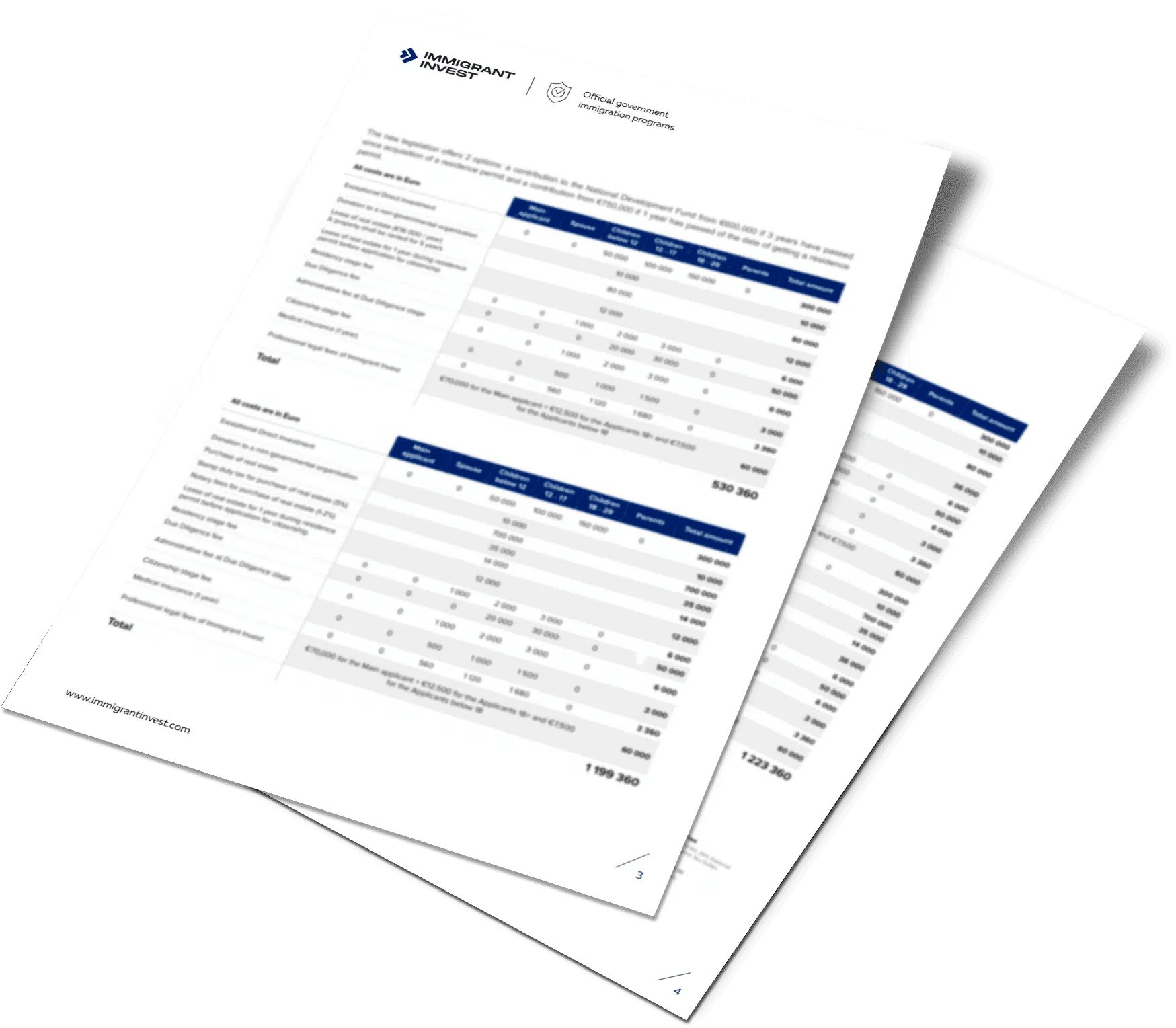
The Global Talent Visa spreads the cost across stages. The total participation cost is €170,000, covering the main applicant and up to three dependents included in a single application. The payment schedule is structured in three stages:
- €20,000 — initial non-refundable payment. It covers compliance checks, document preparation and coordination with the eligible employer or university.
- €75,000 — becomes due after AIMA issues an official appointment for the residence permit procedure. If the application is refused before this stage or no appointment is granted, this amount is refundable in accordance with the contractual terms.
- €75,000 — due after the residence permit has been issued. If renewal is refused at the two-year stage for programme-related reasons, this amount may be refundable under the agreement with the service provider.
Under this structure, only the initial €20,000 is strictly non-refundable. Subsequent payments are conditional and governed by the refund policy in the engagement contract.
Government and related costs
In addition to an investment, Golden Visa applicants incur statutory and operational costs. These include:
- application fee — €632 per family member;
- residence permit card issuance — €6,314 per family member;
- private health insurance — from approximately €400 per person per year, depending on coverage and age;
- bank account maintenance fees and transfer commissions, depending on the financial institution;
- taxes and transaction-related charges linked to the chosen investment structure.
Applicants should also budget for legal assistance, document legalisation and translation, and travel to Portugal for biometrics appointments.
The Global Talent Visa participation fee includes standard statutory charges, such as AIMA residence permit fee — €383 per person.
If more than four family members are included, each additional dependent from the fifth applicant onwards increases the participation cost by €5,000.
Financial risk and liquidity
The main financial risk under the Golden Visa is tied to capital commitment and liquidity. The €250,000 contribution is entirely non-recoverable. The €500,000 route may preserve capital in principle, but funds are typically committed for at least five years, liquidity depends on the investment vehicle, and returns are not guaranteed.
The Global Talent Visa carries a different kind of risk. It does not involve capital lock-in or exposure to investment performance, but the payments are still significant and largely service-based. In practice, the risk is less about market performance and more about whether the applicant is comfortable with a staged but substantial participation fee linked to residence processing and ongoing programme compliance.
How to apply for a Golden Visa in Portugal
Getting a Portugal RP by investment is complicated and takes at least 12 months. Investors are recommended to seek legal support. There are legal companies that directly specialise in helping obtain a Portugal Golden Visa, and Immigrant Invest is one of them.
The procedure for obtaining a residence permit varies depending on the chosen option. However, some steps are mandatory for all applicants. The lawyers can perform most actions through a power of attorney on the investor’s behalf.
1 day
Preliminary Due Diligence
It helps to reduce the risks of failure to 1%. Immigrant Invest’s certified Anti-Money Laundering officers conduct the check. Immigrant Invest only signs an agreement with the investor once the check is passed and both lawyers and the investor are aware of the chances and risks.
It helps to reduce the risks of failure to 1%. Immigrant Invest’s certified Anti-Money Laundering officers conduct the check. Immigrant Invest only signs an agreement with the investor once the check is passed and both lawyers and the investor are aware of the chances and risks.
2+ weeks
Preparation of documents
Immigrant Invest lawyers prepare a personalised list of required documents for the Portugal residence permit application. They also complete government forms and assist with translation and notarisation.
Immigrant Invest lawyers prepare a personalised list of required documents for the Portugal residence permit application. They also complete government forms and assist with translation and notarisation.
1—2 weeks
Obtainment of a tax number
Applicants receive their unique Portuguese tax number, the Número de Identificação Fiscal, NIF, which is essential for opening a bank account, signing contracts, or making investments in Portugal.
Applicants receive their unique Portuguese tax number, the Número de Identificação Fiscal, NIF, which is essential for opening a bank account, signing contracts, or making investments in Portugal.
1—1.5 months
Opening of an account in a Portuguese bank
All investments for the Golden Visa must be made through a Portuguese bank account. We assist with opening and activating the account. Once it’s ready, the applicant transfers the necessary investment funds.
All investments for the Golden Visa must be made through a Portuguese bank account. We assist with opening and activating the account. Once it’s ready, the applicant transfers the necessary investment funds.
1 week to 1.5 months
Investment
Depending on the chosen route, the applicant may invest in fund units, set up a company with job creation, or support cultural or scientific projects. Lawyers collect supporting documents to confirm the investment.
Depending on the chosen route, the applicant may invest in fund units, set up a company with job creation, or support cultural or scientific projects. Lawyers collect supporting documents to confirm the investment.
5—6 months
Application
Electronic copies of the full application are submitted to the Agency for Integration, Migration and Asylum, AIMA, for review.
Electronic copies of the full application are submitted to the Agency for Integration, Migration and Asylum, AIMA, for review.
1—2 weeks
Submission of biometrics
The investor and their family travel to Portugal to submit original documents and provide fingerprints. Appointments must be scheduled in advance through the online system.
The investor and their family travel to Portugal to submit original documents and provide fingerprints. Appointments must be scheduled in advance through the online system.
6—8 months
Approval and acquisition of the residence permit cards
AIMA processes the application within six months of the biometric appointment. Once approved, the investor pays the government fee, and residence cards are issued—either collected in person or by a lawyer with power of attorney.
AIMA processes the application within six months of the biometric appointment. Once approved, the investor pays the government fee, and residence cards are issued—either collected in person or by a lawyer with power of attorney.
Every 2 years
Renewal of the residence permit
To maintain residency, the investor and their family must spend at least 7 days per year in Portugal. The permit is renewed every 2 years, following a process similar to the initial application, including document submission, biometrics, and collection of new cards.
To maintain residency, the investor and their family must spend at least 7 days per year in Portugal. The permit is renewed every 2 years, following a process similar to the initial application, including document submission, biometrics, and collection of new cards.
How to apply for a Portugal Global Talent Visa
The Global Talent route is faster than the Golden Visa and takes around 4 months. Immigrant Invest lawyers manage document collection, university coordination, and submission to AIMA, while the applicant travels to Portugal for the key in-person steps.
Preliminary Due Diligence — 1 day. Immigrant Invest conducts a preliminary check to identify any issues that could affect eligibility. Once the check is passed, the legal team starts preparing the case.
Collection of documents — around 1 month. Lawyers prepare a tailored document list and assist with translations, certification, and legalisation. At this stage, the applicant also arranges the key supporting documents required for the application.
University matching and Letter of Commitment — 2 to 3 weeks. Immigrant Invest presents the applicant’s profile to a suitable Portuguese university or research institution. Once the format of cooperation is agreed, the host institution issues a Letter of Commitment.
Submission of the residence application — around 3 months. After the Letter of Commitment is issued, lawyers submit the application to AIMA under a power of attorney. During the first trip to Portugal, the applicant may also sign the hosting agreement and complete any remaining formalities.
Biometrics and residence card issuance — around 1 to 1.5 months after the appointment. The applicant returns to Portugal for the biometric appointment and submits the original documents in person. After that, AIMA finalises the case and issues the residence card.
Family reunification — around 2 to 3 months after the main applicant’s approval. Once the main applicant has received the residence card, eligible family members may apply under the family reunification procedure.
Tax implications and incentives: fiscal planning for both programmes
Tax treatment under both the Portugal Golden Visa and the Global Talent Visa depends not on the residence permit itself, but on whether the individual becomes a Portuguese tax resident.
Tax residency rules
An individual is considered a Portuguese tax resident if they spend more than 183 days in Portugal within a 12-month period beginning or ending in the relevant tax year, whether consecutive or non-consecutive. Tax residency may also arise if a person maintains a habitual abode in Portugal, for example, by establishing a principal residence or moving their family to the country.
The type of residence permit does not automatically determine tax status. A Golden Visa holder who spends limited time in Portugal remains a non-tax resident. A Global Talent holder who relocates and works full-time in Portugal will usually become a tax resident[4]Source: legislative initiative details, Assembleia da República.
From NHR to IFICI
The former Non-Habitual Resident regime, which offered preferential taxation for up to 10 years, was closed to new applicants from January 1st, 2024[5]Source: foreign income tax obligations, Portal das Finanças.
It has been replaced by the Incentivo Fiscal à Investigação Científica e Inovação, known as IFICI[6]Source: non-habitual resident registration, Portal das Finanças. This regime applies to new tax residents from 2024 onwards who have not been tax residents in Portugal during the previous five years and who carry out high-value activities, such as scientific research, senior management, technology or innovation roles with recognised entities.
Under IFICI, eligible individuals may benefit from:
- 20% flat rate on Portuguese-source employment and self-employment income;
- exemption on most foreign-source income;
- 10-year duration from the year of registration.
Global Talent Visa holders who work for qualifying employers or institutions may be eligible for IFICI, provided they meet the statutory criteria. For them, the tax regime can represent a significant element of the overall planning strategy.
Golden Visa holders, by contrast, will only access IFICI if they become tax residents and personally engage in qualifying professional activity. Passive investors who maintain non-resident status are not taxed in Portugal on their worldwide income. However, income sourced in Portugal, including certain fund returns or capital gains, may be subject to Portuguese taxation. Worldwide income remains taxable in the individual’s home jurisdiction.
CRS, FATCA and international reporting
Both programmes operate within international tax transparency frameworks. Portuguese financial institutions are required to identify the tax residence of account holders and report relevant information under the Common Reporting Standard. This information is exchanged with the individual’s country of tax residence.
US citizens are additionally subject to FATCA obligations[7]Source: IFICI tax regime FAQ, Portal das Finanças. Portuguese banks report US-related accounts in accordance with the bilateral agreement between Portugal and the United States. US citizens must continue to report worldwide income and foreign financial accounts under US law, regardless of whether they reside in Portugal.
Obtaining Portuguese residence through either programme does not in itself affect US tax status. US Exit Tax rules apply only in cases of formal expatriation from US citizenship or long-term permanent residence, not upon acquiring residence in another country.
Vladlena Baranova,
Head of Legal & AML Compliance Department, CAMS, IMCM
Tax outcomes depend on individual circumstances, including days spent in Portugal, family relocation, business structure and existing tax residence. Before committing capital under the Golden Visa or accepting employment under the Global Talent route, it is advisable to obtain cross-border tax advice.
A coordinated approach helps clarify whether Portuguese tax residency will arise, whether IFICI may apply, and how foreign tax credits or reporting obligations should be managed in the home jurisdiction.
Pathway to citizenship and permanent residence
While programmes such as the Golden Visa and Global Talent Visa offer a simplified route to residence, the transition to permanent residence and citizenship follows the standard naturalisation framework.
Investors are subject to the same requirements as other applicants, including the minimum period of legal residence and additional eligibility criteria. This requires genuine residence in Portugal, rather than simply complying with the limited stay requirements of the initial permit.
Permanent residency
After 5 years of legal residence, applicants may apply for permanent residence. Permanent residence grants an indefinite right to live in Portugal and travel within the Schengen Area. It does not confer an EU passport, but it provides long-term stability without requiring naturalisation.
A resident does not need to extend the status, but renewing the residence card every 5 years is mandatory.
Citizenship
Both the Portugal Golden Visa and the Global Talent Visa may lead to Portuguese citizenship after 5 years of legal residence for most non-EU nationals. Applicants must pass a Portuguese language test at A2 level and demonstrate effective links to the country.
For both Golden Visa holders and Global Talent applicants, the period is counted from the date the first residence permit is issued.
Citizenship grants an individual extensive rights:
- to vote and run for office;
- to live, work, and study in any EU country;
- to travel to more than 180 countries visa-free.
Citizenship by naturalisation reform
In June 2025, the government introduced a legislative proposal to extend the required period of legal residence for naturalisation from 5 years to 10 years[8]Source: CRS reporting FAQ, Portal das Finanças.
The proposal was approved by Parliament but subsequently vetoed by the President in December 2025. In April 2026, Parliament approved amendments to the nationality law extending the residence period required for citizenship to 10 years for most non-EU nationals and to 7 years for EU and CPLP nationals.
At the time of writing, the law is under presidential review. Until the law is promulgated and published, the five-year rule remains in force.

A Portuguese passport holders may travel visa-free or with visa on arrival to more than 170 countries, including the United Kingdom, Japan, Canada and most of Latin America
Comparing the advantages of Global Talent and Golden Visas
Both routes can lead to residence in Portugal, but they offer different benefits depending on the applicant’s priorities.
Golden Visa: passive residence model
The Portugal Golden Visa offers a passive residence structure. It does not require employment in Portugal and involves only a minimal physical presence requirement, which makes it well-suited to applicants who want to keep their main home, business interests, and tax residence outside Portugal.
Global Talent Visa: faster processing
The Global Talent Visa is generally processed much faster than the Golden Visa, which makes it more attractive to applicants who want a quicker and more predictable route to residence. Applicants for a GTP typically wait approximately 4 months, while investors’ waiting time reaches up to 3 years.
Global Talent Visa: lower capital commitment
Unlike the Golden Visa, the Global Talent route does not require investment in funds, business, or cultural projects. Instead, it is based on a participation fee, which reduces capital lock-in and eliminates investment risk.
Both visas: greater lifestyle flexibility
Both the Global Talent Visa and Golden Visa allow applicants to maintain residence status without relocating full-time. Talents must stay in the country according to their agreement with the university, while investors only need to visit Portugal for 7 days a year.
Portuguese residents also enjoy access to Portugal and the Schengen Area, as they may visit any of 29 countries and stay there up to 90 days every 180 days.
Global Talent Visa: tax optimisation
Applicants under the Global Talent route who become Portuguese tax residents may qualify for the IFICI tax regime. This means they pay 20% flat rate on Portuguese-source employment and self-employment income, are exempt on most foreign-source income. The regime is applicable 10-year duration from the year of registration.
Global Talent Visa and Golden Visa: family inclusion
Both routes allow family inclusion. The Golden Visa enables the main applicant to add a spouse, parents of any age, and dependent children up to 26 years old, provided they are unmarried, live with the investor or study at a university, and are financially dependent on the investor.
Global Talent Visa applicants may add a spouse and children on the same terms, but not their parents.
Golden Visa: no qualification requirements
To apply for a Golden Visa, one does not need to prove their degree or work experience. On the contrary, the Global Talent Visa is not open to all applicants. It is designed for qualified professionals and depends on meeting the required academic or professional criteria. The route is linked to cooperation with a Portuguese university or research institution.
Global Talent Visa: higher affordability
Global Talent Visa applicants pay a fee of €170,000 for participation in the programme. They do not need to pay thee in a lump sum. Instead, they place a €20,000 initial deposit upon application, then pay a €75,000 milestone fee in year two, and a €75,000 milestone fee in year three.
The Portugal Golden Visa requires a substantially higher financial commitment. Applicants must invest at least €250,000 under the cultural contribution route or €500,000 under other eligible options.
Pros and cons of the Portugal Golden Visa and Global Talent Visa
Why trust Immigrant Invest
Preliminary Due Diligence. Immigrant Invest conducts initial screening before signing a contract or accepting payment. Checks include sanctions lists, politically exposed person status, and court or compliance databases. Early screening helps identify risks and prevents applicants from entering programmes they are not eligible for.
Licensed agent with in-house compliance. The company holds official authorisations in relevant jurisdictions and operates as a licensed agent. It has an internal compliance team with certified specialists. This structure ensures regulatory responsibility and reduces reliance on intermediaries.
Clear cost breakdown and full support. Applicants receive a transparent, itemised breakdown of all costs at the start. It includes government fees, legal services, and other related expenses. Immigrant Invest supports the entire process, including document preparation, tax number registration, bank coordination, biometrics scheduling, and tracking submissions to minimise delays and errors.
Ongoing assistance in Portugal. In Portugal, where procedures involve many parties and longer timelines, structured coordination is essential. Immigrant Invest assists not only with the initial application but also with renewals and long-term status maintenance. This is important for programmes that lead to permanent residence or citizenship.
Policy outlook and risks: what to monitor
For applicants considering either the Golden Visa or the Global Talent Visa, the key issues include possible changes to nationality law, the future direction of the Golden Visa programme, AIMA’s processing capacity, and the timing-related risk that policy changes may affect applications already in progress.
Nationality law uncertainty
The central variable for both programmes is the proposed amendment to the nationality law. A bill introduced in 2025 would extend the required period of legal residence for naturalisation from five to 10 years for most non-EU nationals and to 7 years for EU and CPLP nationals.
Until a final version is promulgated by the President, the five-year rule remains valid, but the absence of clear transitional provisions creates uncertainty for current and future applicants.
Administrative backlog and processing capacity
AIMA continues to address a substantial backlog of pending cases[9]Source: nationality law amendment initiative, Assembleia da República. Recovery plans and digitalisation measures are underway, but extended processing timelines remain a reality for Golden Visa applicants.
The Global Talent category is currently prioritised and therefore less exposed to prolonged delays.
Final considerations: choosing the right route
- Both the Portugal Golden Visa and the Global Talent Visa provide residence in Portugal, access to the Schengen Area and eligibility for citizenship after five years of legal residence.
- The Portugal Golden Visa is more appropriate for applicants who prioritise a passive residence structure, minimal physical presence, and long-term flexibility without relocation.
- The Global Talent Visa is better suited to applicants who prioritise faster processing and a lower financial threshold, and who meet the qualification requirements for highly skilled professionals.
- Possible changes to the nationality law may affect the future timeline to citizenship, and transitional protections have not yet been clearly defined.
- Accordingly, applicants should assess not only eligibility criteria and cost, but also the regulatory trajectory and pros or cons associated with each route.

 Trusted by 10,000+ investors