









Portugal has become one of the main destinations for families seeking to secure residency in a stable, well-developed EU country. Over 1.5 million foreign citizens live in Portugal, and at least 9% of them moved with children.[1]Migration and Asylum Report 2024, AIMA
One of the ways to move to Portugal is the Golden Visa, which is a residence-by-investment programme designed for non-EU investors and their families. Applicants get residence permits, access to Portuguese healthcare and education, and travel freely across the Schengen Area.
This guide explains how the Golden Visa works for families in 2026, including investment options, costs, application steps, and key aspects of relocating with children and other dependants.
What is the Portugal Golden Visa: overview for families
Portugal's Golden Visa is a residence-by-investment programme for non-EU nationals that also extends to their families. A single application can cover close relatives, enabling a spouse, dependent children, and parents to obtain residence permits together with the investor.
The programme offers several investment routes, each with its own minimum threshold. The most accessible option is a €250,000 contribution to approved cultural or artistic projects, while the most widely chosen route involves acquiring investment fund units of at least €500,000.
Golden Visa holders have the right to live in Portugal and travel freely within the Schengen Area. The permit also provides a route to permanent residence and, ultimately, Portuguese citizenship[2]Residence Permit for Investment – Article 90-A, AIMA.
The residence by investment programme was introduced by the Portuguese government in 2012 and has been working continuously since then. In 2023, the Golden Visa underwent some structural changes, and the real estate investment route became unavailable[3]Law No. 56/2023, Official Gazette of Portugal.
Why families choose Portugal's Golden Visa in 2026
Portugal’s Golden Visa combines a low stay requirement with access to a high standard of living, public services, and a path to long-term status in the EU.
Right to move to Portugal or visit at any time
Golden Visa holders and their family members are granted residence status that allows them to live in Portugal without restrictions. It also gives the right to work, run a business, and study in the country.
Investors and their families can relocate immediately after receiving their residence permits or simply visit whenever needed.
Minimal physical residence obligations
The programme features a low stay requirement, making it relatively easy to maintain residency. Investors need to spend only around 7 days per year in Portugal to keep their status.
Fulfilling this requirement is sufficient to renew residence status and to qualify for permanent residence after 5 years.
High quality of life and family-friendly environment
The country ranks strongly in the OECD Better Life Index, particularly in areas such as safety and housing standards. Portugal offers residents a safe everyday environment with low homicide rates and a high share of people reporting that they feel safe walking alone at night.
Portugal performs well in the Human Development Index, which measures and compares three indicators[4]Human Development Index, UNDP. In Portugal, life expectancy at birth is 82.4 years, the expected duration of schooling is 17.5 years, and gross national income per capita is $41,064. This reflects that the country offers stable conditions for a long and healthy life, broad access to education, and a generally good quality of life.
Portugal’s strong housing standards show that most homes have essential facilities, including indoor sanitation, adequate living space per person, and access to basic utilities[5]Better Life Index, OECD Well-being Data Monitor.
A mild climate, well-developed infrastructure, and a relaxed pace of life further contribute to its appeal for families raising children.
Access to local healthcare and education
Golden Visa holders gain access to Portugal’s public healthcare system, which provides broad coverage at low cost. The system is recognised internationally for its efficiency and accessibility. The Numbeo Health Care Index ranks Portugal’s system higher than that in Canada, Iceland, or Switzerland [6]Health Care Index, Numbeo.
Families may choose private healthcare, which is widely available and relatively affordable compared to many Western European countries. For example, an urgent private GP consultation in Portugal can cost around €45—65. To compare, a similar service in Spain costs around €140 and €245 in the Netherlands.
In education, children can attend public schools free of charge or enrol in international schools offering English-language curricula. Depending on their age and education, residents of Portugal may be eligible to study at local universities at the same tuition fee as citizens.
Prospect of EU permanent residence and citizenship
After 5 years of holding a Golden Visa and meeting the stay requirement, investors and their family members can apply for permanent residence. They must also demonstrate Portuguese language proficiency at A2 level and have a clean criminal record.
Citizenship may also be pursued after the same 5-year period. Portugal is currently reviewing its Citizenship Law and may extend the naturalisation timeframe to ten years. As of April 2026, however, it remains possible to apply for a Portuguese passport after completing 5 years of residence, subject to passing the language tests.
Portuguese citizenship grants full EU rights, including the freedom to live, work, and study in any member state, as well as visa-free or visa-on-arrival access to over 180 countries. It can also be passed on to future children after naturalisation.
Getting a Golden Visa as a family: eligibility for the investor and dependants
Fulfilling the investment requirement is only one aspect of qualifying for the Golden Visa programme. The main applicant and their family members must also meet a number of additional eligibility criteria.
Requirements for the investor
The main applicant must:
- be over 18;
- not be a citizen of an EU or EEA country;
- have no criminal record;
- confirm that the investment funds were transferred from outside Portugal;
- prove the legal source of the investment funds;
- have no debts in Portugal.
Eligibility of family members
The main applicant may include certain family members in the Golden Visa application. Family members can apply either at the time of the initial application or at any time after the investor obtains their residence permit.
The investor's spouse may apply if the marriage or partnership is officially registered. Same-sex couples are eligible.
Children under 18 of the investor and their spouse may be included without additional requirements.
Adult children aged 18 to 26 may obtain residence permits if they are financially dependent on the main applicant, registered at the same address, enrolled at a university, and unmarried.
Parents of the investor and the spouse may also be included. Parents under 65 must prove financial dependence on the main applicant, while this requirement does not apply to those over 65.

Vladlena Baranova,
Head of Legal & AML Compliance Department, CAMS, IMCM
Family members who apply for residence permits after the main applicant has already been approved do so through the family reunification route.
If they live outside Portugal, they typically need to apply for a family reunification visa at the Portuguese consulate in their country of residence and provide documents confirming their relationship to the investor.
As a rule, the official processing fees remain the same as for dependants included in the initial application.
Documents required for Golden Visa applicants and family members
The investor is required to provide:
- Valid passport or other travel document.
- Proof of legal entry and legal stay in Portugal.
- Health insurance.
- Criminal record certificate from the country of origin and from any country where the applicant has lived for more than one year.
- Proof of tax identification number, or equivalent, from the country of origin, residence, or tax residence.
- Sworn statement confirming compliance with the minimum investment amount and holding period of 5 years.
- Proof of good standing with the Portuguese Tax Authority and Social Security, or confirmation that no registration exists with these entities.
- Receipt confirming payment of the application processing fee.
- Proof of the investment, such as evidence of a fund subscription or proof of a capital transfer to a cultural or research project.
Family members provide the following:
- Passport and identity documents.
- Civil status records proving the relationship — marriage certificate for spouses or birth or adoption certificates for children.
- Proof of financial dependency, such as bank statements and tax returns — for children over 18 and parents under 65.
- Criminal record certificates — for applicants over 18.
Eligible investment routes
The Portugal Golden Visa programme offers five investment options. They include refundable routes, such as investment in fund units, as well as non-refundable ones, for instance, contribution to cultural projects.
Supporting arts and culture — €250,000+
Investors contribute to the restoration of national heritage sites or to approved cultural projects and activities. This is not a free-form private donation. Golden Visa investments may only be made through eligible entities, including:
- services of the central and peripheral direct administration;
- public institutes;
- entities in the public business sector;
- public foundations;
- private foundations with public utility status;
- intermunicipal entities;
- entities in the local business sector;
- municipal associative entities;
- public cultural associations [7]Law No. 23/2007, Official Gazette of Portugal.
Investment fund units — €500,000+
Investors acquire fund units worth at least €500,000. The fund pools capital into Portuguese companies, industrial sites, or European stocks.
In addition to the investment, applicants pay an annual management fee of up to 7.5%.
The mandatory holding period is at least 5 years. After that, investors may sell the funds and recover their capital. If they have applied for permanent residence by that time, their status is not affected.
In practice, exits usually occur after 6—10 years, with returns paid net of fees.
Investment in research activities — €500,000+
Applicants contribute at least €500,000 to research and development projects carried out by accredited Portuguese entities. These include universities, R&D centres, state laboratories, and other recognised institutions.
Business investments — €500,000+
Foreigners may qualify by investing at least €500,000 in a Portuguese business. This can be done either by setting up a new company or increasing the share capital of an existing one, provided the investment creates at least 5 permanent jobs.
Both the investment and the jobs must be maintained for at least 5 years.
Opening a company and creating jobs — no threshold
Investors establish a company in Portugal and create at least 10 jobs. There is no fixed capital requirement; the key condition is job creation rather than the amount invested.
The jobs must be maintained for at least 5 years. Positions must be registered in Portugal and comply with labour and social security rules.
Portugal Golden Visa costs for a family
The Portugal Golden Visa involves several additional costs beyond the investment itself. These include government fees, health insurance, notary and legal expenses, and charges linked to the chosen investment route.
The total cost for a family depends on the number of applicants, the selected investment option, and other case-specific factors.
State fees
Portugal Golden Visa charges differ depending on whether the application is filed online or in person. For digital submissions, AIMA applies a reduction of around 28% [8]Fee table, AIMA.
For online applications, the main government charges are:
- processing fee — €632.10 per applicant;
- issuance of a residence permit fee — €6,314.20 per applicant.
Upon renewal and when applying for permanent residence at a later stage, the investor pays the following fees:
- renewal of the residence permit — €4,210.30 per applicant;
- issuance of a permanent residence permit — €8,840.90 per applicant;
- renewal of the permanent residence card — €4,420.30 per applicant.
Costs specific to the selected investment route
Obtaining a Golden Visa through fund investment includes a subscription fee of up to 7.5% of the investment amount.
Throughout the 5-year holding period, an investor also pays:
- annual commission on profits — 0.5 to 3%;
- tax on investment income — 14%, applicable only to tax residents of Portugal.
The business investment routes involve costs related to setting up and operating a company. Entities pay a registration fee of at least €220, as well as operational costs, corporate taxes, and social security contributions. Unlike passive options, this route requires active management, and costs vary significantly depending on the business model.
Contributions to culture and science do not require additional management or maintenance costs.
Additional expenses of the Golden Visa process
Beyond government fees and investment-related costs, applicants should account for several supporting expenses required during the process.
Health insurance. Golden Visa applicants must have valid health insurance covering Portugal. For non-residents, private insurance is typically used, with annual premiums starting at around €300 to 1,000 per person, depending on age, coverage, and provider.
Once residency is established, access to the public healthcare system may reduce reliance on private insurance.
Document preparation and legalisation. Applicants must prepare and legalise a set of documents, including criminal record certificates, proof of income, and civil status documents. Costs include:
- notary services;
- certified translations into Portuguese;
- apostille or consular legalisation.
These expenses usually range between €500 and €1,500 per applicant, depending on the number of documents and countries involved.
Bank-related costs. Investment funds must be transferred through a Portuguese bank account.
Opening an account as a foreigner is typically free, although a minimum initial deposit of around €150 is usually required. In addition, account holders pay annual maintenance fees of €50 to 250.
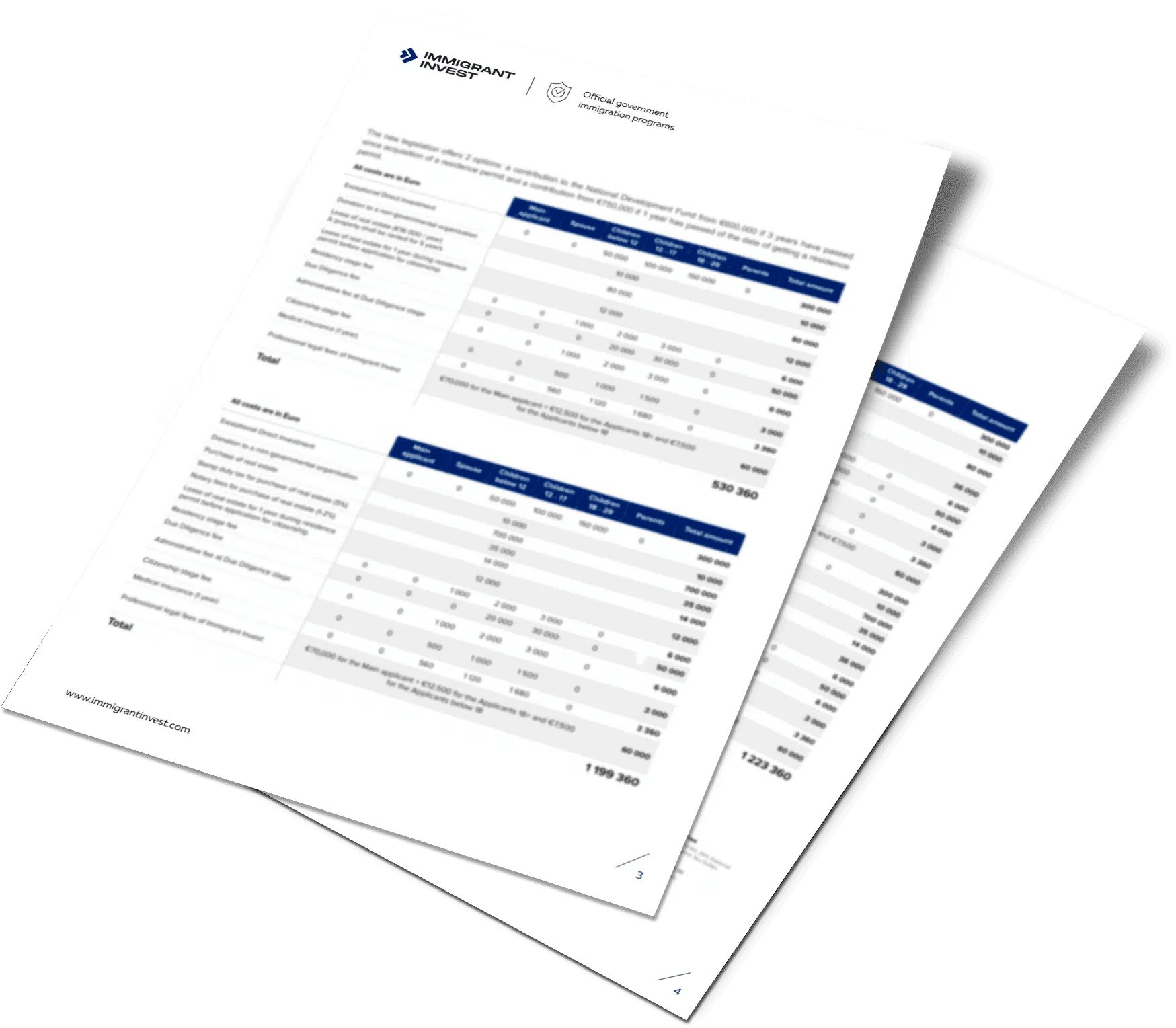
Overall, when combining the investment, government fees, and related expenses, the total cost for a family of four starts from at least €568,784.2. A detailed breakdown is presented in the table below.
Cost breakdown for a family of four for the investment fund option
Step-by-step process of obtaining Portugal Golden Visa as a family
According to Immigrant Invest’s legal practice, it takes over 12 months to obtain the Portugal Golden Visa. All applicants included in the residence permit application — the investor and family members — must visit Portugal at least once during the process to submit biometrics.
The longest stages are usually the reviews carried out by AIMA, the Portuguese Agency for Integration, Migration and Asylum.
1 day
Preliminary Due Diligence
A certified Compliance Anti-Money Laundering Officer checks the investor’s background against international databases. This stage helps identify potential risks before the application starts and, if needed, allows time to strengthen the case or choose another investment route.
A certified Compliance Anti-Money Laundering Officer checks the investor’s background against international databases. This stage helps identify potential risks before the application starts and, if needed, allows time to strengthen the case or choose another investment route.
2 weeks
Document preparation
Our lawyers prepare an individual list of required documents for the investor and family members. They also help complete government forms, arrange translations, and notarise the paperwork.
Our lawyers prepare an individual list of required documents for the investor and family members. They also help complete government forms, arrange translations, and notarise the paperwork.
1—2 weeks
Obtaining a tax number
A Portuguese tax number, or NIF, is needed to open a bank account in Portugal and is also used in many other legal and financial procedures. Immigrant Invest specialists help the investor apply for NIF and obtain it remotely.
A Portuguese tax number, or NIF, is needed to open a bank account in Portugal and is also used in many other legal and financial procedures. Immigrant Invest specialists help the investor apply for NIF and obtain it remotely.
1—1.5 months
Opening a bank account and transferring funds
The investment must be made through the applicant’s account in a Portuguese bank. Immigrant Invest experts assist with the process.
After the account is opened and activated, the required amount is transferred for the investment.
The investment must be made through the applicant’s account in a Portuguese bank. Immigrant Invest experts assist with the process.
After the account is opened and activated, the required amount is transferred for the investment.
2—3 weeks
Investment
The investor completes the chosen investment — acquires investment funds, transfers a contribution to the chosen culture or science project, or sets up a business.
The investor completes the chosen investment — acquires investment funds, transfers a contribution to the chosen culture or science project, or sets up a business.
5—6 months
Application for the residence permit
Electronic copies of the documents are submitted to AIMA for review. The agency takes around 6 months to consider the application.
Electronic copies of the documents are submitted to AIMA for review. The agency takes around 6 months to consider the application.
1—2 weeks
Submission of biometrics
The investor and family members travel to Portugal to submit original documents and provide fingerprints for their residence permit cards. The biometrics appointment must be booked in advance through the electronic system.
The investor and family members travel to Portugal to submit original documents and provide fingerprints for their residence permit cards. The biometrics appointment must be booked in advance through the electronic system.
Up to 6 months
Approval and issuance of the residence permits
AIMA reviews the file after biometrics submission. Once the application is approved, the state fees are paid, and the residence permit cards are issued.
The cards may be collected in person or by a lawyer acting under power of attorney.
AIMA reviews the file after biometrics submission. Once the application is approved, the state fees are paid, and the residence permit cards are issued.
The cards may be collected in person or by a lawyer acting under power of attorney.
Every 2 years
Renewal of the residence permit
To keep the Golden Visa valid, the investor and family members must spend at least 7 days a year in Portugal. The permit is renewed every two years, and the renewal process generally follows the same steps as the initial application.
To keep the Golden Visa valid, the investor and family members must spend at least 7 days a year in Portugal. The permit is renewed every two years, and the renewal process generally follows the same steps as the initial application.
Tax implications for Golden Visa holders
Taxes are one of the key practical aspects to consider when applying for the Portugal Golden Visa as a family. The main point to understand is that holding a residence permit does not, in itself, make a person a Portuguese tax resident.
Those who do become tax residents fall under Portugal’s general tax rules or, in some cases, may qualify for the IFICI regime.
Tax residence in Portugal
Holding a Portugal Golden Visa does not automatically make a person a Portuguese tax resident. Investors who only meet the minimum stay requirement of 7 days per year are generally not treated as such.
Portuguese tax residence is typically triggered when a person spends more than 183 days in Portugal within any 12-month period starting or ending in the relevant tax year.
This distinction is important because Portuguese tax residents are taxed on their global income, while non-residents are taxed only on Portuguese-source income.
Income tax
If a Golden Visa holder becomes a Portuguese tax resident, their personal income is generally taxed under Portugal’s standard rules at progressive rates [9]Income tax rate, IRS.
Portuguese income tax rates:
- up to €8,342 — 12.5%;
- €8,342 to 12,587 — 15.7%:
- €12,587 to 17,838 — 21.2%;
- €17,838 to 23,089 — 24.1%;
- €23,089 to 29,397 — 31.1%;
- €29,397 to 43,090 — 34.9%;
- €43,090 to 46,566 — 43.1%;
- above €86,634 — 48%.
Tax deductions for families
Tax residents in Portugal may benefit from a range of tax deductions related to children and household expenses. These include:
- €600 for each child over 3;
- €726 for each child under 3;
- €900 for the second and subsequent children aged 6 or under;
- €1,306.25 for each child with disability;
- €2,090 of care costs for each child with disability of 90% or more;
- 35% of general family expenses, up to €250;
- 15% of health expenses, up to €1,000;
- 30% of education and training expenses, up to €1,100;
- 30% of education and rehabilitation costs for each child with a disability;
- 25% of insurance premiums or contributions to mutual associations for each child with a disability;
- 100% of eligible VAT on monthly public transport passes and tickets, up to €250;
- 15% of rental costs of up to €1,000 over 3 years, for families transferring their permanent residence to inland areas [10]Deductions and tax benefits, Portugal’s tax authority.
IFICI regime
Some new tax residents may qualify for the IFICI regime, a tax incentive for scientific research and innovation. Under this regime, employment and self-employment income can be taxed at a flat rate of 20% for up to 10 years.
This regime is separate from the Golden Visa and does not apply automatically. It is available only to new tax residents who have not held this status in Portugal in previous years. Applicants must carry out eligible high value-added professional activities, such as scientific research, higher education teaching, or highly qualified roles in export-oriented companies.
Moving to Portugal with family: important things to know
Relocating to Portugal with a family involves more than securing a residence permit. It is important to understand how daily life works in practice, from choosing where to live to understanding how schools and healthcare are organised, to ensure a smooth transition.
Cities in Portugal, popular with expat families
Foreign residents in Portugal are mainly concentrated along the coast. The highest numbers are found in the districts of Lisbon, Faro, Setúbal, and Porto, which together account for over 1 million people, or 71.3% of the country’s foreign population.
The Lisbon area, Porto, the Setúbal district, and the Algarve offer the strongest combination of international communities, schools, and healthcare services.
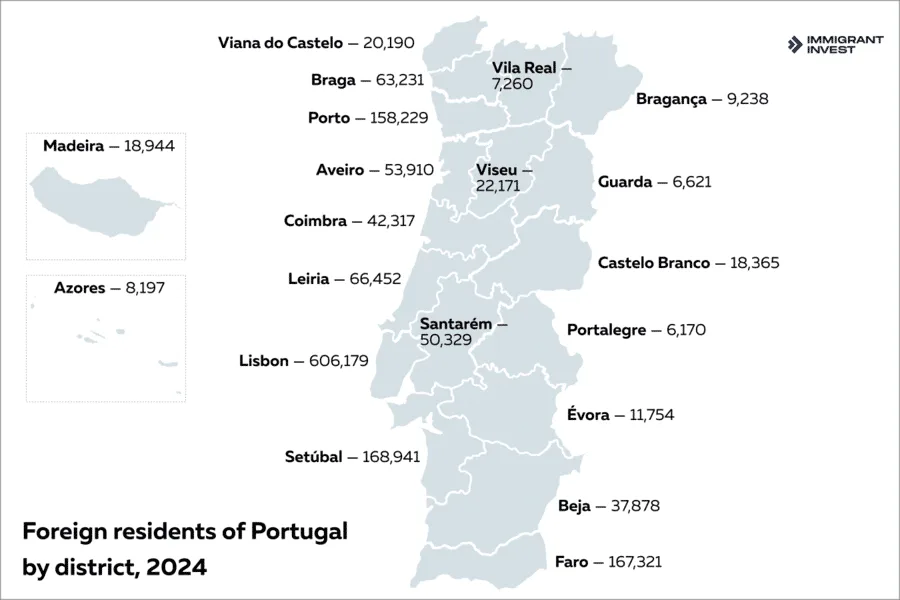
In 2024, the total foreign population in Portugal reached 1.5 mln
Lisbon and the surrounding area are usually the first choice for families who want the widest selection of schools, healthcare providers, and international business services.
The capital offers the most dynamic job market in the country, a large expat community, and easy access to major transport links, including Portugal’s busiest international airport.
Areas such as Cascais, Oeiras, and Estoril are often chosen by families who want to stay close to Lisbon while enjoying a more residential setting, proximity to the coast, and a balance between urban convenience and a calmer lifestyle.
The estimated monthly cost for a family of four in Lisbon is €2,660 per month, excluding rent. Renting a three-bedroom apartment outside of the city centre costs, on average, €1,044 per month.
Porto and nearby municipalities appeal to families looking for a large city with strong infrastructure, well-established public and private services, and a generally lower cost of living than Lisbon.
Porto combines a more compact and manageable urban environment with a strong cultural identity, a well-known food scene, and a slower rhythm of life than the capital. For many families, its main advantage is the ability to access quality services and city amenities without the same level of cost and pace associated with Lisbon.
Monthly expenses for a family of four in Porto average €2,496. Renting a three-bedroom apartment outside the city centre costs around €1,410 per month.
The Algarve, particularly around Faro and other coastal municipalities, is another common choice, especially for families who prioritise climate, international communities, and a more relaxed pace of life.
The region is known for its beach lifestyle and a big expat community, which can make relocation and day-to-day adaptation easier. For families who do not need to live near the country’s main business centres, the Algarve offers a more resort-style environment with good infrastructure, established expat networks, and a strong quality-of-life appeal.
A family of four living in Faro spends around €2,396 a month. Additionally, families pay around €1,340 for renting a three-bedroom apartment outside the city centre.
Education and schooling for expats in Portugal
Portugal has a public education system as well as private and cooperative schools. Public pre-school, basic, and secondary education are part of the national system, and compulsory schooling lasts for 12 years, generally until the age of 18. Public education is tuition-free within the compulsory system.
The main schooling options for expat families are usually the following:
- Public schools — free within compulsory education and following the Portuguese national curriculum. They are the most straightforward choice for families planning long-term integration into Portuguese society.
- Private and cooperative schools — may suit families who want smaller class sizes or a different educational environment while remaining within the Portuguese system. Annual tuition fees at popular private schools in Lisbon range from €2,805 at Externato Rainha Santa [11]Tuition fees, Externato Rainha Santa to 6,400 at Colégio Valsassina [12]Tuition fees, Colégio Valsassina.
- International schools — common in Lisbon, Porto, and parts of the Algarve, and often chosen by families who prefer instruction in English or another foreign language. Tuition fees are higher: in Lisbon, they range from €8,500 at Redbridge International [13]Tuition fees, Redbridge International to 24,000 at United Lisbon [14]Tuition fees, United Lisbon.
University access. Residence in Portugal can help in the long term, but it does not automatically place investors’ children in the same admission category as Portuguese or EU students.
For non-EU nationals, access to public higher education often depends on the rules of the international student regime. Non-EU students who have been legally residing in Portugal for more than 2 years without interruption may fall outside that regime and apply on the same conditions as locals [15]Special Competition for International Students, DGES.
For bachelor’s degrees, integrated master’s degrees, and short technical programmes, the state sets a legal ceiling for a tuition fee, which for the 2025–2026 academic year is €697 [16]Tuition fees, DGES.

University of Lisbon is among the 250 best universities in the world [17]Top universities rating, QS
Healthcare access for Golden Visa families
Healthcare in Portugal performs well by European standards across key indicators. The joint OECD and European Observatory country profile states that life expectancy in Portugal is above the EU average[18]Country Health Profiles 2025, European Commission, and OECD health reporting indicates that 100% of the population has access to core services [19]Health at a Glance 2025: Portugal, OECD.
Portugal’s public healthcare system is the SNS, Serviço Nacional de Saúde. It covers primary care, hospital services, and referrals to specialists.
Foreign citizens with legal residence in Portugal can obtain an SNS user number and access care through the public system. Golden Visa families may use the public system once they obtain their residence permits.
Private healthcare operates alongside the SNS. Many expat families use it for faster access, a wider choice of doctors, and treatment in private hospitals and clinics.
Health insurance policies typically provide either direct access to a provider network or reimbursement of medical expenses, depending on the terms. The average annual premium per insured person is around €418 [20]Health insurance, ASF.
Path to permanent residency and citizenship after Golden Visa for investors and family members
The Portugal Golden Visa is a residence route that can lead to both permanent residence and, eventually, Portuguese citizenship. The two stages follow different rules and timelines.
Permanent residence after 5 years
After 5 years of holding a valid residence permit, Golden Visa investors and their family members may apply for permanent residence in Portugal.
This stage requires maintaining the investment, complying with the minimum stay requirement of 7 days a year, and meeting standard conditions such as having a clean criminal record and demonstrating basic knowledge of Portuguese.
Permanent residence provides a more stable long-term status in Portugal and removes the need to continue renewing temporary Golden Visa permits or to meet the minimum stay requirement.
The permanent residence status itself has no validity limit, but the residence card must still be renewed every 5 years, or earlier if identification details change. Renewal at this stage is also lighter on paperwork, as the holder is not required to resubmit documents already included in AIMA’s electronic system[21]Legal framework for the entry, stay, exit, and removal of foreigners from the national territory, Official Gazette of Portugal.
After obtaining permanent residence, investors may withdraw their capital if the investment was made in fund units.
Citizenship eligibility: current rules
Under current Portuguese law, foreign nationals may apply for citizenship after 5 years of legal residence, provided they meet the main requirements. These typically include holding a valid residence permit, demonstrating Portuguese language proficiency at the A2 level, and having no serious criminal convictions [22]How to obtain Portuguese nationality, General Secretariat of the Ministry of Justice.
However, Portugal is revising its Nationality Law, and a major change was approved by Parliament in April 2026. The reform proposes extending the minimum residence period for citizenship from 5 to 10 years for most non-EU nationals, including Golden Visa investors.
The new law requires completion of the legislative process, including presidential approval. This means the current 5-year rule remains in place for now, although the timeframe may change in the near future.
Risks and pitfalls when applying to Portugal Golden Visa
While the Portugal Golden Visa is a well-established residence programme, families should be aware of several practical risks that can affect timelines, eligibility, and long-term outcomes.
Eligibility risks for family members
Family applications often depend on strict eligibility criteria, especially for adult children and parents.
Adult children are usually required to be financially dependent, unmarried, and in education. During long processing periods, their status may change — for example, they may complete their studies or no longer meet dependency criteria.
Parents and other dependants must also prove financial reliance on the main applicant, which requires documented evidence rather than assumptions based on age or relationship.
To avoid delays and requests for additional documentation, investors should include all eligible family members from the outset and maintain clear, consistent proof of dependency throughout the process.
Delays and document validity issues
Application reviews by AIMA can take several months, and many supporting documents, such as criminal record certificates, are valid only for a limited period. As a result, applicants may need to obtain updated documents more than once.
This issue can be managed by timing document preparation closer to submission and carefully tracking validity periods.
Investment-related risks
Risks depend on the chosen route. For example, under the fund option, capital must be maintained for at least five years to remain compliant with residence requirements. Early withdrawal or changes to the investment structure may affect renewals.
In addition, investment funds are subject to market risk, and returns are not guaranteed. These are standard financial risks. The appropriate approach is to review the investment terms in detail, including holding periods and exit options, before committing funds.
Banking and transfer challenges
Opening a Portuguese bank account is required and may take time due to compliance checks. In some cases, restrictions in the applicant’s home country may affect the ability to transfer funds abroad.
These are practical, not legal, barriers, but they can delay the process. Starting the bank account setup early is an effective way to reduce this risk.
Physical presence and travel requirements
The minimum stay requirement, although low, applies to each family member individually. Coordinating travel for all dependents, especially children or elderly parents, can be challenging. In addition, all applicants must travel to Portugal to submit biometrics during the application process.
These are standard procedural requirements. Planning travel in advance and keeping records of time spent in Portugal is usually sufficient to manage this aspect.
Portugal compared to other residence-by-investment programmes
Several other countries offer residence-by-investment programmes suitable for families. Such options are available in countries such as Italy, Hungary, and Latvia.
Each programme has its own set of requirements and benefits. The rules for including family members in the application also vary.
Some countries, such as Greece and Latvia, still offer the option of obtaining a residence permit through real estate investment. Others, including Malta and Cyprus, provide a more direct route to permanent residence.
Comparison of residence by investment opportunities
Country | Type of residence | Investment threshold | Real estate option | Visa-free Schengen travel | Years to citizenship | Included family members |
|---|---|---|---|---|---|---|
Temporary | €250,000 | Not available | Yes | 5 | Spouse, children under 26, parents | |
| Temporary | €250,000 | Available | Yes | 7 | Spouse, children under 21, parents |
| Temporary | €250,000 | Not available | Yes | 10 | Spouse, children, parents |
| Temporary | €250,000 | Not available | Yes | 11 | Spouse, children under 18, parents |
| Temporary | €50,000 | Available | Yes | 10 | Spouse, children under 18 |
| Permanent | €169,000 | Part of the total investment | Yes | Not available | Spouse, children under 29, parents, grandparents |
| Permanent | €350,000 | Available | No | 8 | Spouse, children |

 Greece
 Italy
Italy Hungary
 Latvia
 Malta
Malta Cyprus
How Immigrant Invest can help your family get a Golden Visa
Applying for the Portugal Golden Visa as a family involves multiple steps, strict requirements, and coordination between several applicants.
Immigrant Invest is a consulting company that helps high-net-worth individuals obtain residence and citizenship by investment. We hold licenses allowing us to work with programmes in Europe, the Caribbean, and other parts of the world. Lawyers at Immigrant Invest are certified members of the Investment Migration Council.
We support families throughout the process with a focus on compliance, clarity, and risk reduction at every stage. Before starting the application, our team conducts preliminary Due Diligence and AML checks. This includes reviewing criminal records, sanctions exposure, PEP status, and other potential risk factors. The goal is to identify any issues early and ensure the application is structured correctly from the outset.
Families benefit from our end-to-end support through a single point of contact. We assist with document preparation, notarisation and apostilles, bank account opening, and coordination of biometric appointments for all family members. Our team also helps manage renewals and keeps track of deadlines across the entire family application.
Another important advantage is access to Portuguese legal expertise and practical guidance based on current AIMA procedures. This includes clear information on timelines, requirements for dependents, and realistic expectations throughout the process.
Key takeaways on the Portugal Golden Visa for families
- The Portugal Golden Visa allows investors to include their spouse, children, and parents in a single application and obtain residence permits for the whole family.
- The programme requires a low level of physical presence — about 7 days per year — while still leading to permanent residence after 5 years.
- Investment options start at €250,000, with the most popular route being €500,000 in investment funds.
- Tax residence is separate from the residence permit, meaning families can hold Golden Visas without becoming Portuguese tax residents.
- Portugal offers an inviting environment for families, with access to healthcare, education, and a potential path to EU citizenship.


 Trusted by 10,000+ investors