









Dual citizenship allows individuals to be legally recognised as citizens of two countries at the same time, granting them the rights and privileges of both nations.
For US citizens, obtaining Portuguese citizenship can open up a wide range of opportunities, from living and working in the European Union to enjoying Portugal’s high quality of life. Following the recent US presidential election, American interest in Portugal citizenship has risen significantly.
This guide covers everything you need to know about Portugal’s stance on dual citizenship, the advantages for US nationals, and the various routes to acquiring Portuguese citizenship, including the popular Portugal Golden Visa program.
What is dual citizenship?
Dual citizenship means that a person is legally recognised as a citizen of two different countries at the same time. This status allows them to enjoy the rights and privileges of both countries, such as the ability to live, work, and vote in either country.
Dual citizens also have to follow the laws and responsibilities of both countries, like paying taxes or serving in the military if required.
Each country has its laws about whether and how a person can hold dual citizenship.
Some nations freely allow their citizens to hold dual citizenship. For example, Canada and the United Kingdom allow their citizens to hold multiple citizenships without any restrictions.
Certain countries allow dual citizenship under specific conditions. For instance, Japan permits dual citizenship only until the age of 22. Japanese citizens who hold dual nationality by birth must choose one nationality by this age. If a person does not choose, they will be required to renounce one of the nationalities.
Some countries do not allow dual citizenship at all. For example, India requires its citizens to renounce their Indian citizenship if they acquire citizenship of another country.
Many countries have different rules depending on how dual citizenship is acquired. For example, a person may automatically become a dual citizen at birth if their parents are from different countries, even if one of those countries does not normally allow dual citizenship.
Dual citizenship in Portugal
Portugal allows its citizens to hold dual citizenship. Individuals who acquire a Portuguese passport do not have to give up their original nationality to become a Portuguese citizen. In fact, Portugal permits its citizens to hold multiple citizenships without any restrictions, including holding three or more nationalities.
The country has several pathways to citizenship, including:
- naturalisation;
- descent;
- marriage to a Portuguese citizen;
- Portugal Golden Visa program, which is particularly popular among investors.
A child born in Portugal can become a Portuguese citizen at birth if at least one parent has been legally living in the country for at least one year before the child is born.
If a child has at least one Portuguese parent, they automatically acquire Portuguese citizenship at birth — no matter where in the world they are born.
Foreign nationals who move to Portugal can apply for citizenship after 5 years of legal residence, and they are not required to give up their original nationality. One popular way to become a resident in Portugal is through the Golden Visa program.
As a dual citizen, one can live, work, and vote in both Portugal and their other country of citizenship, as well as travel more easily between these nations. Dual nationality holders also must follow the laws of both countries and might have obligations like paying taxes in both places, depending on their rules.
Dual citizenship between Portugal and the USA
Both Portugal and the USA allow their citizens to have dual citizenship, allowing individuals to hold both nationalities at the same time.
Obtaining Portugal citizenship. Americans can acquire Portuguese citizenship if they have Portuguese parents or grandparents, have been married to a Portuguese national for at least three years, or have lived in Portugal for at least five years.
Obtaining US citizenship. To become a US citizen, Portuguese citizens usually need to move to the United States and live there as permanent residents. This often starts by getting an immigrant visa that can lead to a green card, like one for work, family, or the Diversity Visa Lottery. After living in the US with a green card for five years, they can apply for American citizenship by naturalisation.
Both countries have tax obligations for their citizens. The United States taxes its citizens on their worldwide income, no matter where they live. In contrast, Portugal uses a residence-based tax system, meaning you’re only taxed on your global income if you’re considered a tax resident there.
Dual citizens may need to file tax returns in both countries. However, thanks to a tax treaty between the US and Portugal, you can avoid being taxed twice on the same income by claiming credits or exemptions.

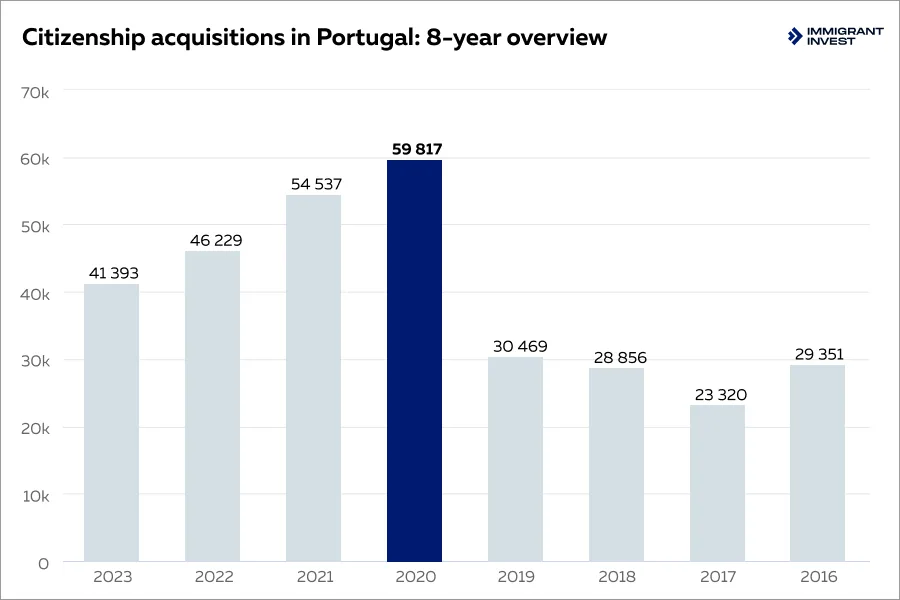
Every year, the number of US citizens who obtain a Portuguese passport increases. In 2022, 14,599 Americans became citizens of Portugal, 34% more than in 2021
9 advantages of Portuguese citizenship for US nationals
1. Free access to the Schengen Area. US citizens can visit EU countries without a visa, but only for up to 90 days within any 180‑day period. With Portuguese citizenship, however, you can travel freely across all Schengen Area and EU countries without counting days or facing visa restrictions.
2. Living in the EU. As a Portuguese citizen, you have the right to live, work, and study in any of the 27 European Union countries without needing a visa or work permit. In addition, you can also reside and work in other Schengen countries that are not part of the EU, such as Switzerland, Norway, Iceland, and Liechtenstein, thanks to special agreements that grant similar freedom of movement.
3. High quality of life. Portugal is known for its high quality of life, pleasant climate, picturesque landscapes, and clean beaches. In addition, the cost of living is affordable there, and the level of safety is high. Portugal is ranked as the 26th most prosperous country in the Legatum Prosperity Index 2023.
4. Access to healthcare and social services. Portuguese citizens are entitled to various social benefits, including healthcare and social security. Portugal’s healthcare system is highly rated, providing comprehensive medical services to residents at little or no cost compared to the US.
5. Educational opportunities. Portuguese citizens benefit from access to quality education at local universities, which offer low tuition fees compared to many other countries. Eight Portuguese universities are featured in the QS World University Rankings, reflecting strong academic standards.
As EU citizens, Portuguese students can also study at universities across the European Union under the same fee structures as local students.
Children with Portuguese citizenship are entitled to attend public schools both in Portugal and in other EU countries under the same conditions as nationals, giving families access to a wide range of free or subsidised educational opportunities.
6. Business opportunities. As a Portuguese citizen, you can start a business with minimal bureaucracy and benefit from Portugal’s startup-friendly initiatives like “Startup Portugal,” as well as access EU-wide grants and funding.
In addition, you can optimise taxation by registering a company in the Autonomous Regions of Madeira or the Azores, where companies benefit from a reduced corporate tax rate of 14.7% on taxable income, compared to the standard Portuguese corporate tax rate of 21%.
Portuguese citizenship also grants you the right to freely establish and operate businesses across all EU member states, vastly expanding your market reach.
7. Stability and safety. Portugal was ranked 7th on the 2024 Global Peace Index and is considered one of the safest countries in the world, with low crime rates and a stable political environment.
8. Prospect of obtaining a special tax status. Portugal ended its popular NHR tax program for most new residents in 2024. But if you’re moving to Portugal for work in areas like science, technology, or education, you might still qualify for a new special tax program.
Called the Incentive for Scientific Research and Innovation, or IFICI, this new program offers a flat 20% income tax rate instead of a progressive scale of 13 to 48% for people in certain high-skilled jobs.
9. Peaceful retirement. Portugal is a popular retirement destination for Americans, offering a lower cost of living, excellent healthcare, and a relaxed lifestyle. Senior people with at least €920 monthly passive income, such as dividends, rent, or pension, relocate to Portugal and apply for a residence permit after a Portugal D7 visa, also known as the Retirement Visa.

Ways of obtaining dual citizenship in Portugal
The Portuguese nationality law describes multiple ways of obtaining citizenship in Portugal. Here are the main routes to obtaining Portuguese citizenship.
By birth. If one or both of the child's parents are Portuguese citizens, they can obtain citizenship, regardless of where they were born. A child born in Portugal can acquire citizenship by birth even if their parents are not citizens if at least one of the parents had resided in Portugal for more than a year before the child's birth.
By descent. In Portugal, citizenship by descent is granted only to direct grandchildren of Portuguese nationals. The grandparents must not have lost their citizenship. Descendants will be granted citizenship if they can demonstrate their connection to the Portuguese community.
By naturalisation. Foreign nationals can apply for Portuguese citizenship through naturalisation after legally residing in Portugal for a minimum of five years. There are several ways to obtain citizenship by naturalisation in Portugal:
- by investment;
- by obtaining a D7 visa for financially independent people;
- by obtaining a D8 visa for digital nomads;
- by funding a startup;
- by working for a Portuguese employer;
- by committing to study or scientific research at a Portuguese university;
- by marriage or family reunification.
Applicants must also prove a substantial link with the national community, have sufficient knowledge of Portuguese, and have the means to support themselves. Additionally, they must have no criminal convictions that would result in a sentence of three years or more under Portuguese law.
By marriage. Spouses of Portuguese citizens can apply for citizenship after three years of marriage or civil union. The process involves demonstrating a genuine connection to Portugal, which can include proof of residence or regular visits to the country.
For an exceptional contribution. Portugal also offers citizenship for individuals who have made significant and recognised contributions to Portugal in areas such as culture, science, arts, or sports. These cases are evaluated on an individual basis.
Who is eligible for Portugal dual citizenship by naturalisation
Portugal dual citizenship requirements include residing in the country under certain rules, demonstrating proficiency in the Portuguese language, and having no criminal record.
Residency requirements. To apply for Portuguese citizenship by naturalisation, you must have legally lived in Portugal for at least 5 years. This includes time spent under any type of residence permits, such as family reunification, study, work, or investment, including the Golden Visa.
Thanks to a 2024 change in the nationality law, the five-year period now starts from the date you apply for a residence permit, not from the date the permit is issued. This means the time spent waiting for approval now counts toward citizenship eligibility, as long as the permit is eventually granted.

Zlata Erlach,
Head of the Austrian office
You don’t need to live in Portugal full-time to maintain your legal residency, but you must keep your residency status active and valid.
For most residence permit holders, this means you cannot be outside of Portugal for more than 6 consecutive months or 8 months in total during the validity period of your permit — unless you have a justified reason, such as work, studies, or medical treatment abroad.
Golden Visa holders have even more flexibility: they are only required to spend 7 days per year in Portugal — either consecutive or spread out. This rule makes the Portugal Golden Visa one of the most residency-light programs in Europe.
Knowledge of the Portuguese language. Applicants must demonstrate a basic understanding of the Portuguese language, equivalent to A2 level on the Common European Framework of Reference for Languages, or CEFR. This means you should be able to hold simple conversations about everyday topics and understand basic written texts and instructions.
You can prove your language skills in one of the following ways:
- passing the CIPLE exam — Certificado Inicial de Português Língua Estrangeira;
- completing a certified Portuguese language course from an accredited institution.
Some individuals may be exempt from the language requirement, such as people who have already completed education in Portuguese, elderly applicants, or those with mental or physical conditions that prevent language learning.
Clean criminal record. You must have no serious criminal convictions to be eligible for citizenship, meaning:
- no prison sentence of three years or more, under Portuguese law;
- no involvement in terrorism, human trafficking, or other crimes considered a threat to national security or public order.
Minor offences like parking tickets or small fines typically do not affect your application, but each case is reviewed individually.
How to get Portugal citizenship after a Golden Visa
The Portugal Golden Visa program is designed for non-EU citizens who make significant investments in the Portuguese economy. Golden Visa holders can apply for citizenship after five years of maintaining their investment and residency.
Investment. Foreign nationals can choose from five investment options to be eligible for a Golden Visa:
- purchase of investment fund units for at least €500,000;
- business investments of €500,000+ with the creation of at least 5 jobs;
- creation of at least 10 jobs after opening a company;
- investment of €250,000+ in the preservation of cultural heritage or the arts;
- investment of €500,000+ in research activities conducted by public or private institutions.
Requirements. The investor must be over 18 years old, have medical insurance, and have no criminal records or debts in Portugal. The money for investments must have been legally earned outside Portugal, and the source and legality of income are to be confirmed.
Family inclusion. Applicants for the Portugal Golden Visa can include their close family members in the application. This applies to:
- spouses;
- children under 18;
- children from 18 to 26, fully financially dependent on the main applicant;
- financially dependent parent of the investor or their spouse.
Validity. Portugal residence permits for investors are initially valid for two years and can be renewed in two-year increments.
The Golden Visa offers much greater flexibility than most other residence permits, like the D7 or Digital Nomad Visa, which require at least eight months of residency per year. In contrast, Golden Visa holders are only required to spend seven days per year in Portugal, making it one of the easiest pathways to EU citizenship without full-time relocation.
How to get dual citizenship in Portugal as a US citizen
After holding a residence permit for five years, US citizens may apply for permanent residency in Portugal or directly for Portuguese citizenship by naturalisation. In this section, we focus on the process of obtaining Portuguese dual citizenship via the Golden Visa route.
1 day
Preliminary Due Diligence
A Certified Compliance Anti-Money Laundering Officer checks the investor’s information against international databases. Our check helps to reduce the refusal risk to 1%.
A Certified Compliance Anti-Money Laundering Officer checks the investor’s information against international databases. Our check helps to reduce the refusal risk to 1%.
1—2 weeks
Obtaining a tax number
Applicants receive a unique nine-digit number called Número de Identificação Fiscal . It is required to open a bank account in Portugal, buy or rent real estate, register a business, and in many other cases.
Applicants receive a unique nine-digit number called Número de Identificação Fiscal . It is required to open a bank account in Portugal, buy or rent real estate, register a business, and in many other cases.
1—1.5 months
Opening an account in a Portuguese bank
Investment under the Portugal Golden Visa Program must be made from the applicant’s account in a Portuguese bank. We assist in opening and activating the account. Once everything is set up, the applicant can transfer the required money for the investment.
Investment under the Portugal Golden Visa Program must be made from the applicant’s account in a Portuguese bank. We assist in opening and activating the account. Once everything is set up, the applicant can transfer the required money for the investment.
2—3 weeks
Making the investment
Based on the chosen option, the applicant can purchase investment fund units, establish a company and create the required jobs, or make an investment supporting the arts or research. Our lawyers gather all the necessary documents to verify the investment.
Based on the chosen option, the applicant can purchase investment fund units, establish a company and create the required jobs, or make an investment supporting the arts or research. Our lawyers gather all the necessary documents to verify the investment.
5—6 months
Preparing documents and applying for a Golden Visa
Immigrant Invest lawyers provide the investor with an individual list of documents needed for the residence permit application. They also complete government forms and assist with translation and notarisation. This process takes up to two weeks.
The documents are then e-copied to the AIMA, the Agency for Integration, Migrations, and Asylum of Portugal. The application is processed for 4—5 months.
Immigrant Invest lawyers provide the investor with an individual list of documents needed for the residence permit application. They also complete government forms and assist with translation and notarisation. This process takes up to two weeks.
The documents are then e-copied to the AIMA, the Agency for Integration, Migrations, and Asylum of Portugal. The application is processed for 4—5 months.
1—2 weeks
Submitting biometrics
The investor and their family must travel to Portugal to submit original documents and provide fingerprints for their residence permit cards. The fingerprinting appointment must be scheduled in advance through the electronic register.
The investor and their family must travel to Portugal to submit original documents and provide fingerprints for their residence permit cards. The fingerprinting appointment must be scheduled in advance through the electronic register.
6—8 months
Obtaining residence permit cards
AIMA reviews the investors’ documents for up to eight months from the submission of the original documents and biometric data. Upon approval, the investor pays the fee for the residence permit cards. The cards are prepared within two weeks and issued either directly to the investor or to their lawyer by proxy, who then sends the documents to the investor.
AIMA reviews the investors’ documents for up to eight months from the submission of the original documents and biometric data. Upon approval, the investor pays the fee for the residence permit cards. The cards are prepared within two weeks and issued either directly to the investor or to their lawyer by proxy, who then sends the documents to the investor.
In 5 years
Applying for citizenship
To maintain residency, the investor and their family members must spend at least seven days a year in Portugal. The residence permit must be renewed every two years.
The naturalisation period for Golden Visa holders starts when they pay the government fee during the application process. After five years of holding a Golden Visa, they can apply for Portuguese citizenship. To get a passport, they will have to pass a Portuguese language proficiency exam.
To maintain residency, the investor and their family members must spend at least seven days a year in Portugal. The residence permit must be renewed every two years.
The naturalisation period for Golden Visa holders starts when they pay the government fee during the application process. After five years of holding a Golden Visa, they can apply for Portuguese citizenship. To get a passport, they will have to pass a Portuguese language proficiency exam.
Required documents for Portugal citizenship application
The specific documents required may vary depending on the basis of your application, e.g. residency, marriage, or descent. However, here is a general list of required documents for applying for Portuguese citizenship by naturalisation:
- application form filled out in Portuguese;
- two recent passport photographs in colour;
- valid passport or certified copy;
- original birth certificate with the seal of the issuing entity;
- proof of income or financial means, such as bank statements, tax returns, or employment contracts;
- supporting documents for accommodation in Portugal, if applicable;
- certificate of no criminal record from the country of origin and the country where the applicant has lived continuously for more than 1 year;
- residence permit for the required period;
- proof of knowledge of basic Portuguese, A2 level or higher;
- marriage certificate, if applicable;
- proof of payment of the applicable fee.
Applications can be submitted in person at the Agency for Integration, Migration and Asylum, at a Portuguese consulate, or online via the official portal.
How to integrate into the Portuguese community
Moving to Portugal is more than just relocating — it's an opportunity to truly connect with the local culture and people. Here are some tips to help you feel at home in Portugal.
Learn the language, even just a little. Portuguese people appreciate it when foreigners make an effort to speak the language. You don’t need to be fluent right away, but knowing key phrases can open doors and warm hearts. Consider taking a local language course, practising with language exchange partners and using apps like Duolingo or Babbel to build daily habits.
Engage with neighbours and locals. Portuguese communities are friendly and welcoming, especially in smaller towns. A simple “bom dia” — good morning, or offering help to a neighbour, can lead to lasting friendships. Don’t hesitate to attend neighbourhood festivals or community events, shop at local markets and strike up casual conversations and join hobby or volunteer groups.
Embrace local cuisine and customs. Sharing food is a central part of Portuguese life. Meals are often long, social occasions filled with conversation and hospitality. Trying local dishes is not only a delicious experience, but also a way to understand the culture.
Sample the many variations of bacalhau — salted cod, often called the national dish, or warm up with a comforting bowl of caldo verde, a traditional soup made with kale, potatoes, and chouriço sausage.

Don’t miss a hearty feijoada, a rich bean stew with meat, especially during the summer festivals
Understand the culture and social norms. Portuguese culture values humility, politeness, and family. Take time to observe:
- slower pace of life, especially outside major cities;
- importance of punctuality in formal settings, but flexibility in informal ones;
- quiet hours and respectful behaviour in shared spaces.
Stay informed and legal. Keeping your residence status in good standing is also part of integration. Make sure you understand local laws, renew your permits on time, and stay updated on your rights and responsibilities.
Be patient. Integration is a journey, not a race. Portugal’s warm climate is matched by its warm people — so give it time, and soon enough, you’ll feel right at home.
Key points about dual citizenship between Portugal and the USA
- Portugal and the USA both recognise dual citizenship.
- Portugal citizens enjoy visa-free access to over 170 countries, including 29 EU members.
- Portuguese citizenship grants the right to live, work, and study in any EU country.
- Dual citizens must comply with tax obligations in both Portugal and the USA.
- Pathways to Portuguese citizenship include descent, marriage, naturalisation, and investment through the Golden Visa program.
- Obtaining Portugal citizenship by naturalisation is possible after at least 5 years of residence.
- Basic knowledge of Portuguese and integration into society may be necessary.


 Trusted by 10,000+ investors