









Portugal has phased out its well-known Non-Habitual Resident, or NHR, preferential tax regime in 2025. NHR was replaced by a new framework, the IFICI tax regime, often referred to as NHR 2.0.
Both former and current regimes levy 20% of foreign-based income instead of a progressive rate. However, the two regimes target different taxpayer profiles.
This guide outlines the requirements, benefits, procedure, documents, and the differences between the former NHR regime and the new IFICI system.
What is IFICI, and why does it matter for foreign professionals?
The IFICI tax regime, or Innovative Fiscal Incentive for Scientific Research and Innovation, is Portugal’s updated framework for attracting skilled foreign specialists. IFICI applies to highly qualified professionals whose work is linked to Portugal’s priority areas.
Professionals pay a reduced 20% flat tax rate on employment or self-employment income earned in Portugal. The tax status is valid for 10 years.
Eligible activities include:
- teaching or research in higher education institutions;
- scientific research and development;
- medical practice and other healthcare activities;
- engineering, mathematics, and physical sciences;
- information and communication technologies;
- management or executive roles in eligible companies;
- work in certified startups;
- research and development projects;
- work in organisations recognised by specialised agencies;
- professional activity in the Azores or Madeira under regional rules.
The regime is designed to help Portugal balance fiscal sustainability with attracting international talent through targeted tax incentives.
Applicants submit their IFICI registration through Portal das Finanças. The regime is available to new Portuguese tax residents who have not been tax residents in Portugal in the previous 5 years. Applicants must also not have previously benefited from the former NHR regime or another special tax regime in Portugal.

Pavel Reshetnikov,
Consultant, Compliance Anti Money Laundering Officer, certified CAMS
The transition from the Non-habitual Resident regime to IFICI, also referred to as NHR 2.0, introduces significant changes. The previous regime offered broad tax benefits to a wide range of applicants. The new system focuses on highly qualified individuals involved in scientific research and innovation.
Under the former NHR regime, most foreign-sourced income, including pensions, was exempt from taxation. Under IFICI, pensions are no longer covered.
From NHR to IFICI: timeline of Portugal’s tax regime changes
Portugal’s strategy for attracting foreign residents through tax incentives has changed significantly over the past 15 years.
2009: introduction of NHR
Portugal introduced the Non-habitual Resident, or NHR, regime to attract foreign nationals. The programme offered tax exemptions on foreign-sourced income and a flat 20% rate on certain types of income earned in Portugal. As a result, it became popular among retirees, investors, and remote workers.
Compared with countries such as the UK, where top income tax rates reach up to 45%, the NHR regime provided a flat 20% rate on eligible income and exemptions on many foreign earnings. This difference allowed many international investors to reduce their tax burden and preserve capital over the long term.
The Portugal Golden Visa programme gained strong demand from international investors, partly due to the favourable tax environment that supported relocation.

Trusted by 10,000+ investors
Check your eligibility for the Portugal Golden Visa
2012—2018: peak demand among pensioners and investors
The NHR regime saw its highest demand between 2012 and 2018. During this period, many foreigners, especially retirees from France, Italy, and Brazil, moved to Portugal to benefit from tax-free pension income for up to 10 years.
Initially, pensions were exempt from tax. Since 2020, they have been taxed at a reduced flat rate of 10%.
The number of foreign residents in Portugal reached around 480,000, the highest level since 1976. By 2019, the figure exceeded 500,000[1]Source: The number of foreigners in Portugal, Minister of Internal Affairs, Portugal.
In addition to pensioners and investors, the country also attracted students, researchers, and skilled professionals, contributing to the overall growth in foreign residents.
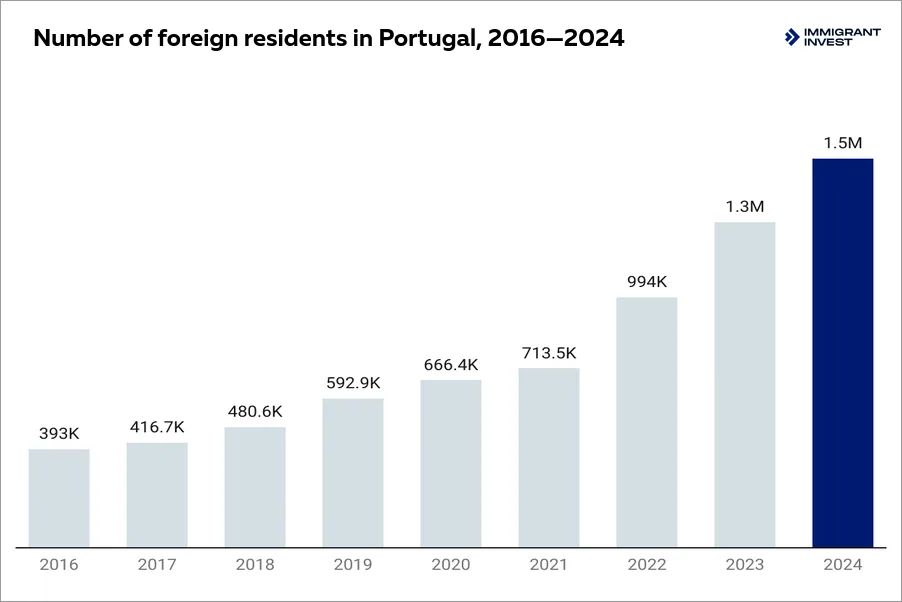
In addition to pensioners and investors, Portugal also attracted students, researchers, and skilled workers, contributing to the record growth of foreign residents
2020—2023: criticism and policy adjustments
The influx of foreign residents under favourable tax conditions increased demand for housing. Property prices rose significantly in Lisbon, Porto, and coastal areas.
This trend contributed to growing public criticism of the NHR regime. Limited housing supply and rising prices made property less affordable for locals and intensified concerns about social inequality.
At the same time, the fiscal impact of the regime became more pronounced. By 2024, the annual cost of tax exemptions linked to NHR exceeded €1.7 billion, the highest level since its introduction[2]Source: NHR tax expenditure, Jornal Económico.
Rising housing costs and increasing budgetary pressure led to political debate. The European Union also called for closer alignment of Portugal’s tax policies with EU standards. In response, the government gradually reduced tax benefits and prepared broader reforms, which led to the replacement of NHR with IFICI in 2025.
2025: introduction of IFICI
On January 1st, 2025, Portugal discontinued the NHR regime and introduced the IFICI tax regime, also known as NHR 2.0. Its main advantage is a 20% flat tax rate on qualifying Portuguese employment and self-employment income for 10 consecutive years[3]Source: NHR 2.0: Portugal's tax incentive, Idealista.
The Tax Authority confirms the registration status by March 31st of each year.
The first approvals confirmed that IFICI is no longer only a replacement for NHR on paper[4]Source: IFICI first approvals in 2026, Statebay. The regime is now being applied in practice, but its scope is much narrower than the original NHR. Portugal continues to use tax incentives selectively, focusing on professionals who contribute to research, innovation, and strategic sectors of the economy.
IFICI vs NHR: key differences

5 benefits of Portugal’s IFICI regime
The IFICI tax regime is designed to attract qualified specialists while offering practical advantages to those who meet the criteria. For foreign professionals, entrepreneurs, and researchers, these benefits combine financial incentives with long-term planning opportunities.
1. Reduced 20% income tax rate
Eligible individuals apply a flat 20% tax rate to employment and self-employment income earned in Portugal. This is lower than the standard progressive rate, which reaches up to 48%.
2. Relief from double taxation
Certain types of foreign-sourced income, including dividends, royalties, and employment income, may qualify for tax exemptions or credits. This helps prevent double taxation under Portugal’s international tax agreements.
3. 10-year tax status
IFICI status is granted for a period of 10 consecutive years. This provides consistency in tax treatment and supports long-term financial and residency planning.
4. Access to Portugal’s innovation ecosystem
IFICI is aimed at professionals working in science, technology, healthcare, higher education, startups, and research. For eligible applicants, the regime may support career development in sectors backed by Portugal’s economic policy.
5. Compatibility with several residence routes
IFICI is not a residence permit, but it can be combined with different legal residence options. Depending on the applicant’s profile, these may include the Portugal Golden Visa or employment-based residence.
The tax benefit applies only if the applicant meets both residence and IFICI eligibility requirements.
Portugal IFICI tax regime eligibility criteria: who qualifies
The Portugal IFICI tax regime has strict eligibility requirements. These are set out in the updated regulation No. 352/2024/1[5]Source: IRS filing period, Portal das Finanças. Applicants first meet the general conditions for the regime.
They must:
- become Portuguese tax residents after January 1st, 2024;
- not have been Portuguese tax residents in the previous 5 years;
- not have used the NHR regime or another special tax regime before.
To become a Portuguese tax resident, an applicant needs to spend more than 183 days in Portugal within a 12-month period, either consecutively or with interruptions. Another route is to have a home in Portugal that shows the intention to use it as a habitual residence.
Educational and professional qualifications
IFICI is intended for highly qualified professionals with proven expertise. Applicants qualify if they have one of the following:
- at least a Level 6 qualification under the European Qualifications Framework, such as a Bachelor’s degree, plus 3 years of relevant professional experience;
- a Level 8 qualification under the European Qualifications Framework, such as a PhD or Doctorate, with no work experience requirement.
Eligible professions
IFICI applies only to selected professional groups. These categories are linked to areas that contribute to research, healthcare, and technological development in Portugal.
Eligible professionals include:
- university professors and researchers;
- medical doctors and healthcare specialists;
- specialists in physical sciences, mathematics, and engineering;
- ICT and technology professionals;
- senior executives and company directors, including CEOs, board members, and executive managers.
Company and sector criteria
Employment under IFICI must be connected with a company or institution that supports Portugal’s strategic economic priorities.
The employer must meet two conditions:
- Generate at least 50% of its turnover through exports in the current year or the previous 2 years.
- Operate in an eligible sector, such as extractive and transformative industries, information and communication, research and development, higher education, healthcare, or related services.
Alternative qualification routes
Portugal also allows several alternative routes for specialists who do not fall under the standard criteria. These include:
- research and development employees working under the SIFIDE tax incentive programme;
- directors or employees of certified startups;
- PhD researchers integrated into national scientific networks;
- employees of organisations approved by specialised agencies IAPMEI or AICEP;
- professionals working in the Azores or Madeira under special regional rules.
The IFICI regime is more selective than the former NHR regime. It focuses on advanced qualifications, eligible professional activity, and companies that contribute directly to Portugal’s economy.
Residence routes that may be combined with IFICI
IFICI is a tax regime, not a residence permit. Foreign professionals first need a legal basis to live in Portugal and become Portuguese tax residents. The suitable route depends on the applicant’s profile, income source, and professional plans.
Portugal Golden Visa
Portugal Golden Visa is a residence by investment route for non-EU and non-EEA nationals. It suits investors who want to obtain residence without relocating permanently to Portugal.
The Portugal Golden Visa offers 5 investment options:
- €250,000+ contribution to arts or cultural heritage;
- €500,000+ purchase of investment fund units;
- €500,000+ investment in scientific research;
- €500,000+ investment in a Portuguese company;
- creation of a company that generates at least 10 jobs, with no fixed minimum investment threshold.
Successful applicants receive a residence permit valid for 2 years. It is renewable for further 2-year periods if the investor continues to meet the programme requirements, including the minimum stay requirement of 7 days a year in Portugal.
The process of issuing the Portugal Golden Visa usually takes 12+ months, provided the documents are submitted correctly and no additional requests are made.
Portugal Golden Visa holders may apply for IFICI only if they separately meet the tax regime’s eligibility criteria and become Portuguese tax residents. This means that holding a Golden Visa is not enough.
For example, an investor who obtains the Portugal Golden Visa by investing in a Portuguese company may qualify for IFICI if they:
- become a Portuguese tax resident;
- work as a manager or director in that company;
- company operates in an eligible sector and meets the required economic criteria.
By contrast, a passive investor who only purchases investment fund units and does not carry out eligible professional activity in Portugal usually does not qualify for IFICI.
Portugal Global Talent Visa
Portugal Global Talent Visa is a residence route for highly qualified professionals, entrepreneurs, researchers, and experts who contribute to Portugal’s academic, research, or innovation environment.
Applicants cooperate with a recognised Portuguese university or research institution through mentorship, innovation support, research, guest lectures, or other academic formats. Participation may take place online or in person, depending on the applicant’s schedule.
The route does not require a financial investment into funds, real estate, or business. Instead, the applicant secures a formal partnership with a Portuguese university or research institution. This cooperation is confirmed by a Letter of Commitment, which outlines the applicant’s role in research, mentorship, startup support, or expert lectures.
Main applicants usually need:
- Bachelor’s degree or higher, 3 to 5 years of professional experience;
- no criminal record, savings of at least €15,000;
- accommodation in Portugal;
- health insurance.
The total programme fees start at €170,000. This amount covers the main applicant and up to 3 dependants. Additional family members cost €5,000 per person, starting from the 5th applicant.
Successful applicants receive a 2-year residence permit, which is renewable for another 3 years. The total period of residence validity is 5 years.
The process usually takes 4+ months, based on Immigrant Invest’s legal practice.
Portugal Global Talent Visa may support an IFICI application if the applicant’s activity meets the tax regime’s criteria and they become a Portuguese tax resident. This means that the applicant must also live in Portugal long enough to obtain tax resident status or have a home there that shows an intention to use it as a habitual residence, as well as carry out an eligible research activity.
A founder who supports a certified startup through mentoring or innovation work may also qualify if the activity is recognised under IFICI rules.
How to apply for IFICI Portugal: step-by-step guide with deadlines and expert tips
Applying for the Portugal IFICI tax regime requires preparation before the application is filed. Applicants need to confirm tax residence in Portugal, collect documents that prove their qualifications, and show eligible professional activity.
Based on the experience of Immigrant Invest lawyers, the IFICI application process usually takes 2 to 3 months, provided the applicant meets the requirements and submits a complete file without missing documents.
1—2 weeks
Obtain Portuguese tax identification number
The first step is to obtain a Portuguese tax identification number, known as the NIF. It is issued by the Portuguese tax office. Foreign applicants may also obtain it through a representative in Portugal.
The NIF is required for most further steps. Applicants use it to open a bank account, sign contracts, interact with Portuguese authorities, and register as tax residents.
The first step is to obtain a Portuguese tax identification number, known as the NIF. It is issued by the Portuguese tax office. Foreign applicants may also obtain it through a representative in Portugal.
The NIF is required for most further steps. Applicants use it to open a bank account, sign contracts, interact with Portuguese authorities, and register as tax residents.
Several months
Secure legal residence and proof of address in Portugal
IFICI applicants must have legal residence in Portugal. This means they need a valid visa or residence permit and proof of address in the country.
Proof of accommodation may include a rental agreement, property purchase deed, or another document that confirms the applicant’s residential address in Portugal.
The residence stage often takes longer than the IFICI application itself. The timeline depends on the chosen visa route, document preparation, and appointment availability.
IFICI applicants must have legal residence in Portugal. This means they need a valid visa or residence permit and proof of address in the country.
Proof of accommodation may include a rental agreement, property purchase deed, or another document that confirms the applicant’s residential address in Portugal.
The residence stage often takes longer than the IFICI application itself. The timeline depends on the chosen visa route, document preparation, and appointment availability.
3—4 weeks
Collect academic and professional documents
Applicants prepare documents that confirm their education, qualifications, and professional experience. These may include diplomas, certificates, CVs, employment history, and contracts.
If the applicant qualifies through a startup, research project, or approved organisation, additional evidence is prepared at this stage. This may include startup certification, confirmation of R&D activity, or approval from the relevant Portuguese authority.
Applicants prepare documents that confirm their education, qualifications, and professional experience. These may include diplomas, certificates, CVs, employment history, and contracts.
If the applicant qualifies through a startup, research project, or approved organisation, additional evidence is prepared at this stage. This may include startup certification, confirmation of R&D activity, or approval from the relevant Portuguese authority.
2—3 weeks
Submit the IFICI application to the Portuguese Tax Authority
After the documents are ready, the applicant submits the IFICI application to the Portuguese Tax Authority, Autoridade Tributária e Aduaneira.
The application file includes identification documents, proof of tax residence, proof of legal residence in Portugal, academic and professional documents, and confirmation of eligible employment, self-employment, business, or research activity.
After the documents are ready, the applicant submits the IFICI application to the Portuguese Tax Authority, Autoridade Tributária e Aduaneira.
The application file includes identification documents, proof of tax residence, proof of legal residence in Portugal, academic and professional documents, and confirmation of eligible employment, self-employment, business, or research activity.
4—6 weeks
Wait for verification and approval
The Portuguese Tax Authority reviews the application and checks whether the applicant meets the IFICI eligibility criteria.
The authority may verify employment, qualifications, professional activity, and approvals from official bodies. Missing or inconsistent documents often lead to delays. Professional assistance helps reduce the risk of errors at this stage.
The Portuguese Tax Authority reviews the application and checks whether the applicant meets the IFICI eligibility criteria.
The authority may verify employment, qualifications, professional activity, and approvals from official bodies. Missing or inconsistent documents often lead to delays. Professional assistance helps reduce the risk of errors at this stage.
How to report income as an IFICI tax resident?
After obtaining the status, a tax resident submits an annual personal income tax return, known as IRS, through the Portuguese Tax Authority portal[6]Source: Tax payments, Portal das Finanças.
Portugal’s tax year runs from January 1st to December 31st. The annual IRS return is usually submitted between April 1st and June 30th of the following year. For example, income earned in 2025 is declared between April 1st and June 30th, 2026. The Portuguese Tax Authority confirms this filing period on Portal das Finanças.
The tax return includes Portuguese income and, for Portuguese tax residents, foreign-sourced income. IFICI affects how qualifying income is taxed, but it does not cancel the reporting obligation.
If tax is due, the payment details appear in the taxpayer’s personal area on Portal das Finanças. The Portuguese Tax Authority allows taxpayers to check their current payment obligations and obtain payment references online [7]Source: IFICI Regulation, Government Order No. 352/2024/1.
Documents required for Portugal IFICI
Applicants for the Portugal IFICI tax regime prepare a full set of documents that confirm their identity, tax residence status, qualifications, and eligible professional activity.
Personal identification documents
To confirm identity and legal residence in Portugal, applicants provide:
- valid passport;
- residence permit in Portugal;
- Portuguese tax identification number, NIF.
Academic and professional documents
IFICI is intended for highly qualified professionals, so applicants provide evidence of their education and expertise.
The document package may include:
- degree or diploma, at least EQF Level 6;
- professional qualification certificates;
- proof of work experience, such as employment records, contracts, CV, and references.
Employment or business documents
Applicants also prove that they carry out eligible professional activity in Portugal. This may be confirmed by an employment contract with a Portuguese company in an eligible sector, business registration documents, or startup certification.
Depending on the qualification route, additional documents may be required. For example, applicants may need approval of an R&D project under the SIFIDE programme or validation from Portuguese authorities such as IAPMEI or AICEP.
Proof of residence and financial standing
Applicants may also be asked to confirm stable residence and financial capacity in Portugal. Relevant documents include:
- proof of accommodation, such as a rental agreement or property deed;
- health insurance valid in Portugal;
- recent bank statements or other proof of funds, if requested by the authorities.
A complete document package helps the Portuguese Tax Authority and immigration services verify that the applicant meets the IFICI criteria. Missing or inconsistent documents often cause delays or refusals, so professional assistance helps reduce the risk of errors.
Common mistakes when applying for IFICI
IFICI has stricter rules than the previous NHR regime. Applicants may face delays or lose eligibility if they rely on a general understanding of NHR instead of checking the new requirements.
Common mistakes include:
- assuming that tax residency alone is enough to qualify;
- applying without an eligible profession or activity;
- relying on a service contract where an employment contract is required;
- failing to prove the required education level or professional experience;
- confusing NHR transitional rules with IFICI rules;
- not keeping documents that confirm eligible activity and income;
- failing to report changes in employment, activity, or eligibility.
Applicants must be able to provide evidence in any year in which they used the regime. If the activity, employer, or eligibility status changes, the applicant must communicate the change within the required deadline.
Taxpayers must submit a new registration request when there is a change in the entity responsible for the application or in the company that must prove the requirements. The ordinance also requires taxpayers to keep proof of activity and income and present it when requested by the Tax Authority[8]Source: IFICI regulation, Diário da República.
How Immigrant Invest can help you
Immigrant Invest is a consulting company that helps investors obtain residence permits in Portugal. The company has worked in investment migration since 2006 and has assisted more than 500 investors and their family members with Portugal residence permits.
The support covers the whole process:
- initial consultation;
- preliminary Due Diligence;
- selection of a suitable residence route;
- document preparation;
- application submission;
- maintaining residence status after approval.
Immigrant Invest also helps applicants open a bank account in Portugal and prepare the documents required for the whole family.
Before filing an application, the Compliance Department conducts a preliminary Due Diligence check. This helps identify possible risks in advance and reduce the risk of refusal. According to the company, the rejection rate among its clients is less than 1%.
Immigrant Invest lawyers are members of the Investment Migration Council, and the team includes certified AML officers. The company also has a Portuguese office in Lisbon, which helps coordinate local procedures and communication with Portuguese authorities.
Final thoughts on Portugal’s new tax regime
- Portugal’s transition from NHR to IFICI, also known as NHR 2.0, shows a shift in how the country attracts foreign residents.
- Eligible applicants receive access to a 20% flat tax rate, relief from double taxation, and predictable tax treatment for 10 years.
- IFICI is aimed at highly qualified professionals, researchers, and innovators in science, technology, healthcare, green energy, and other strategic sectors.
- Portugal Golden Visa holders may also apply for IFICI if they meet the regime’s professional, tax residence, and sector requirements.
- The new regime supports Portugal’s broader policy focus on innovation, research, science, and sustainable economic development.

 Trusted by 10,000+ investors