









To open a company in Portugal, an expat needs to get a residence permit or citizenship, a tax and social security number, and a bank account in the country.
If you do not have a residence permit in Portugal but want to start a business in the country, you can do it under the Portugal Golden Visa Program. The program allows expats to get Portugal residence permits by investing €500,000 in a company that creates at least 5 jobs or 10 jobs but without a fixed investment amount.
Let’s see how to open a company in Portugal.
Company registration steps in Portugal for expats
To open a company in Portugal, an expat needs to have a residence permit or citizenship. But applicants for the Portugal Golden Visa Program first go through all the steps of a company opening process and only then get a residence permit card.
The company opening process, including the preparation of documents, takes an average of 2 months. Registration of the company itself takes 1—2 days.
Company opening process in Portugal
Get a tax number in Portugal
Get a social security number
Open a bank account in Portugal
Name your company
Choose your business structure or type
Register your company
1. Getting a tax number in Portugal. The tax number Número de Identificação Fiscal (NIF) is needed to make payments in Portugal.
Foreigners can get a tax number remotely by a power of attorney. It means a person finds a tax representative in Portugal, such as a lawyer or a law firm. Then a person and a lawyer sign a power of attorney based on which the lawyer deals with the Portuguese tax administration and gets a number for the client.
To get a tax number in Portugal, one needs to submit documents to the Portuguese tax office:
- a completed application for registration of a taxpayer number;
- a copy of the internal passport;
- a copy of the international passport;
- a Taxpayer Identification Number in an origin country;
- a bank statement to confirm the legality of income.
The Portuguese Tax Authority usually approves an application in two weeks. A new Portugal taxpayer enters into the register of taxpayers and gets a certificate with a unique nine-digit number and a personal account on Portugal’s tax service website.
2. Getting a social security number. In Portugal, employers are obliged to get the Social Security Identification Number (NISS) and notify the Social Security office when they take on workers.
Employers in Portugal are also required to make social security contributions for a company and employees. The contributions are calculated by applying the contribution rate to the gross remuneration.
Social security in Portugal accesses the rights of employees and protects against the following:
- lack of work-related income caused by illness, disability, maternity, work injury, unemployment, old age or death of a family member;
- inaccessible medical care;
- insufficient family support, especially for children and adult dependents.
Foreign nationals who do not have a NISS can apply for one using the 'NISS NA HORA' service.
Applicants fill out the application and submit the following data to the 'NISS NA HORA to get a Social Security Identification Number (NISS):
- full name;
- date of birth;
- place of birth;
- nationality;
- gender;
- marital status;
- current registration address;
- tax identification document number (if already assigned);
- a citizen card, residence permit, or another civil identification document from the country of origin and a simple copy.
When a legal representative requests, they should notarise the copy of the civil identification document of the person for whom the NISS is being requested.
The request is made in person at the district headquarters of the Social Security district centres or the local Social Security offices in Portugal. The service is available by appointment through telephone numbers: +210 548 888 or +300 088 888. The application for NISS in Portugal is free of charge.
3. Opening a bank account in Portugal. To open an account, one passes Customer Due Diligence. It means that one has to visit a bank in Portugal personally to provide passport details, income information and a Portuguese tax number. If having a tax representative in Portugal, one provides their details either.
After passing through a bank check, one gives their fingerprints and provides a sample signature to the bank to issue a card.
4. Naming your company. Entrepreneurs can choose the company’s name from an online list of Institute of Registries and Notary (IRN) with available names, or they can create it themselves or use their surnames.
Investors first get approval, If they wish to propose a name for their company, and only then can they apply to open a company.
To get approval for a company’s name, an entrepreneur completes a questionnaire and submits the name for approval to the IRN. The name approval process takes up to seven working days.
No approval is required when choosing a name from the online list of available names. Typically, the client is asked to select up to three name options from a list. On the company's registration day, an IRN employee will check the relevance and availability of the selected option on the spot.
Approval is also not required when using a surname as a company name.
5. Choosing your business structure or type. There are multiple legal structures for businesses in Portugal, regulated by the Portuguese Companies Code. Entrepreneurs can select the one that fits their companies’ structure best.
Company types and their features in Portugal
6. Registering a company. There are three ways of setting up a company in Portugal: online, on the spot and the traditional method.
Empresa Online allows Portuguese businesses to be set up and registered on the Internet for 1—2 days for €360.
Establishing a business in Portugal is also available through Empresa de Hora's on‑the‑spot system. Companies can be created in an hour for €360 via this government scheme. All partners should be present, with all legal representatives and necessary documentation.
Entrepreneurs also can register their Portuguese business at a Commercial Registry Office.

Trusted by 10,000+ investors
Check your eligibility for the Portugal Golden Visa
Benefits of starting a business in Portugal
Ease and low cost of registering a company. Portugal is in the top ten in the world in terms of ease of registering a company. Entrepreneurs can open their companies by filling out just one form in less than an hour.
The form inquires about specific information about an entrepreneur’s company. For example, the type of company and each partner’s capital share. It costs €360, and a company will be registered within one to two days.
Tax benefits. 14.7% is the corporate tax rate in Portugal’s free economic zones, the Azores and Madeira. In contrast, mainland Portugal’s standard corporate tax rate is 21%.
Madeira also has a reduced corporate tax rate of 5%. The rate applies to companies that get income from transactions with foreign entities or businesses with an IBCM licence.
VAT rates in Portugal are the lowest in the EU. For example, businesses producing food and related services in the Azores region pay 4% and Madeira — 5%. In mainland Portugal, the standard VAT rate is 23%.
Expats also can get a special tax status of a Non-Habitual Resident (NHR) in Portugal. The status allows expats not to pay taxes on global income. With the NHR status, one pays the tax for the income earned in Portugal at 20%. In contrast, Portugal’s standard income tax rate can be as high as 48%.

Madeira, Portugal's free economic zone
Governmental support. In Portugal, public mechanisms support small and medium-sized companies. There are also specific support programs for entrepreneurs.
The Startup Portugal+ Programme aims to support the development of entrepreneurship in Portugal. Startup Portugal operates as a medium between the government, entrepreneurs, incubators, and accelerators. It helps implement public policies and private initiatives and attract the best foreign talent, founders, and investors.
In addition to the Startup Portugal, the Portuguese government offers other support programs for entrepreneurs:
- Startup Visa is a residence visa for entrepreneurs which aims to attract investment, talent and capacity for innovation to Portugal.
- Tech Visa is a certification program for companies that want to attract highly qualified and specialised personnel to Portugal, citizens from countries outside the Schengen area.
- Semente provides tax benefits to investors who inject capital into early-stage startups and creates a more favourable tax regime for capital gains obtained through startup investment.
- Call Tourism (Portugal Ventures) is investing between €200,000 and €1 mln in non-technological and technological projects in tourism.
- ADN Startup provides a global amount of up to €10 mln to support access to bank finance for micro-enterprises at the early stage of their life cycle.
Reliable and accessible banking system. Sometimes startups cannot receive investments from foreign investors directly because of the lack of a bank account. Banks can either simplify this process or delay it for many months.
Portuguese banks are more favourable to non-residents, unlike most EU countries, where third-country citizens are likely to be denied opening an account.
More than 150 financial institutions operate in the country, including public and private retail banks and cooperative, investment and mobile banks. Branches of international banks operate in the country as well.
The best international banks in Portugal are:
- the German Deutsche Bank and N26;
- the French Oney Bank and BNP Paribas;
- the US Citibank;
- the Spanish Bankinter and the Wizink bank.
The number of fraud activities per transaction in Portugal is 0.009%. It is one of the lowest rates in the European Union.
The most demanded industries in Portugal
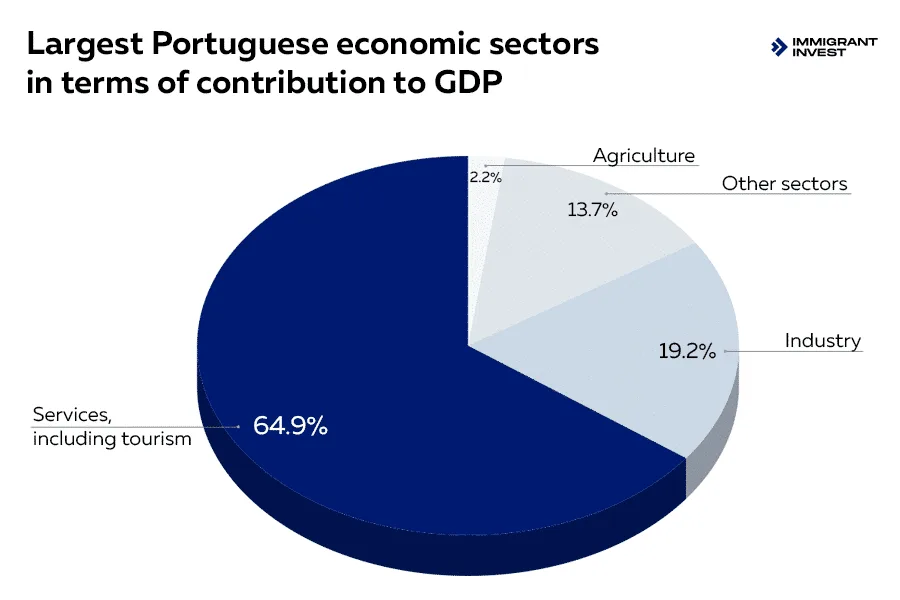
The tourism industry is the most popular among investors. It brings Portugal about 20% of its GDP as more than 25 million tourists visit Portugal annually.
Investment in the hotel industry is the most popular tourism direction among Portugal’s expat entrepreneurs. The most popular areas are the Riviera, Algarve, Azores, and Madeira.
Another industry in Portugal that needs investments is agriculture. For example, grape growing and wine production, fishing and fish processing, and meat production.
Portugal’s capital, Lisbon, traditionally attracts investors. Port logistics and precious metals are also in demand for investment in Portugal.
Portugal Golden Visa for starting a business
The Portugal Golden Visa Programme allows investors to get residence permits by investing in the country’s economy. It has seven investment options, two of which include starting a business in Portugal:
- minimum of €500,000 investments into business with the creation of at least 5 jobs;
- opening a company with the creation of at least 10 jobs, with no fixed investment amount.
For a company opening with the creation of at least ten jobs option, entrepreneurs can rely on Decreto-Lei n.º 248/86. It indicates the minimum authorised capital depending on a company’s type. For example, to open a Private Limited Company in Portugal, one needs to document the presence of a minimum authorised capital of €5,000.

Joseph,
A shareholder of a waste recycling company
We needed a branch run by one of us to gain a foothold in the EU market. I’ve volunteered to move to the EU and manage our company there. I applied for the Portugal Golden Visa Program, and we chose to open a company with the creation of at least 10 jobs. By now, we’ve already stood firm in the Portuguese IT market. In three years, we plan to enter the IT market of the European Union.
With Portugal residence permits, expats can travel without visas to the Schengen Area and spend in these countries for up to 90 days out of 180. After five years of maintaining the status, expats can apply for permanent residence or citizenship in Portugal.
Portuguese citizens travel without visas to 188 countries. That includes destinations like the USA, Canada, the UK, and Australia. Also, Portuguese citizens can choose to live in any EU country.
Other benefits of the Portugal Golden Visa are:
- no need to take a language proficiency or history exam;
- no need to permanently reside in the country, as seven days a year are enough;
- expats can get a residence permit for a period of eight months;
- the status is obtained by the investor’s entire family, including parents.

 Trusted by 10,000+ investors