









The Portugal D7 visa is also known as the Passive Income Visa. Any non-EU citizen with a passive income of at least €920, or $1,085, per month is eligible for it if they buy or rent residential property in the country.
The visa allows foreigners to travel to Portugal and apply for a two-year residence permit, which they can later renew. In 5 years, expats will be eligible for citizenship by naturalization.
After the 2024 presidential election, many Americans think about immigration to Portugal. In this article, we explain the rules of obtaining the D7 visa and how US citizens can get it.
What is the Portugal D7 visa?
The Portugal D7 visa is also known as the Passive Income Visa. It is intended for financially independent foreigners, including pensioners and investors.
To obtain such a visa, a foreigner must prove a passive income of at least €920, or $1,085, per month and buy or rent residential property in Portugal.
The D7 visa is issued for four months. In this period, the foreigner needs to come to Portugal and apply for a residence permit, giving them the right to work there.
The initial term of the residence permit is two years. After that, it can be renewed for three years if the foreigner does not leave Portugal for more than 6 months in a row or 8 months in total during the PR validity period.
5 benefits of the Portugal Passive Income Visa
1. Right to live in Portugal. The D7 visa holders can live in one of the warmest and safest European countries with a lower cost of living than in the major cities in the United States and with a higher quality of life.
2. An easy way to become a Portugal resident. The D7 visa is a more affordable way of getting a residency permit in Portugal than other options, such as the Golden Visa program and the Digital Nomad Visa.
While the D7 visa requires a passive income of at least €920, or $1,085, the Golden Visa candidates invest at least €250,000, or $295,000, and Digital Nomad visa applicants prove remote income of over €3,680, or $4,340.
3. Moving to Portugal with the family. The spouse, children, and parents can be included in the application together with the main applicant.
4. Right to work and study in Portugal. The D7 visa holders can run businesses and open new companies in the country. The legal residents will have access to the educational system, with the yearly tuition fee at public universities varying between $3,200 and 5,300 for non-EU students — a lot cheaper than in the United States, where the average tuition fee is $26,000 per year.
5. Prospect of Portugal citizenship. A foreigner can apply for Portuguese citizenship by naturalization after five years of legally residing in the country. A US citizen will be able to obtain the nationality of the EU country without giving up their first passport.

How to move to Portugal and how fast you can do it via the D7 visa
Requirements for D7 visa for US citizens
Applicants. To get a D7 visa to Portugal, the main applicant should:
- be over 18 years old;
- have no criminal record;
- have a stable passive income of at least €920, or $1,085, outside Portugal;
- buy or rent property in Portugal;
- be ready to move to Portugal.
Family members. Close relatives of the passive income holder can be included in the D7 visa application. This applies to:
- a spouse or a partner in a civil union with no criminal record;
- children under 18;
- children between 18 and 21 who are unmarried, study at a university, and are unemployed;
- disabled children of any age;
- parents who are financially dependent on the main applicant.
Passive income. The minimum passive income to obtain the D7 visa is tied to the minimum salary in Portugal. In 2026, it is €920, or $1,085, per month.
The sum must be increased by 50% if the foreigner includes a spouse or a parent in the application and by 30% for each child. That means that a married couple must earn from passive income sources at least €1,380, or $1,628, per month, or €1,656, or $1,953, per month if a child is included.
The following forms of income are eligible for the Portugal D7 visa:
- pensions;
- real estate rent;
- dividends if you don’t work for the company;
- interest from savings;
- royalties;
- intellectual property;
- earnings from long-term, fixed-rate financial investment;
- transferable equity.
Applicants also confirm savings of at least 12 Portuguese monthly wages. In 2026, the required sum is €11,040, or $13,023. When applying with the family, savings requirements increase by 50% for a spouse and 30% for each child. This means, the main applicant needs to add €5,520, or $6,393, for a spouse and €3,132, or $3,907, for each child.
Property in Portugal. Before applying for the visa, applicants secure accommodation in Portugal. There are no limits to the type, age, value, or location of the property the applicant buys or rents to obtain the D7 visa.
The average property price in the country is €2,526 ($2,620) per m². In Portugal’s capital, Lisbon, the prices could go as high as €5,333 ($5,531) per m².
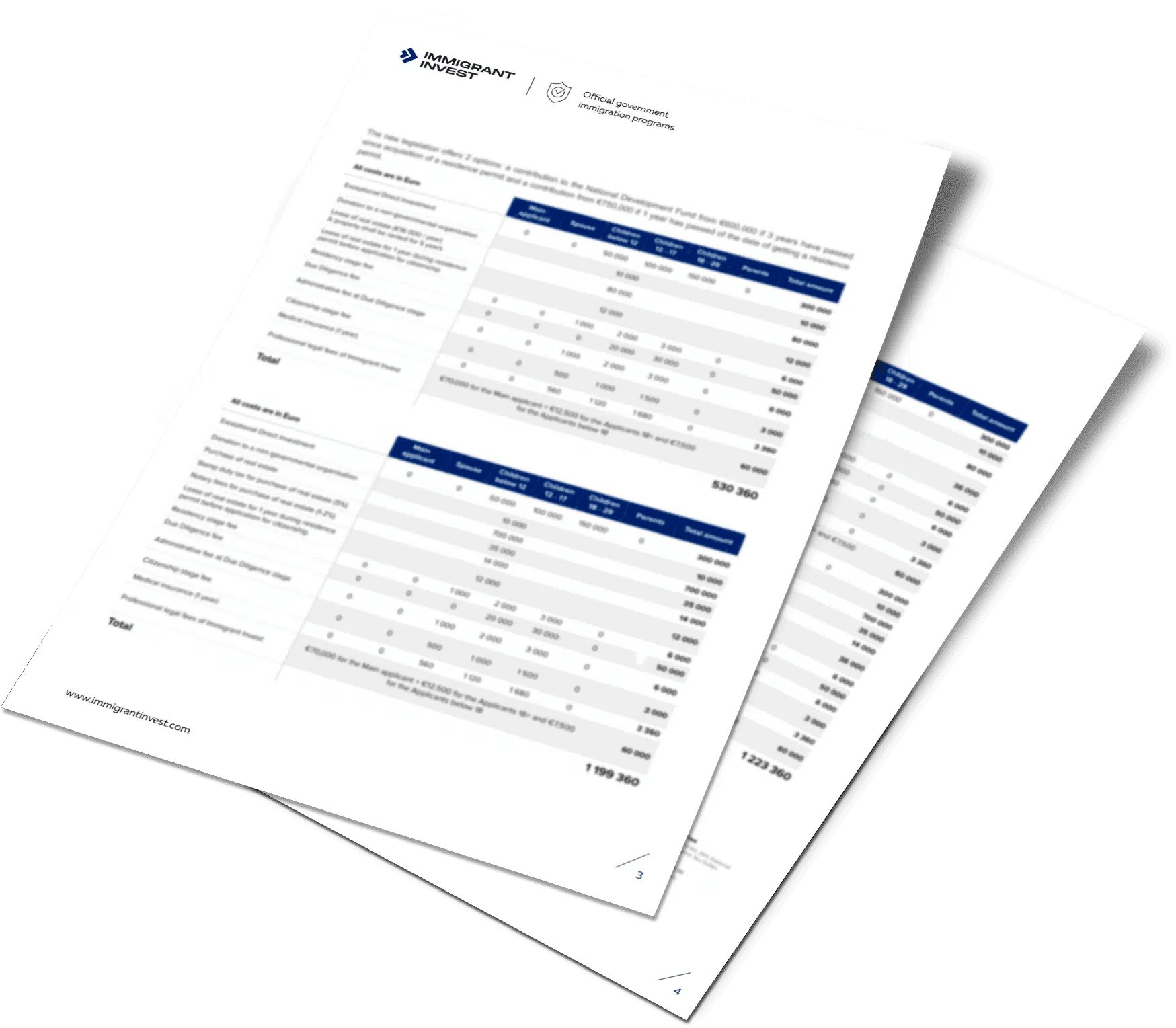
Costs for obtaining Portuguese passive income visa for US investors
The cost of the Portugal D7 visa depends only on two factors: the number of family members in the application and the value of the property they are buying or renting.
If the applicant buys a property, they are also expected to pay stamp duty and property tax. If they choose to rent housing, the landlord will pay the taxes.
Apart from these expenses, the applicant must also buy or rent residential property without any value limits or requirements. For example, the average price of a one-bedroom apartment for sale in Lisbon is €370,000, or $384,000, while a monthly rent can cost around €900, or $933.
If the applicant chooses to buy housing, they also pay a 0.8% stamp duty, a 0 to 8% property transfer tax, and an annual tax of 0.3 to 0.8% of the property’s value.
Documents to apply for D7 visa
The following documents are required along with the D7 visa application form:
- valid passport;
- two passport photos;
- proof of passive income of at least €920, or $1,085, per month;
- proof of accommodation — a 12-month lease agreement or an ownership certificate;
- proof of clean criminal record;
- valid travel insurance with health coverage;
- six months of bank statements.
Obtaining Portugal D7 visa and residence permit from the United States: step-by-step guide
The process of applying for the D7 visa can take 6 or more months and can be done in the United States. Once the visa is obtained, the US citizen needs to visit Portugal and apply for a residence permit.
The Immigrant Invest lawyers help the applicants throughout each step of the process. Here is how it goes.
1 day
Preliminary Due Diligence
An Anti Money Laundering Officer performs a Preliminary Due Diligence. The procedure is obligatory, while the results are confidential. The check helps reduce the chance of rejection to 1%.
An Anti Money Laundering Officer performs a Preliminary Due Diligence. The procedure is obligatory, while the results are confidential. The check helps reduce the chance of rejection to 1%.
Up to 5 business days
Obtaining Portugal NIF number
The taxpayer identification number, or Número de Identificação Fiscal (NIF), will allow the applicant to open a bank account and buy or rent property in Portugal. For applicants from the United States, it can be done remotely through a tax representative in Portugal.
The taxpayer identification number, or Número de Identificação Fiscal (NIF), will allow the applicant to open a bank account and buy or rent property in Portugal. For applicants from the United States, it can be done remotely through a tax representative in Portugal.
Up to 2 months
Purchase or rent property
Applicants can choose property remotely from the United States or travel to Portugal. Buying housing could take several months while finding a place to rent is typically faster.
Applicants can choose property remotely from the United States or travel to Portugal. Buying housing could take several months while finding a place to rent is typically faster.
2+ weeks
Opening a Portuguese bank account
An applicant opens an account in a Portuguese bank using their NIF number. In some cases, documents confirming the legality of their income are needed.
An applicant opens an account in a Portuguese bank using their NIF number. In some cases, documents confirming the legality of their income are needed.
2—3 weeks
Making an appointment in the Portuguese consulate
Once all the documents are collected, applicants can visit the Portuguese consulate in their country to submit their application.
The process can take longer than 3 weeks, depending on how busy the consulate is.
Once all the documents are collected, applicants can visit the Portuguese consulate in their country to submit their application.
The process can take longer than 3 weeks, depending on how busy the consulate is.
Up to 4 months
Application approval
The Portugal D7 visa is usually issued within 60 days from the day when the application is submitted.
The Portugal D7 visa is usually issued within 60 days from the day when the application is submitted.
4 months
Traveling to Portugal with a valid D7 visa
The Portugal D7 visa is valid for 4 months. During this period, applicants travel to the country. They can live in Portugal during that period, but they will only be able to work there if they obtain a residence permit.
The Portugal D7 visa is valid for 4 months. During this period, applicants travel to the country. They can live in Portugal during that period, but they will only be able to work there if they obtain a residence permit.
2—3 weeks
Applying for a residence permit
The application is submitted personally to the Agency for Integration, Migration and Asylum, AIMA.
The application is submitted personally to the Agency for Integration, Migration and Asylum, AIMA.
3+ weeks
Receiving a residence permit card
After the application is approved, the Portugal D7 visa holder can receive the residence permit card by mail. The first residence permit is issued for two years. After this term, it can be renewed for a further three years.
After the application is approved, the Portugal D7 visa holder can receive the residence permit card by mail. The first residence permit is issued for two years. After this term, it can be renewed for a further three years.
Differences between the D7 visa and Golden Visa in Portugal
The D7 visa is not the only way to obtain a residence permit in Portugal. For investors, there is a possibility of applying for a Portugal Golden Visa.
In this case, the applicant makes a minimum investment of €250,000, or $250,000, into the Portuguese economy, with several options available, such as purchasing investment fund units, investing in business and creating jobs, supporting arts and cultural heritage, or donating to scientific research.
Portugal D7 and Golden Visa differences
Key things to remember about Portugal D7 visa
- The Portugal D7 visa opens up an easy path to a residence permit for US citizens with any kind of passive income of at least €920 per month from outside of Portugal.
- Pensions, real estate rent, royalties, dividends, and interest qualify as eligible forms of passive income to apply for the D7 visa.
- The other key condition to get the visa is buying or renting residential property of any kind in the country.
- The visa is issued for 4 months. Within this period, the applicant must travel to Portugal to obtain a two-year residence permit.

 Trusted by 10,000+ investors