









Portugal and Greece have Golden Visa programs that allow foreigners to obtain residence permits by investment. The minimum eligible sum is €250,000 in both countries.
In this article, we compare Portugal and Greece Golden Visas, so that you can decide which investment program suits you better.
Overview of Portugal and Greece Golden Visas
A Golden Visa is a residence permit issued in exchange for investment in a country’s economy. Applicants can buy real estate, purchase securities, or open companies. After passing Due Diligence, they become residents within several months.
Greece and Portugal are among the several European countries that have Golden Visa programs.
Timeframes. In Greece, the status is obtained within 4 or more months, whereas in Portugal, the process is longer and takes at least 12 months.
Investment options. Greece has nine investment options, the most popular of which is purchasing real estate worth at least €250,000. However, since August 31st, 2024, the investment threshold will increase to €400,000 and €800,000, depending on the region.
Portugal offers five investment options but does not allow the purchase of real estate under the Golden Visa program. Most applicants choose to purchase investment fund units for €500,000.
Portugal and Greece Golden Visas benefits
Some common advantages of the Portugal and Greece Golden Visas are:
- visa-free travel within the Schengen Area for up to 90 days within a 180-day period;
- access to free healthcare and education in Europe;
- the opportunity to obtain citizenship;
- special tax regimes for investors.
Differences do exist, especially regarding minimal residency requirements. Portugal requires foreigners to visit the country for at least 7 days a year to maintain the status. There is no such requirement in Greece, which is a major advantage compared to other Greek residence permit types.
While both countries offer special tax regimes, Portugal has specific criteria for eligibility. Investors who are tax residents in Madeira or the Azores and work in companies there can obtain the tax status of a Non-Habitual Resident (NHR). This status also applies to investors working in startups. In Greece, any investor can pay a flat tax if they obtain tax residency.
Portugal vs. Greece residence permits by investment pros comparison
Investment options for Portugal and Greece Golden Visas
Foreigners can obtain residency status in both countries if they invest at least €250,000. In Portugal, applicants choose from 5 options, while Greece offers almost twice as many paths to residency by investment.
Portugal has the following options:
- purchase of investment fund units — €500,000+;
- supporting art and restoring cultural heritage — €250,000+;
- supporting research activities — €500,000+;
- business investment — €500,000+;
- opening of a company with the creation of 10 jobs — no minimum investment requirements.
In addition to making the investment, foreigners must pay an application fee of €605 per person, a residence permit card issuance fee of €6,045 per person, and a minimum administrative fee of €300 per person. All applicants must have health insurance costing about €400 per individual.
In Greece, there are 9 investment options:
- real estate purchase — €250,000 to €800,000;
- a 10-year lease of tourist accommodation — €250,000+;
- a timeshare for tourist accommodation — €250,000+;
- receiving real estate as inheritance or a gift — €250,000+;
- a purchase of shares in mutual or alternative investment funds — €350,000+;
- opening a fixed-term deposit — €500,000+;
- purchase of government bonds — €500,000+;
- purchase of corporate and government bonds listed for trading — €500,000+;
- business investment — €800,000+.
Starting September 1st, 2024, investors buying real estate must contribute €400,000 to 800,000, depending on the location of a property.
The minimum investment is €800,000 for real estate in Attica, Thessaloniki, Mykonos, Santorini, and on islands with the population of 3,100 and more people. The required investment is €400,000+ if real estate is located in other regions.
The previous minimum sum of €250,000 applies only if the investor purchases a property for renovation or conversion into residential premises.
Aside from investment, the applicant also pays a fee of €2,000 for themselves and €150 per every adult family member included in the application. Health insurance, which is obligatory, costs about €300 per person.
Those who buy real estate in Greece must also pay notary fees of 1—2% of the property value and a property transfer tax of 3.09% of the property value.
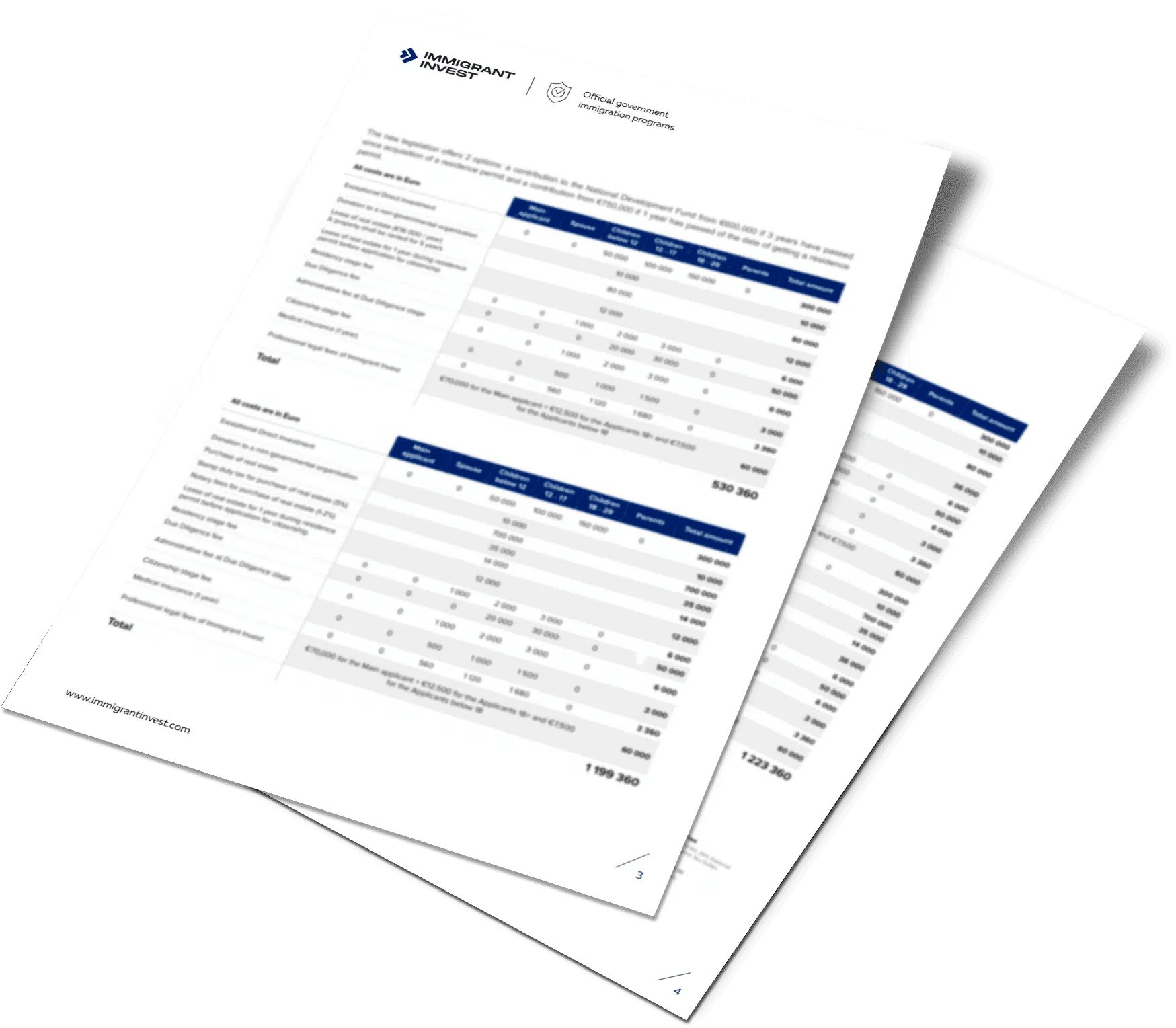
Let’s consider the expenses for obtaining Golden Visas under the most popular investment options: purchase of investment fund units in Portugal and buying real estate in Greece.
Minimum expenses for obtaining Golden Visas for one applicant and a family of four
Requirements for investors and their families to obtain Portugal and Greece Golden Visas
Investors applying for a Portugal or Greece Golden Visa must meet the following criteria:
- be over 18;
- come from non-EU and non‑EEA countries;
- have no criminal records or prosecutions;
- confirm the legality of their income.
Portugal Golden Visa applicants must also ensure their investment funds are earned outside Portugal.
In both countries, investors can include their spouses, children, and parents in the application.
Requirements for family members
Step-by-step process of obtaining Portugal and Greece Golden Visas
According to the experience of Immigrant Invest lawyers, obtaining a Golden Visa takes at least 12 months in Portugal and at least 4 months in Greece. During this period, the investor must visit the chosen country to submit biometrics and provide original documents. Immigrant Invest accompanies applicants throughout the entire process.
1 day
Preliminary Due Diligence
A certified Compliance Anti-Money Laundering Officer checks the investor’s background against global databases, such as Europol and Interpol, to identify refusal risks. This process usually takes one day. After this, Immigrant Invest signs an agreement with the applicant.
A certified Compliance Anti-Money Laundering Officer checks the investor’s background against global databases, such as Europol and Interpol, to identify refusal risks. This process usually takes one day. After this, Immigrant Invest signs an agreement with the applicant.
1—2 weeks
Obtainment of a tax number
In both countries, the applicant must obtain a tax number: Número de Identificação Fiscal (NIF) in Portugal and a Tax Identification Number (AMF) in Greece. This is necessary for activities like buying or renting real estate, opening bank accounts, and registering businesses.
Immigrant Invest lawyers apply for a tax number on behalf of the investor.
In both countries, the applicant must obtain a tax number: Número de Identificação Fiscal (NIF) in Portugal and a Tax Identification Number (AMF) in Greece. This is necessary for activities like buying or renting real estate, opening bank accounts, and registering businesses.
Immigrant Invest lawyers apply for a tax number on behalf of the investor.
1—3 months
Fulfilment of investment conditions
The applicant fulfils the investment requirements, such as opening a company or purchasing securities. Lawyers gather all documents proving the investment.
The applicant fulfils the investment requirements, such as opening a company or purchasing securities. Lawyers gather all documents proving the investment.
Up to 6 months
Preparation of documents and application
Lawyers provide the applicant with a customised list of required documents, fill out government forms, and assist with translation and notarisation.
In Portugal, e-copies are sent to the Agency for Integration, Migration and Asylum (AIMA). The application is considered within 4‑5 months.
In Greece, documents are submitted via the official website of the Greek migration service, with consideration taking 1—2 weeks.
Once the application is approved, the investor enters Portugal or Greece on the Schengen visa.
Lawyers provide the applicant with a customised list of required documents, fill out government forms, and assist with translation and notarisation.
In Portugal, e-copies are sent to the Agency for Integration, Migration and Asylum (AIMA). The application is considered within 4‑5 months.
In Greece, documents are submitted via the official website of the Greek migration service, with consideration taking 1—2 weeks.
Once the application is approved, the investor enters Portugal or Greece on the Schengen visa.
1—3 weeks
Submission of biometrics
The investor and their family visit Portugal or Greece to submit original documents and fingerprints for residence permit cards. The appointment is booked in advance.
The investor and their family visit Portugal or Greece to submit original documents and fingerprints for residence permit cards. The appointment is booked in advance.
Up to 8 month
Consideration of the application
In Portugal, AIMA reviews documents and biometric data for up to 8 months. In Greece, the authorities consider the application within 1—2 months. Once approved, the investor collects their documents in person or through a lawyer.
In Portugal, AIMA reviews documents and biometric data for up to 8 months. In Greece, the authorities consider the application within 1—2 months. Once approved, the investor collects their documents in person or through a lawyer.
Every 2 or 5 years
Renewal of the residence permit
To maintain residency in Portugal, investors and their families must stay in the country for at least 7 days annually. The residence permit requires renewal every 2 years.
Greek residence permits are granted for 5 years, with the opportunity for extension for the same period.
To prolong the status, the investor must undergo the same application process again and maintain the investments.
Foreigners can obtain permanent residence 5 years after receiving temporary residence permits in both countries.
To maintain residency in Portugal, investors and their families must stay in the country for at least 7 days annually. The residence permit requires renewal every 2 years.
Greek residence permits are granted for 5 years, with the opportunity for extension for the same period.
To prolong the status, the investor must undergo the same application process again and maintain the investments.
Foreigners can obtain permanent residence 5 years after receiving temporary residence permits in both countries.
Opening a bank account. During the process of obtaining the Golden Visa in Portugal, the investor must open a Portuguese bank account and transfer the investment money from it. Immigrant Invest assists in opening and activating the account. The process takes 1 to 1.5 months.
Those applying for the Golden Visa in Greece don’t need to have a Greek bank account. They can transfer investment money from banks in other countries.
Obtaining citizenship after Portugal and Greece Golden Visas
Both the Portugal and Greece Golden Visas lead to citizenship. To obtain a passport, the foreigner must meet residency requirements, gather documents, and file an application with the country’s authorities.
Years of residence. Portuguese citizenship can be obtained after 5 years of holding a residence permit. In Greece, a person becomes eligible for a passport after 7 years of being a resident.
Physical presence. Portuguese residents who want to become citizens do not need to live in the country continuously. Spending 7 days per year is enough to maintain the status. A person must live in Greece for at least 183 days a year to obtain Greek citizenship.
Language proficiency. Both countries require foreigners to know the official language: Portuguese in Portugal and Greek in Greece.
Citizenship test. In Greece, applicants must pass a citizenship test that includes questions on the country’s culture, history, geography, and civics. There is no citizenship test in Portugal.

Both Portugal and Greece recognise dual citizenship; thus, you can enjoy an opportunity to keep your other nationality and be a citizen of two or more countries simultaneously
Which country to choose for living
Greece and Portugal are relatively similar countries. They both have a Mediterranean climate and a low cost of living compared to many other EU states. However, people choose them for different reasons.
Portugal is one of the safest countries in the world, so it is perfect for families and retirees looking for a calm and peaceful lifestyle. Digital nomads often choose Portugal, making it a great option for remote workers who want to be around like‑minded people.
People who enjoy water sports might also find Portugal very appealing. Due to its favourable climate, diverse coastline, and strong maritime traditions, the country is usually seen as a fantastic destination for both sailing and surfing.
Greece might benefit businesspeople who would like to optimise their taxes. For example, investors who obtain Golden Visas and become tax residents have the right to pay a flat tax of €100,000 on their foreign income annually.
The country is an excellent choice for history and culture lovers, as there are many ancient sites dating back to centuries BC. Greece is also great for people who like travelling. Its location allows easy access to countries such as Italy, Bulgaria, Türkiye, Egypt, Lebanon, and many others.
Portugal vs. Greece: comparison
Key takeaways: Golden Visa programs in Greece and Portugal
- Portugal and Greece grant Golden Visas in exchange for an investment of at least €250,000.
- In Portugal, the most popular option is purchasing investment fund units. In Greece, applicants usually buy real estate.
- The Portugal Golden Visa takes at least 12 months to obtain, while the Greece Golden Visa takes a minimum of 4 months.
- To be eligible for a residence permit by investment, the applicant must be over 18, have a clean criminal record, and prove the legality of their income.
- Both Golden Visas lead to citizenship. Obtaining a Portuguese passport takes 5 years and doesn’t require relocation. In Greece, one is eligible for citizenship after 7 years of continuous residency.
- The benefits of both residence permits are visa-free travel within the Schengen Area, the right to have dual citizenship, free access to education and healthcare, and inclusion of family members.


 Trusted by 10,000+ investors